Twenty-five of Major League Baseball’s 30 club owners will do something Thursday they have never done. They will vote in an election for a baseball commissioner.
Bud Selig, who voted for commissioners before he became commissioner himself, has his own idea of who should succeed him next January. His close old friend and a previous voter, Jerry Reinsdorf of the Chicago White Sox, has a different idea.
Their differences have created a controversy that has become so heated that the commissioner felt compelled to issue a statement Friday denying any rift with anybody over the selection process. It is unlikely that anybody believed him.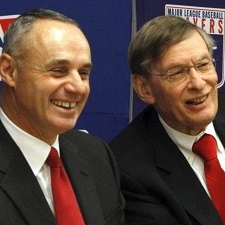
Although the commissioner denied in his statement that he has promoted any candidate, it is well known that Rob Manfred, his chief operating officer, is his choice over Tom Werner, chairman of the Boston Red Sox, and Tim Brosnan, MLB’s executive vice president for business.
Selig, Manfred and Werner did not return telephone calls seeking comment. Brosnan took my call but declined to comment. Reinsdorf “just replied that he respectfully will take a pass,” the White Sox head of communications, Scott Reifert, wrote in an e-mail.
One person who did not decline to respond to my questions was Bill DeWitt Jr., chairman of Selig’s succession committee. I called DeWitt, the St. Louis Cardinals chairman, because it was unclear what would happen if the owners, at their meeting in Baltimore Thursday, failed to elect a commissioner on the first ballot or subsequent ballots.
Election requires at least 23 votes from the 30 clubs, a 75 percent majority. Based on my most recent reporting (through Saturday night), it appears that Manfred has the support of 20 to 22 clubs, Werner six or seven and Brosnan one. Werner needs eight votes to block Manfred’s election, which is Reinsdorf’s goal.
The breakdown:
- Manfred: Yankees, Orioles, Indians, Royals, Tigers, Twins, Astros, Mariners, Rangers, Braves, Mets, Marlins, Phillies, Cubs, Pirates, Cardinals, Dodgers, Giants, Padres, Rockies
- Werner: White Sox, Red Sox, Angels, Athletics, Brewers, Diamondbacks, Blue Jays
- Brosnan: Reds
That leaves the Rays, who one baseball official said are expected to support Manfred, and the Nationals, whose preference is seen as leaning toward Manfred, but that is uncertain.
One official said the Reds are expected to vote for Brosnan on the first ballot because of his relationship with Bob Castellini, the Reds’ president and C.E.O. If no one is elected on the first ballot, the Reds are expected to switch their vote to Manfred.
If the Reds and the Rays vote for Manfred, he would have 22 votes, one short of election. The Nationals, then, even if they vote for Werner on the first ballot, could become the kingmaker as Manfred vote No. 23.
If Manfred receives 21 or 22 votes on the first ballot, it would be difficult to see how the clubs, even under Reinsdorf’s heavy-handed politicking, could not accede to Selig’s wishes and give Manfred the additional vote or two that he needs for election.
There probably isn’t an owner, including Reinsdorf, who hasn’t benefit from Selig’s time as commissioner. Owners have become wealthier than they could have imagined, with industry revenue skyrocketing to $9 billion, and franchise values soaring.
But take the unlikely scenario that no one is elected on any of several ballots. What happens then?
It has been speculated that if Werner were not elected or failed to get a substantial number of votes, Reinsdorf would call time and wave in a new candidate from the sidelines. Yeah, one official said, but only people who were interviewed by the succession committee could be candidates.
That would limit the substitute candidates to Stuart Sternberg, the Tampa Bay owner, and Mark Attanasio, the Milwaukee owner. They were the only baseball people besides the three candidates who were interviewed. Rick Levin, former president of Yale University, was interviewed but later withdrew from consideration.
However, DeWitt, the succession committee chairman, set the record straight, saying the major league constitution doesn’t allow for additional candidates on the election of a commissioner.
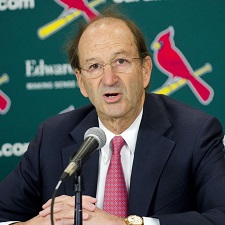 “Our responsibility is putting forward recommended names to the executive council and the council will put names forward for a vote,” the St. Louis Cardinals chairman said in a telephone interview. “There is no provision to elect others. There is no provision for anyone to propose a different name. We would have to submit it to the executive council.”
In other words, at Thursday’s meeting the owners will elect Manfred, Werner or Brosnan, or they will elect no one and the succession committee will have to start over.
Manfred, of course, can be elected. It’s highly unlikely that Werner can be, which is why it’s curious that Reinsdorf chose the former television producer to be his stalking horse. Did he pick Werner because he actually thought he could win? Did he think Werner would make a good commissioner?
One of the reasons Reinsdorf was said to oppose Manfred’s election was that he doesn’t think Manfred has what it takes to be a good commissioner. Does he think Werner has what it takes?
For the past dozen years Werner has been chairman of the Red Sox, working with John Henry, the principal owner, and C.E.O. Larry Lucchino. He presumably deserves some credit for the team’s off-field success, but he’s not doing anything alone. When he owned the San Diego Padres in the early 1990s, he made a mess of the franchise and had to sell it after only four years. What would he do as commissioner?
By allowing Reinsdorf to use him to try to block Manfred’s election, Werner is not exactly showing gratitude to Selig for making it possible for him to get back into baseball. In 2001 Werner was trying to buy the Red Sox but didn’t have the money needed. Selig, who liked Werner, put him together with Henry, and the two of them were able to snatch the team from Charles Dolan, who reportedly made a higher bid.
Without Selig, Werner would not be in position to be on the ballot, where he and Reinsdorf are trying to get enough votes to block Manfred’s election.
With his action, Reinsdorf, too, is showing gratitude to Selig, his best and closest friend in baseball for the past three and a half decades. Fay Vincent, who preceded Selig as commissioner, is by no means a mean-spirited person as Reinsdorf is, but I wonder if he is enjoying watching this cat fight play out.
Selig and Reinsdorf led the 1992 move to oust Vincent as commissioner because they didn’t want him in the way when they launched their labor war against the union in 1994.
Now history, in a variation of that version, is repeating itself as Reinsdorf wants Manfred out of the way because he wants to go to war with the union in 2016. Manfred, in an unprecedented feat, has negotiated three consecutive labor contracts without a work stoppage.
While Selig boasts of two decades of labor peace, Reinsdorf complains that Manfred was too soft on the union and vows to crush the union next. Being too soft is another reason Reinsdorf opposes Manfred.
Another reason is probably the most curious. Reinsdorf thinks Selig has been too secretive and not transparent enough as commissioner and feels Manfred will be the same way.
This raises a question: Why did it take Reinsdorf until the 22nd year of Selig’s tenure to decide that Selig was too secretive and not transparent enough? The owners extended Selig’s contract several times with hefty raises, up to $25 million a year, if not higher.
Presumably Reinsdorf voted for those extensions. Why did he, if he thought Selig was too secretive and not transparent enough?
I have pointed out twice in the past three months that Reinsdorf, also chairman of the Chicago Bulls of the NBA, voted to elect Adam Silver as David Stern’s successor as NBA commissioner but doesn’t want Manfred to succeed Selig.
A reader responded that there was nothing inconsistent about Reinsdorf’s different positions, saying the owner might have had reasons to support Silver but not Manfred. Indeed, replying to that question for an earlier column, Reinsdorf said through a spokesman “different leagues, different circumstances.”
But in another seeming double standard, Reinsdorf has said Selig shouldn’t be involved in selecting his successor because he’s not an owner while he apparently didn‘t object to Stern’s involvement in selecting Silver as his successor even though he didn’t own a team.
“David made the recommendation and everyone embraced the idea,” said a lawyer with vast knowledge of NBA developments. “It was discussed all along that when David stepped down Adam would succeed him. There was always the sense that everyone wanted Adam. There was no search. The only thing I can think of is Adam did a better job of getting the owners’ support.”
Maybe the mistake Manfred made was not doing a better job getting Reinsdorf’s support.
But then, if Reinsdorf is intent on getting a payroll cap in the 2016 negotiations (or 2017, 2018 or 2019, however long it takes to settle the work stoppage), no amount of sucking up to Reinsdorf would have helped.
Remember, Reinsdorf still blames Donald Fehr, then the union leader, for the 1994 strike. I never understood the reasoning for that bizarre view until recently when I was thinking about Reinsdorf’s desire to revisit the idea of a payroll cap. Reinsdorf must blame Fehr for not agreeing to a cap.
Reinsdorf, Bill Giles of Philadelphia, Mike Ilitch of Detroit and Peter Angelos of Baltimore are the only owners left from that strike. Those four and DeWitt are the only owners who voted in the July 9, 1998 election that made Selig commissioner. Reinsdorf, Giles and Ilitch are the last owners standing from the day, Sept. 9, 1992, that Selig became acting commissioner.