Don Mattingly has learned a thing or two in the past quarter century or so. In 1987 Mattingly, a 25-year-old first baseman with the New York Yankees, let himself be intimidated by George Steinbrenner. Now the 52-year-old manager of the Los Angeles Dodgers, Mattingly has turned the tables but on the Dodgers.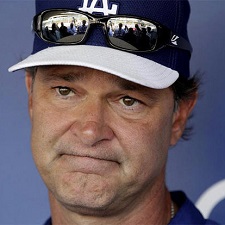
In 1987 Mattingly was headed to salary arbitration, and people on both sides of the labor fence believed he could win a record salary over $2 million. However, the previous year Steinbrenner said he would never pay a player $2 million, implying that he would trade such a player before he would pay him such an outrageous salary.
Mattingly didn’t want the Yankees’ owner to trade him so he directed his agent to submit a salary of $1,975,000. The Yankees went in at $1.7 million, and of course Mattingly won, though he also could have won at a few hundred thousand more.
Fast forward to last Monday when Mattingly and Dodgers’ general manager Ned Colletti held a season-ending news conference at Dodger Stadium.
Mattingly, whose three-year contract expired at the end of the team’s season, surprised the members of the news media by announcing that an option year in his contact for 2014 became guaranteed when the Dodgers defeated Atlanta in the division series of the playoffs.
Mattingly announced it, not Colletti, and in my mind, and perhaps others, combined with other factors, it prompted speculation that the Dodgers didn’t really want Mattingly back.
At the same time, I thought that Mattingly sounded brazen in his remarks, saying, in effect, that he wanted a multi-year contract but that the Dodgers wouldn’t give him one.
The Yiddish term “chutzpah” came to mind. I didn’t know if Mattingly knew what it meant, but I knew that Stan Kasten, the Dodgers’ president, did. You don’t grow up in Lakewood, N.J., and go to Yeshiva High School in New York and not know the word, which means utter nerve or unmitigated gall.
Kasten, however, didn’t return my calls to discuss the Mattingly matter, and that added to my suspicion for two reasons: Kasten has been easily accessible in his 18-month tenure with the Dodgers, but now he didn’t want to talk about Mattingly, and he had also evaded Dodgers’ writers so he hadn’t talked about Mattingly at all.
Besides announcing at the news conference that his option had become vested, Mattingly said he didn’t know if he would manage the Dodgers next season. In effect, he said the Dodgers should sign him to a multi-year contract or not expect him back. It was bad enough working this year as a lame-duck manager, Mattingly said; don’t expect him to do it again.
Mattingly had wanted the Dodgers to exercise the option before the season, but they declined to do so. Mattingly said his lame-duck status hurt him and hurt the team.
“When you’re put in this situation, the organization basically says, ‘We don’t know if you can manage or not,’'” Mattingly said.
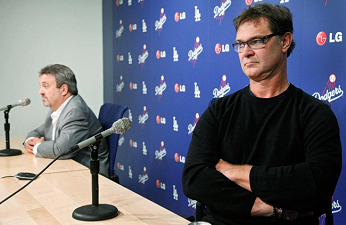 He added: “This has been a frustrating, tough year, honestly. With the payroll and the guys that you have, it puts you in a tough spot in the clubhouse. We dealt with that all year long. Really what it does, it puts me in a spot where everything that I do is questioned because I’m basically trying out or auditioning to say, ‘Can he manage or can he not manage?’ To me, it’s at that point where three years in, you either know or you don’t.”
In other words, Mattingly seemed to be saying, you’ve seen enough of me so if you want me to manage your team, give me a multi-year contract, If not, I’ll be on my way.
In adopting that stance. Mattingly, I felt, was displaying utter nerve or unmitigated gall because I don’t believe he has done anything or is in a position to dictate terms to the Dodgers.
Let’s be realistic. For more than a third of this past season, Mattingly was managing the second wealthiest roster in baseball history into oblivion. On June 21 (nearly halfway through the season) the Dodgers were a season-high 12 games under .500 (30-42), in last place and a season-high 9 ½ games out of first.
Mark Walters and his fellow owners saw their $220 million in payroll going rapidly down the drain.
If Mattingly is going to get credit for the team’s subsequent 42-8 run that turned the Dodgers’ season around, we can’t ignore the 30-42 start that threatened the season.
Nor should we ignore the fact that the new owners had a right to delay a contract extension until they had seen Mattingly manage an entire season. Mattingly wasn’t their choice; he was a holdover from the regime of Frank McCourt and was fortunate that the Walter/Kasten group opted to keep him on the job after its $2 billion purchase.
Mattingly has been fortunate in his post-playing career in being in the right place at the right time. He joined Joe Torre’s coaching staff with the New York Yankees in 2004, then went to Los Angeles with Torre in 2008 after the Yankees named Joe Girardi Torre’s successor.
Thus, Mattingly was on the scene in Los Angeles when Torre retired after the 2010 season. When he took that job, Mattingly had one “season” of managerial experience, that in the Arizona Fall League in 2010.
With Torre, Mattingly fared far better than two other Torre coaches, Chris Chambliss and Willie Randolph. At that time, a member of the Yankees’ organization told me that Torre had told Chambliss and Randolph that he would help develop them as coaches so they would be in position to compete for jobs as managers. It never happened.
Randolph got a manager’s job, with the New York Mets, but the Mets’ general manager, Omar Minaya, was responsible for that job. Chambliss never did get a job as a major league manager.
Up to and including last Monday’s news conference, the Dodgers had not indicated if they planned to retain Mattingly. That could have explained Kasten’s silence. What they had done was fire their bench coach, Trey Hillman, who was Mattingly’s No. 1 choice for his coaching staff, a minor league manager of Mattingly and a close friend.
In my vast experience with Steinbrenner’s methods, firing a coach who was close to a manager the owner wanted gone was a sign that the manager should begin looking for another job (see Billy Martin and pitching coach Art Fowler as exhibit A). I don’t remember how many times Steinbrenner took that step as a prelude to firing the manager, but it was always a telltale sign.
Another negative sign for Mattingly could have been the front office’s failure to announce that his option had vested with the playoff victory over Atlanta’
If the Dodgers planned to retain Mattingly, it would have made sense for general manager Colletti to announce that Mattingly had earned the option as soon as the Dodgers beat the Braves. That would have seemed like good news upon good news, one positive development after another.
But it was left for Mattingly himself to make the announcement a couple of weeks after the fact. That, too, sounded like a page out of the bizarre Steinbrenner playbook.
Except in Steinbrenner’s strategic mind, announcing that a manager would be back seemed like a positive development, one the fans would greet with approval. Being reluctant to announce it suggested that the Dodgers weren’t thrilled that Mattingly had met the requirement to get his extra year.
Colletti hired Mattingly to replace Torre three years ago and said earlier this week that he favored retaining him. But his absence of announcement indicated otherwise. If nothing else, it indicated that Colletti’s superiors felt otherwise.
But late Wednesday night Kasten spoke and clarified the confusion. He had not spoken, he suggested, because the commissioner has a rule against clubs making major announcements during the World Series. The Dodgers’ news conference was two and a half days before the World Series began, but let’s not quibble over timing.
I don’t know that the Dodgers felt intimidated by Mattingly’s remarks and stance at the news conference, but they got his message.
According to MLB.com, “Dodgers president Stan Kasten wouldn’t go into Mattingly’s future beyond the fact that ‘it never occurred to me that he wouldn’t honor the contract. I absolutely always knew that.’”
The article also said there was no indication that Mattingly would get a multi-year contract, but “he has indicated through his agent that he will fulfill the option year,”
ESPN.com quoted Kasten as saying, “I never had any thought he would renege on his contract. It was never a question for me.”
The article said Kasten wouldn’t go beyond that, but it quoted Mattingly’s agent, Ray Schulte, as saying, “We feel confident Stan will be reaching out to Don within a few days, but we don’t know his timetable.”
“Donnie feels like he was able to say his piece,” Schulte added. “He he did it for the betterment of the organization and now it’s out there. Hopefully we can make this a positive and move forward,”
There was no comment from anyone that resembled what Steinbrenner told me in 1987 after Mattingly won a $1,975,000 salary.
“The monkey is clearly on his back,” the owner said. ”He has to deliver a championship for the Yankees like Reggie Jackson did when he was the highest-paid Yankee. The pressure is on him. I expect he’ll carry us to a World Series championship, or at least the pennant.”
Then, offering his new view of Mattingly, Steinbrenner added: ”He’s like all the rest of them now. He can’t play little Jack Armstrong of Evansville, Ind. He goes into the category of modern-player-with-agent looking for the bucks. Money means everything to him.”