The third and last volume of Fay Vincent’s oral history project for the Hall of Fame is in print and will go on sale March 16. Titled “It’s What’s Inside the Lines That Counts,” the Simon & Schuster book features oral histories of half a dozen or so Hall of Famers and one person who is notoriously not in the Hall of Fame — Marvin Miller.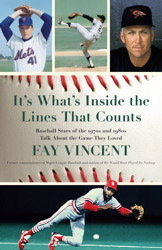
To Vincent’s great and lasting credit, unlike most management officials, he has not let his position of former baseball commissioner blind him to Miller’s impact on baseball. Vincent has long supported Miller’s candidacy for the Hall, both in speech and in writing. And he has included him in his latest book with such notable players as Tom Seaver, Juan Marichal, Ozzie Smith and Cal Ripken.
In his chapter, Miller, now 92 years old, tells of his upbringing in Brooklyn not far from Ebbets Field and some experiences that led to his union involvement. One experience was his job with the New York City welfare department in 1940 and the first time he saw people being evicted from their home for failure to pay rent.
The sheriff and his deputy, Miller recounted, removed all of their furniture from the home and put it on the sidewalk. After they left, Miller said, “I saw for the first time the most remarkable sight. All of these neighbors and people who had been standing so silently began to pick up everything there was and put it back into the house.”
It was a ritual, Miller said he learned. The sheriff knew what happened after he left, but he had done his job.
Miller went to work for the United Steelworkers Union in 1950, and it was there that he learned the importance of union solidarity, which he fostered so effectively and extremely well after he became executive director of the baseball union in 1966.
“I still would like to be remembered,” Miller concluded, “as somebody – and I’m hopeful that this will be so – as somebody who built a very solid union from the beginning, working with some bright people but ones without labor experience, without union experience, who became a really solid, united force to the point where today theirs is still considered one of the strongest and most democratic in the country.”
In the interest of full disclosure, I should acknowledge that I aided Vincent in a couple of the interviews that appear in the book, though not the Miller section. I have been asked, on the other hand, to support a move to petition the Hall of Fame to hold a special election on Miller’s candidacy for the Hall.
The move was initiated by Ray Grebey, who as the owners’ chief labor negotiator was Miller’s bitter adversary in the 50-day players strike of 1981. I disclosed Grebey’s surprising position and quoted him on it in a column on this site last November.
A month later, after Miller’s fourth failed Hall vote in seven years, Grebey wrote a letter to the Hall’s board of directors urging them to consider having a special election on Miller. Jeff Idelson, the Hall’s president, said Wednesday Grebey’s letter and his proposal will be shared with the board at its meeting later this month.
“It’s a board decision,” Idelson said.
Miller is aware of Grebey’s effort but neither endorses it or rejects it. “I’m not about to ask anybody to do anything or to stop doing anything,” Miller said on the telephone Wednesday. “In my view the time has passed.”
 Miller, at one time, would have been honored to be elected to the Hall of Fame. But the various committees that have addressed his candidacy have treated him shabbily, and he has asked the Hall to omit him from further consideration. Hall officials have not seen fit to comply with his wishes.
In his effort, Grebey has enlisted Allen Barra, a baseball writer, who worked with Miller on his 1991 autobiography “A Whole Different Ball Game.”
“I have this problem,” Miller said. “There’s Ray Grebey and there’s Allen Barra. The two of then talk frequently and enthuse each other. Allen came to me and said ‘I know you don’t approve of this, but you have to do it.’”
Miller said Barra related a conversation he had with Grebey, who wanted to know “what I thought of this.” “Barra said it amuses him,” Miller related, “and Grebey said ‘I remember that look across the table. I’d say something he thought was ridiculous and he wouldn’t say anything but he’d give me this look.’”
I suspect Miller has that look now for the Hall of Fame, its board of directors and its various voting committees.
In 2007, when the veterans committee included all Hall of Famers, Miller received 63 percent of the vote, falling 10 votes short of the 75 percent needed for election.
“Someone from the Hall called me,” Miller recalled, “and said research showed anyone who got 63 percent was elected eventually.”
But Miller suspected that others at the Hall knew that, too, and that’s why they changed the committee, reducing it to a management-dominated 12-man committee. Miller has called the current format a rigged vote because he can’t be elected by a management-dominated committee.
For Miller to be elected in a special election the vote would have to be rigged in the other direction.
There is virtually no chance that the Hall’s directors will accede to Grebey’s proposal. Nor, in my opinion, should they.
If they created a special election for Miller, who would the voters be? Would the Hall have to determine before naming voters how they would vote to justify the special election. What good is a special election if the man the election is designed to elect isn’t elected?
However it would be orchestrated, it would be a farce, and Miller’s time on the ballot has been too much of a farce already. As Miller said, the time has passed.
Let it remain the Hall’s shame that Marvin Miller’s plaque doesn’t adorn its walls.