Alan Embree is left-handed and breathing but three weeks into spring training doesn’t have a job.
“He’s not only left-handed and breathing, but he’s throwing the ball very well,” the pitcher’s agent, Ron Shapiro, said. “We’re confident.”
It’s an old joke in baseball. It doesn’t matter how old a left-handed pitcher is; if he’s able to get to the mound without the aid of a cane or a wheelchair, some team will sign him for its bullpen. To some players like Embree, though, it’s not so funny anymore because it’s not happening.
Other left-handed pitchers without jobs include Jarrod Washburn, Eric Milton, Joe Beimel and Ron Mahay, the last remaining replacement player from the 1994-95 strike.
But other veterans don’t have jobs either, whether they are left-handed or right-handed, as clubs continue getting younger and cheaper: John Smoltz, Gary Sheffield, Hank Blalock, Joe Crede, Jermaine Dye, Nomar Garciaparra, David Weathers, Russ Springer, Pedro Martinez. In all, 33 of the 171 players who filed for free agency in November and who haven’t retired are unemployed.
“Clubs are showing a trend towards younger players,” Shapiro said, “but in my experience the older guys get opportunities later in spring training if they are in shape.”
Embree, who turned 40 in January, “is staying in shape and hoping the opportunity comes,” his agent said, adding that no one has made Embree an offer. “I don’t find it unusual, but because he’s a lefty and can still bring the ball I’m a little surprised, though not dismayed. I’m still hopeful.”
Embree, who has pitched for 11 teams in his 15-year career, relieved in 36 games for Colorado last season, earning $2 million. The Rockies declined to exercise a $3 million option for this season, paying Embree a $250,000 buyout instead.
The union hasn’t been oblivious to the development of recent years where older players are bypassed for less costly younger players. Union officials aren’t talking about it, but they are watching closely.
Agents have noticed the change in the pattern of free-agent signings. One agent said he doesn’t think it’s a new development at all but has been a plan perhaps 10 years in the making.
“Clubs made a big-picture decision,” the agent said, speaking anonymously to protect his clients. “A guy may be a shade better, but they’d rather use younger guys.”
Theories abound for the preference for younger players at the expense of the over-35 gang: clubs want to get younger, clubs want to be rid of players from the steroids era, clubs want to eliminate older players to weaken the union in collective bargaining. The word heard most often is collusion.
 Clubs always scoff at the notion of collusion, which the union regularly raises, but the history of the last 25 years demands that the union be suspicious of the clubs and alert for their efforts to undermine the free-agent market. The clubs have only themselves to blame because of their blatant violations of the rules in the mid-1980s.
Three consecutive years of acting illegally against free agents give the union valid reason to be ever vigilant.
If the market has moved more slowly, if at all, for many free agents in the last couple of years, it could be the result of legitimate club decisions in how to exercise their leverage in contract negotiations. If a free agent feels he has to accept a smaller salary to get a job, the club has done its job for its economic benefit.
If, on the other hand, the clubs have engaged in a master plan to freeze out higher-priced veterans, both to render them unemployed and to send a message to future free agents, that game would fall under the label of collusion.
The union is in the process of studying free-agent developments of last year and this to determine if there is a case for collusion. The union and management agreed to wait for the conclusion of this winter’s free-agent activity before discussing the possibility of a grievance alleging collusion. That time is approaching.
Michael Weiner (above), in his first year as union chief, declined to say when the time is by which the union has to make a decision, but it is clear that it will be forthcoming not long after the season begins. If the union decides to file a grievance, it could stem from last year, this year or both years.
Some agents believe there is a strong case for collusion based on, among other things, similar offers multiple clubs have made to the same free agent. There was a lot of agent talk about that development last year. This year it could be the absence of offers to free agents, though clubs can’t be forced to make offers unless the decision to withhold them is a joint decision.
Maybe the veteran left-handed pitchers will provide the basis for a grievance. If Embree, Mahay and Washburn don’t get jobs, the union could allege that the clubs have discriminated against players who are over 35 and throw with their left arms.
WILL SMOLTZ COPY ROGER AND PEDRO?
When Roger Clemens was a free agent following the 2005 season, he introduced a new element to free agency. He did not sign with anyone during that off-season but instead waited to decide if he wanted to continue playing, then belatedly signed with Houston and made his first start for the Astros June 22. The delayed beginning to his season limited him to 19 starts that year instead of the full complement of 32 or 33.
The following year he repeated that pattern, signing late with the New York Yankees, beginning his season June 9 and making 18 starts.
Pedro Martinez used the Clemens example last year, signing late with Philadelphia and starting what would be his nine-start season (plus three post-season starts) Aug. 12.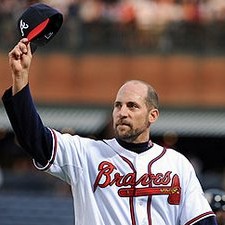
Martinez may opt for a similar timetable this season, though some baseball people think he may retire.
Then there is John Smoltz. He was a free agent for the second successive year this winter and remains unsigned. Last year he signed with Boston in January but, recuperating from shoulder surgery, he didn’t pitch until June 25, making eight starts before the Red Sox released him.
His time with the Red Sox did not constitute a strong comeback. He had a 2-5 record and an 8.32 earned run average. But St. Louis scouts saw something they liked, and the Cardinals signed Smoltz. He pitched more effectively for them, compiling a 1-3 record and 4.26 e.r.a. in seven starts.
Now he is a free agent again, and teams have expressed interest. However, their interest hasn’t been sufficient to induce the 42-year-old right-hander to sign. Neither Smoltz nor his agent, Lonnie Cooper, returned telephone calls to discuss the pitcher’s plans, but a spokesman for the agent – yes, some agents have spokesmen – said Smoltz was working out while taking a low-key approach to his free agency.
“He wants to play for a contender,” the spokesman, Chris Capo, said. “He might wait like Pedro. If it comes to waiting and seeing what happens and doing something in May or June, he’s comfortable with that.”
A general manager who has explored the possibility of signing Smoltz said he wants to “pick his spots” and will wait because he “might not feel he’s up to pitching 200 innings.”
BYE BYE, BOONES
 Now that Aaron Boone has retired, the Boone clan will take a break from Major League Baseball until Jake Boone is ready. The timeout will be extended. Jake, the son of Bret Boone, is only 10 years old, according to his grandfather Bob or 11 according to his uncle Aaron.
“Do you think the game will survive?” Bob asked jokingly.
Bob’s father, Ray, an infielder, played in the majors, mostly for the Indians and the Tigers, from 1948 through 1960. Bob, a catcher, played from 1972 through 1990, mostly for the Phillies and the Angels.
When Bret played second base for the Mariners on Aug. 19, 1992, the Boones became the majors’ first three-generation family. Bret played through the 2005 season.
Aaron, four years younger than Bret, arrived in the majors in 1997 and played third base mostly for the Reds. But the Reds traded him to the Yankees on the trading deadline day in 2003, and he earned a permanent spot in Yankees immortality by hitting an 11th-inning home run in Game 7 of the league championship series against the Red Sox.
But now Aaron is retired and set to begin his next career as a studio analyst for ESPN.
“It was just time,” Aaron said in a telephone interview. “I’ll be 37 next week. As far as my heart surgery, everything is great. I could definitely do it. But missing a full season, being 37, having knee issues, I can’t do things the way the way I wanted to.”
Boone had heart surgery a year ago but returned to the Astros in September, starting two games and pinch-hitting in eight others. He had no hits in 13 at-bats.
So what about the next generation?
“My son seems to have some athletic ability, but Brandon’s not even 5. My brother’s oldest son is 11. He’s a heckuva player, a really good athlete. You never know. He’s only 11, but he’s a pretty darn good player.”
Jake is the oldest of Bob Boone’s four grandsons. ‘Jake is going to have a lot of pressure,” Grandpa said. “He’s as good as Bret was defensively at his age. He’s a shortstop. He’s 10.”
POLITICS AND BASEBALL MAKE STRANGE BEDFELLOWS
If this were a proposal for a television reality show, the networks would reject it. But it’s as real as real gets. If Richard Ravitch, lieutenant governor of New York, becomes governor, it will most likely be with the involvement of Randy Levine, his successor as baseball’s chief labor negotiator during the players strike of 1994-95.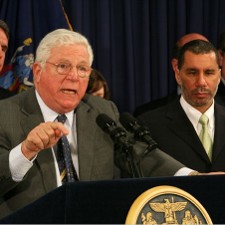
Ravitch is in line to become New York governor because the state’s incumbent governor, David Paterson, has one foot in quicksand as the result of at least two incidents, one involving tickets for a World Series game at Yankee Stadium last year that Paterson didn’t pay for. Paterson at one point said that Levine, the Yankees’ president, invited him to the game, but Levine said he was mistaken.
The State Commission on Public Integrity accused Paterson of falsely testifying under oath during an ethics investigation into his acquisition of the tickets.
The panel said that when the governor finally paid for the tickets he had backdated or had someone else backdate his personal check to support his contention that he had planned to pay for the seats, which cost $425 each.
It’s possible that Paterson could survive and not be forced from office, leaving Ravitch as lieutenant governor, a position he has because of a court decision and not an election. Paterson had been lieutenant governor under Eliot Spitzer and became governor when Spitzer was forced out in a sex scandal.
Paterson then appointed Ravitch lieutenant governor, and the appointment withstood a legal challenge by Republicans.
Ravitch was the owners’ chief labor executive who initiated discussions about revenue sharing in August 1993. Levine attended the sessions as counsel to George Steinbrenner.
“Dick has been a long tine friend of mine,” Levine said. “I knew him before he took the baseball job.”
Ravitch’s labor negotiating experience had been limited to his bargaining with the Transit Workers Union in New York when he headed the Metropolitan Transportation Authority. He underestimated the task of negotiating with the baseball players union and found himself immersed in a nasty strike.
His role ended before the strike did. The unhappy owners fired him and hired Levine, who engendered a far more positive relationship with Donald Fehr, the union leader. They didn’t find an instant solution, but they eventually found a way out of their labor battle.
Levine subsequently went into politics himself, serving as deputy mayor of New York City under Rudolph Giuliani before joining the Yankees as their president.