On three successive days in July of 1978 the Red Sox led the Yankees in the American League East by 14 games. The Yankees had won the division title in the two seasons before that one, and the Red Sox had finished first in the division the year before the Yankees’ twin titles. It looked like the Red Sox were prepared to take their turn again.
The Red Sox, however, would squander that lead. As all Red Sox fans know all too miserably well, the Yankees caught the Red Sox, took a small lead, the Red Sox then caught the Yankees, they finished in a tie for first and the Yankees won the playoff game and the division championship.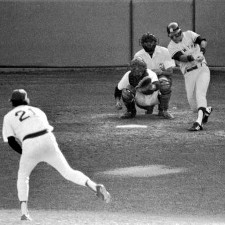
I am not here, however, to remind my Boston friends of that dreadful turn of events. In fact, the Red Sox recovered and won two World Series a quarter of a century later. My point in recalling that season is to write about a popular misconception that emerged from that season.
For reasons I have never unraveled, many people, including at least one writer who covered the Yankees, have said or written that the Yankees trailed the Red Sox on those days in July by 14 ½ games, that the Red Sox largest lead over the Yankees that season was 14 ½ games. But it simply isn’t true.
It’s in my daily book that I kept as 14 games, and I had my crack researcher go back into the newspapers of that time and scrutinize the standings. The biggest difference between the teams was 14 games, not 14 ½.
There were no doubleheaders that could have made the half-game difference, no difference in time zones or starting and finishing times of games that could have created that extra half game. No, the Yankees were 14 games behind the Red Sox, and that was that.
That mistake is one of the most popular misconceptions that I think still exist in baseball lore. Another favorite of mine is “Mr. May.” That was the derogatory tag George Steinbrenner put on Dave Winfield for his inability to hit in a series, but contrary to what many people think it wasn’t the 1981 World Series in which Winfield had 1 hit in 22 at-bats..
Even a World Series history book that sits on a shelf in my office has it wrong, saying in its 1981 segment, “the Yankee owner began referring to him mockingly as Mr. May.” It actually would be four years before Steinbrenner created “Mr. May” for baseball infamy.
Steinbrenner declared Winfield “Mr. May,” as a play on Reggie Jackson’s “Mr. October,” during a September series with Toronto in 1985, ridiculing him for his inability to produce runs in that critical division-race series. I know precisely when Steinbrenner said it because he made the comment during the third game of the four-game series after plopping himself down in a seat next to me in the Yankee Stadium press box.
Two other popular misconceptions involve the Red Sox:
 Bucky Dent’s three-run home run did not win the 1978 playoff game between the Yankees and the Red Sox. It gave the Yankees a 3-2 lead in the game the Yankees won, 5-4, with Jackson’s home run serving as the decisive run – in October, of course.
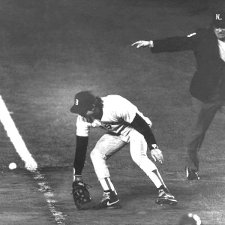
Bill Buckner’s infamous error did not lose the 1986 World Series for the Red Sox. It lost Game 6, and the Red Sox lost Game 7 to the Mets without Buckner’s help.
These flashes from the past came to mind because of another popular misconception. This one has been around just about as long as the Yankees-Red Sox misconceptions.
Last week the Associated Press carried an article about Curt Flood that was timed to an auction of many items from his career. Writing about Flood’s losing Supreme Court case, the reporter wrote, “But it prompted a radical overhaul of Major League Baseball’s power structure, ushering in free agency and rapidly escalating salaries for players.”
The Flood case did none of that. There was no link between the 1972 Flood decision and the 1975 Messersmith-McNally arbitration that did what the Flood case was unable to do and the 1976 labor negotiations between the players and the owners that established free agency and triggered the escalation of player salaries.
“First and foremost they blithely skip over the fact that we lost the case; we did not win,” Marvin Miller, the union leader at the time, said in a telephone interview this week of the people who link Flood to free agency. “Anybody is free to conjecture what the positive impact of losing the case might have been. That’s hard to say.
“In a legal sense, when the case was over, we were exactly where we were before Flood filed his suit, so to construe that as leading to free agency is a stretch.”
However, Miller added, that does not mean the Flood case was without its impact on relations between players and owners.
“I have always given the Flood case significant credit,” Miller said, “for being able to negotiate the arbitration of grievances regarding interpretations of the contract, which had not existed before.”
When the case was in Federal court, Miler recalled, the union was in negotiations with the clubs’ lawyers, “and though I can’t prove it, their lawyers were concerned about how their previous position would stand up.”
Until then, players’ grievances were decided by the commissioner, who was not exactly an impartial arbiter. The union won the right to have an impartial arbitrator hear and decide grievances.
“They were willing to do what was previously unimaginable,” Miller said. “They were willing to take authority out of the hands of the commissioner and put it in the hands of an arbitrator chosen by both sides. That enabled me to file a grievance a few years later challenging the renewal clause.”
In 1975, after Andy Messersmith and Dave McNally had gone through the year without signing new contracts and filed a grievance saying they should be freed from their teams, an arbitrator, Peter Seitz, heard the case and ruled in the players’ favor.
“How would Bowie Kuhn have ruled if he had the authority to?” Miller asked, referring to the then commissioner. The answer, of course, is obvious. And that’s no misconception.