When spring training began a year ago, there was no question that the most stunning development of the off-season had been the New York Yankees’ $423.5 million expenditure for three free agents – CC Sabathia, A.J. Burnett and Mark Teixeira. With spring training under way, one team gets the nod for the most stunning development of this year’s off-season, and the expenditure wasn’t anywhere near that of the Yankees.
It was the Cincinnati Reds and their signing of Aroldis Chapman for $30.25 million.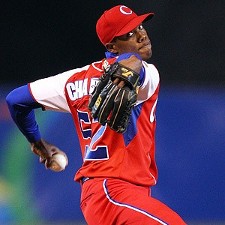
A Cuban defector, Chapman was pursued by the usual suspects, but it was the Reds, most often a non-player in these games, who nabbed him. That is simply mind-boggling. How did the Reds pull it off? “That’s a good question,” Walt Jocketty, their general manager, said.
The Reds signed Chapman on Jan. 11, the date on which Jocketty began working for the Reds two years earlier. Having worked in a variety of front office jobs, including 13 years as the St. Louis Cardinals’ general manager, Jocketty was familiar with the Reds’ free-agent history.
Chapman is a left-handed pitcher who defected from the Cuban national team during a tournament in the Netherlands last July. He will turn 22 on the last day of this month.
Having attracted attention in last year’s World Baseball Classic, Chapman instantly became the top priority on the lists of scouts from many teams.
“Our scouts had been following him since the World Baseball Classic,” Jocketty said. “When he defected in July our guys followed him some more. We didn’t get an opportunity to see him as much as we might see other free agents, but we saw him enough where our guy liked him a lot.”
Just before Christmas, Chapman’s agents held a workout for interested parties in Houston. Jerry Walker, a longtime Jocketty aide, and other Reds scouts, attended the session and, Jocketty said, “they all liked him a lot.”
If history was a guide, it was about this time that the Reds would have been expected to drop out of the race. About half a dozen other teams were avidly interested, and that was usually the signal for the Reds to abandon pursuit.
“We started talking about what it would cost,” Jocketty acknowledged, “and I said ‘gee, I don’t know that we can do this.’ But I talked to ownership about it. I showed our reports to Bob Castellini and he got excited. We got into it and felt it was important for the long term of this organization.”
The Reds thought so highly of Chapman that they were willing to give him a six-year contract (the sixth year as a player option) where other teams wouldn’t go beyond five years.
“We felt this guy provided a commodity that’s hard to find,” Jocketty said. “He’s a young kid with a much above average fastball, 95 to 98, and he tops 100 at times. He’s sound mechanically. We went for it.”
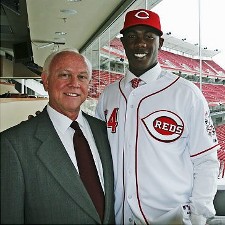 Jocketty, who built the Cardinals’ 2006 World Series winner, said that he dreamed of a pitching rotation with Chapman, Johnny Cueto, Edinson Volquez, Homer Bailey and Mike Leake. Cueto, Volquez (at 26 the oldest) and Bailey are incumbent members of the rotation, and Leake was the team’s No. 1 draft choice last year.
“I’ve always been of the philosophy that pitching wins championships,” Jocketty said.
The general manager called Chapman’s signing both exciting and a risk. But so far Chapman has received rave reviews within the organization.
“We sent him to Arizona to work with Bryan Price, our pitching coach, and he was excited,” Jocketty said. “Tony Fossas is one of our minor league pitching coaches, and we appointed him his guardian. Fossas was amazed what a great athlete he was and how quickly he picked up what he was showing him. He’s thrilled at his overall makeup and approach.”
The signing has made an impact on the Reds’ fans, too.
“I was on our caravan for four, five days,” Jocketty said, “and the fans were very excited about it. Their reaction was ‘wow, the Reds did this.’ Nobody even knew we were in on it. One guy said it shows you’re trying something different.”
It’s different, all right. The Reds’ free-agent history is filled with names like Francisco Cordero, David Weathers, Mike Stanton, Scott Hatteberg, Jerry Hairston, Alex Gonzalez, Willy Taveras, Mike Lincoln and Arthur Rhodes.
The Reds and their fans will find Chapman even more exciting if he is deemed ready to pitch in the major leagues this year.
“We’ll know more in a couple weeks after we get him in games,” Jocketty said. “His command needs improvement. It would be great if he could start the season with us, but I don’t expect it. The worst thing we can do is rush this guy.”
FREE AGENT FORMULA DOUBLES PAY
The Aroldis Chapman signing comes at a perfect time to demonstrate the difference between a free agent and a drafted player. Chapman was a free agent because when he defected from Cuba, he didn’t go to the United States but instead became a resident of Andorra.
As an Andorran, Chapman was not subject to the June draft but was free to sign with any team. His contract with the Reds is worth a guaranteed $30.25 million for six years, the sixth at his option for a $5 million salary. Chapman will have five days after the 2014 World Series to pick up the option.
The contract also includes a $16.25 signing bonus, which will be paid over 11 years, $1.5 million at his signing, $1.5 million each succeeding Nov. 1 for four years and $1.25 million each Nov. l for the next seven years.
Compare that contract with the one Stephen Strasburg, also a pitcher, signed with the Washington Nationals last August as the No. 1 pick in last June’s draft. Considered one of the most talented players ever to be in the draft, he signed a four-year contract for $15.1 million, including a $7.5 million signing bonus paid in three installments last year, this year and next year.
Scott Boras was Strasburg’s agent but not even he was good enough to overcome the system that makes a drafted player worth half as much as a comparable player who is a free agent.
STARTERS IN NEW HOMES
An early look at projected starting pitching rotations shows that 13 teams traded for or signed pitchers to upgrade their rotations or maintain the level of last year’s rotation.
The most interesting to watch, as I have previously observed, will be the Philadelphia Phillies’ rotation swap of Cliff Lee for Roy Halladay. The Phillies will not get a do-over here so they have to hope that Halladay will give them significantly more than Lee might have. Lee, on the other hand, is a significant upgrade for Seattle.
 Like the Phillies, Texas swapped starters, trading Kevin Millwood (at left) to Baltimore and signing Rich Harden as a free agent. On the surface, it would seem to be an economic swap, but the figures say otherwise.
Millwood has a $12 million salary for this season, after which he can be a free agent. The Rangers guaranteed Harden $7.5 million for a year plus an option year, but they also gave the Orioles $3 million to help pay Millwood’s salary.
On balance the Rangers are saving $1.5 million. That doesn’t seem to be much of a savings, but maybe the departing owner, Tom Hicks, is looking to save any millions he can on the hundreds of millions that he owes the banks. And maybe it was a trade for the ages. Harden is 7 years younger than Millwood.
The Angels of Anaheim also swapped starters, but their decision seemed to be based on money. They didn’t want to give John Lackey the kind of contract he got from Boston – $82.5 million for five years. They were more comfortable paying Joel Pineiro $16 million for two years.
Milwaukee and Arizona each added two starters. The Brewers did it via free agency, signing Randy Wolf and Doug Davis, who started for the Brewers for three years in a previous tenure. The Diamondbacks traded for their two new starters, getting Ian Kennedy from the Yankees and Edwin Jackson from the Tigers in the three-way Curtis Granderson deal.
Detroit wound up with a new starter in that deal, Max Scherzer.
Four other pitchers signed their way into rotations – Jon Garland in San Diego, Bret Myers in Houston, Jason Marquis in Washington and Ben Sheets in Oakland
One of the more interesting aspects of those developments is that two of the pitchers, Marquis and Pineiro, expressed a desire to play in New York for the Mets. Despite the Mets’ glaring need for starters, though, they didn’t return the interest. They didn’t like Marquis enough to sign him, and by the time they got around to being serious on Pineiro, he was gone.
SLIGHTLY USED STARTERS
Three other pitchers will be start-of-the-season  new, if slightly used, to their 2010 rotations. They were traded to their teams last season and had in-season auditions, not that they needed them.
Jake Peavy (at right) started three games for the White Sox and won all three with a 1.35 earned run average and only 7.65 baseruuners allowed per nine innings.
Scott Kazmir started six games for the Angels, emerging with a 2-2 record, 1.73 e.r.a. and 9.66 baserunners per nine innings.
And then there was Carl Pavano, who started 12 games for Minnesota and compiled a 5-4 record and 4.64 e.r.a.