Manny Ramirez told Los Angeles reporters earlier this week that this would be his last season with the Dodgers. At the same time a revealing document showed up in the court that is hearing the nasty divorce case of the team’ owners, Jamie and Frank McCourt.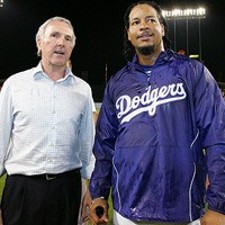
Wait a minute. Maybe I should reword that sentence. Maybe it should read the nasty divorce case of Frank McCourt, the Dodgers’ owner, against his wife Jamie because Frank says he owns the Dodgers and Jamie doesn’t. Whatever. Let’s not detract from the important issue here. That is Ramirez’s mindset.
Manny didn’t say why he plans to leave the Dodgers when his contract with them expires after the coming season. Maybe he didn’t want to say. But maybe he wants to leave them because he is distraught at the prospect of the McCourts breaking up. Don’t snicker. Manny, at his advancing age, has become a sensitive guy. All right, go head and snicker.
At the rate the McCourts are going, they won’t be long for the Dodgers either. This promises to be one of the nastiest of nasty divorces. Whether or not Frank McCourt is upheld as the sole owner, he faces a difficult, if not impossible, task of being able to operate the team.
From the day he/they bought the Dodgers, the McCourts’ financial ability to maintain a functional operation over time has come under question. Toss in a divorce settlement or court judgment, and that ability will most likely be even more severely tested, McCourt’s insistence that life will proceed smoothly to the contrary.
Every situation is different, but the closest case for comparison is only 90 miles south of Chavez Ravine. When John Moores, owner of the San Diego Padres, and wife Becky headed for divorce, Moores set about laying the groundwork for the sale of the team. He negotiated a deal with Jeff Moorad, player agent turned club executive, under which he sold 30 percent of the team to a group headed by Moorad on the way to the Moorad group gaining majority control.
Moores didn’t want to sell the Padres any more than McCourt would want to sell the Dodgers, but he eschewed false bravado and faced reality.
The Dodgers’ lack of off-season activity would make a pretty good exhibit A to support the theory that they are ailing financially. They made no substantive free-agent moves other than re-signing Vicente Padilla, they traded Juan Pierre and they opted not to re-sign Randy Wolf, Orlando Hudson and Jim Thome.
Their list of players invited to spring training was filled with out-of-work veterans like Alfredo Amezaga, Nick Green, Angel Berroa, Doug Mientkiewicz, Brian Giles, Jeff Weaver, Ramon Ortiz and Russ Ortiz.
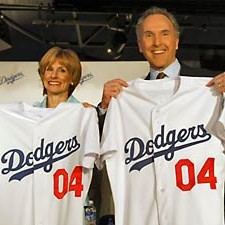 I asked Ned Colletti, the general manager, if his off-season efforts had been affected by the divorce.
“I think they have been affected somewhat by the economy; that’s played a huge role,” Colletti said. “No matter what industry people are in, the economy has made them think twice about doing things. While some companies have continued to operate like it’s five years ago, others have not.”
What effect might the divorce have on the Dodgers? “I wouldn’t want to speculate,” he said.
Colletti, a good man, who worked his way up from public relations to general manager, is in an unenviable position. He is responsible for producing a contending team every year, but he and the rest of baseball and Dodger fandom recently got a glimpse of the future, and it didn’t look encouraging.
The Los Angeles Times reported that a document filed by Jamie McCourt in the divorce case disclosed that the team plans to cut its payroll from last season’s $132 million to $107 million this season despite an expected rise in revenue.
The Dodgers, in fact, the document showed, plan to continue reducing player payroll as a percentage of revenues each year while revenues increase from $295 million last year to $529 million in 2018. The plan, the document showed, is to lower the percentage of revenue spent on player compensation from 42 percent in 2007 and 2008 to 25 percent by 2013, where it would stay through 2018.
The Dodgers, the Tines said, did not dispute the accuracy of the document.
If Ramirez holds to his word and leaves the Dodgers as a free agent after this season, he will help them reduce the payroll, given that they are paying him $45 million in the two-year contract, though much of it is deferred.
Even if Ramirez reached the end of the season and said “only kidding,” the Dodgers could ignore him as a free agent and force him to walk away. But what if he had the type of monster season of which he is capable and the fans demanded the Dodgers re-sign him?
Maybe Manny has scrutinized the landscape and concluded that there aren’t many teams that would pay him the wage to which he has become accustomed ($20 million a year the last 10 years). Or rather it would have been his agent Scott Boras who did the scrutinizing.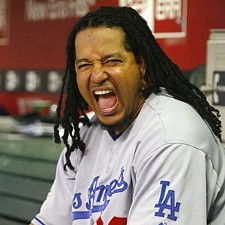
Perhaps Manny’s spring declaration was part of a Boras ploy. Lull the Dodgers into thinking Ramirez didn’t want to play for them and get then nervous enough to re-sign him. Boras has been suspected of producing similar ploys, including one with Ramirez to induce the Red Sox to trade him to the Dodgers in 2008.
Boras has steadfastly denied pulling any such tactics out of his arsenal of agentry tricks, but one would not expect him to admit that he had.
Whatever the case, Ramirez doesn’t expect to be around when the McCourt divorce becomes final and the status of the Dodgers is fully known. For Ramirez to jump ship when it is foundering is not surprising, not at all. That would be Manny being Manny.
On the other hand, don’t expect the Dodgers’ payroll to sink anywhere near 25 percent of revenues. Although Commissioner Bud Selig has not commented publicly on the McCourt mess, he would seriously frown on the 25 percent level.
The total industry payroll averages 51 percent of total revenue. The ideal number in the commissioner’s mind is 50 percent, but he can live with 51. He has shown teams that spending above 50 or 51 percent leads to financial losses and spending below it leads to losses on the field.
Selig can’t order teams to be at the 50-51 percent level, but he has potent persuasive power. It comes with the territory.