The Tal Smith era is over in Houston – for the second time. At the age of 78, Smith is unlikely to return for Tal III.
As far as John McMullen was concerned, there shouldn’t have been a Tal II.
When McMullen bought the Astros in 1979, he inherited Smith as the team’s president and general manager. But only 15 months later McMullen fired Smith, privately citing insubordination and personal indiscretions as the reasons.
When he sold the team to Drayton McLane Jr. late in 1992, McMullen sought and said he obtained McLane’s promise that he wouldn’t hire Smith, but McLane put Smith in charge of the front office two years into his ownership.
“That was a low blow,” McMullen’s widow Jacqueline said on the telephone recently. “Mac was not happy about that at all.”
This time Smith was fired by the Astros’ new owner, Jim Crane, a Houston businessman, who has seen first-hand the mess the Astros have become. The 106-loss 2011 season was the worst in the franchise’s history. Crane also fired general manager Ed Wade, a long-time Smith associate.
The sale of the Astros and Smith’s dismissal got me thinking about McMullen, who was my favorite owner in all of the years that I have written about baseball. McMullen, who struck many people as gruff and irascible, was not well liked by many of his fellow owners, the Houston news media and some Astros fans. His players, though, loved and appreciated him. And I found him to be the most honest owner I have ever dealt with and a rare man of his word.
Much more often than not McMullen and I disagreed philosophically, but that didn’t affect our relationship. We met when I interviewed him in May 1979 at his 30th floor World Trade Center office in 1979 when he was buying the Astros. It was during that interview that he uttered the memorable remark that “there’s nothing more limited than a limited partner in the Yankees,” which he was as a limited partner of George Steinbrenner.
McMullen was so proud of that comment that he occasionally brought it up in subsequent conversations. He also liked and repeated the remark of his then 9-year-old son Johnny that “the two points I promised him in the Yankees is worth more than all the Astros.”
McMullen’s time in Houston might have gone more smoothly had he publicly explained his reasons for firing Smith. However, despite being urged to do so by associates he felt it was an internal matter and remained silent.
When Ford Motor Credit owned the team, Smith was in total control. With McMullen, like Steinbrenner a ship builder, on board, Smith lost that control. He reacted, in McMullen’s view, by being insubordinate and disloyal, behaving rudely toward Mrs. McMullen, among other things, and not talking to Robert Harter, whom McMullen named president of the Houston Sports Association.
 When a top-level official of a Houston newspaper told McMullen that Smith was leaking derogatory stories about him to the newspaper and McMullen confirmed the information, Smith was gone.
His departure was probably inevitable. He disagreed strongly with McMullen’s first major decision to make free-agent Nolan Ryan the first $1 million-a-year player, and that kind of clash was an invitation to a dismissal.
Ryan pitched for the Astros for nine years, and as he was about to celebrate his 42nd birthday and again was a free agent, McMullen opted not to re-sign him. Ryan pitched five more seasons and two more no-hitters (Nos. 6 and 7) for the Texas Rangers.
McMullen candidly acknowledged his mistake. “I didn’t know he was going to pitch that long,” he said.
The Houston media and fans never gave McMullen, a New Jersey resident, the credit he deserved for saving the Astros for their city. For three years before his purchase, the team was owned by GE and Ford Motor credit companies, which except for McMullen would very likely have sold the team to someone who would have moved it elsewhere.
Blind to that reality, the Houston media preferred to hold a major grudge against McMullen for sacking Smith, who was popular with reporters. They rejoiced when McLane brought Smith back in 1994.
McLane, who did not return a telephone call to discuss his hiring of Smith, became known as a notoriously meddling owner. He blocked trades that could have been beneficial to the Astros, and his misguided involvement in baseball operations prompted Gerry Hunsicker to leave the Astros after nine seasons, during which he established himself as one of the best general managers in the business.
The first order of business of the new owner is to find a general manager. As soon as Crane took over, his president and chief executive officer, George Postolos, named Dave Gottfried, the assistant general manager, as the interim general manager but said he was not a candidate for the position.
“The search for a new general manager begins immediately,” said Postolos, a former top-ranking executive with the N.B.A. Houston Rockets.
However, by the eve of the start of the winter meetings, only one candidate was known to have been interviewed, Bill Geivett, the Colorado Rockies’ assistant general manager. The Astros were prepared to interview Thad Levine, the Texas assistant general manager, but he declined the opportunity.
Speculation about the Astros’ primary choice has centered on Andrew Friedman, the Tampa Bay general manager. It’s unlikely that Friedman would leave Stu Sternberg, the Rays’ owner, who brought him into baseball from the brokerage business, but Friedman is a Houston native and he could be intrigued by the idea of returning home and building his hometown team into a winner.
Hunsicker would be another likely candidate because of his previous success in Houston, but he reiterated recently that he likes what he’s doing now and isn’t interested in being a general manager again. On the other hand, he is the Rays’ senior vice president for baseball operations, and if Friedman were to defect to the Astros, Sternberg would likely ask Hunsicker to replace him.
When it came to hiring front-office executives, McMullen was in the forefront of seeking members of minority groups. Bob Watson, a former Astros’ first baseman, credited McMullen with making his front-office career by naming him the Astros’ assistant general manager. Watson later became the general manager before moving to the Yankees, where he headed the team’s first of four World Series championships in a five-year period.
McMullen also hired a young woman, Pam Garner, as communications director. Today she is the team’s president of business operations.
Perhaps most interestingly, well before anyone talked of such opportunities for minorities, McMullen tried to lure Joe Morgan back to Houston, where he laid his Hall of Fame foundation, to be general manager – his choice, Morgan, however, was too deeply involved in business to accept the offer.
When McMullen decided to sell the team, he said, “I’m not selling it for the money.” He explained that he was no longer having fun in Houston; too many people there wouldn’t let him.
A couple of other things stand out for me about McMullen, who died in 2005 at the age of 87. He owned more stock than Steinbrenner in Steinbrenner’s American Shipbuilding Company, and it made the Yankees’ owner crazy when anyone mentioned that fact.
More personal to me, however, was a gesture that McMullen made that was totally unexpected. One day about 10 years before McMullen died, his driver, Ronnie, rang the doorbell at my house, carrying a cardboard box.
“Dr. McMullen would like you to have these,” he said.
The box was crammed with framed photographs of Presidents throwing out the first ball on opening day. They hang today on a wall in my office, from William Howard Taft to Bill Clinton.
“He had the same photos at home,” McMullen’s son Peter told me recently, “and thought you would appreciate them.”
AND THE WINNER IS …
The Red Sox simply won’t let the Yankees outdo them. Step for step they march, onward and – downward.
On Dec, 12, 2008, the Yankees signed a free agent 31-year-old right-handed starting pitcher to a 5-year contract for $82.5 million. On Dec, 16, 2009, not to be outdone, the Red Sox signed a free agent 31-year-old right-handed starting pitcher to a 5-year contract for $82.5 million.
In his second season with the Yankees, A. J. Burnett won my first annual Sigh Young award. I am pleased to announce that in his second season with the Red Sox, John Lackey, not to be outdone, has won the second annual Sigh Young award.
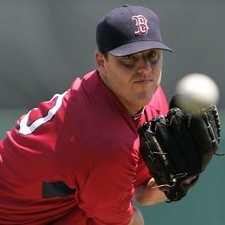 If you haven’t figured it out instantly, I give the award to the pitcher whom I consider to have been the worst in the majors that season. For 2011, Lackey wins the award arms down. He had no serious competition.
In 28 starts, he had a 12-12 won-lost record and the worst earned run average, 6.41, of the 132 pitchers who made 20 or more starts. Even worse, Lackey far exceeded other pitchers in his futility.
The starter with the next highest e.r.a. was Edison Volquez of Cincinnati at 5.71, but Lackey’s e.r.a. was more than a full run – 1.06, to be precise – higher than that of any pitcher who made at least as many starts as he did. Like Lackey, J.A. Happ of Houston started 28 games, and emerged with a 5.35 e.r.a. Burnett finished the season with an 11-11 record and a 5.15 e.r.a and was 124th on the 132-pitcher list.
Lackey was a major contributor to the infamous Red Sox September collapse. He started five games, losing two, and the Red Sox lost all five. He had a 9.13 e.r.a. in his starts.
His year got worse after the season ended. First, he was identified as one of three starters who drank beer and ate fried chicken in the clubhouse during games they weren’t pitching. Then Lackey learned he needed elbow surgery, the Tommy John variety, and he had it Nov. 1. Based on Tommy John recovery time of at least 12 months, he will miss the entire 2012 season, assuring he won’t be a repeat winner of the Sigh Young award.
The operation, however, could be beneficial to the Red Sox. They have an option for 2015 in his contract in which the salary would be the minimum ($500,000) if Lackey misses significant time because of injury.
UNFAIR TO FRANCONA
While news of the Boston Red Sox managerial situation has been understandably focused on the new manager, Bobby Valentine, a much needed look was taken last week at a development with the old manager.
When he left the Red Sox at the end of the season, Terry Francona was unfairly and ignorantly maligned by someone in the team’s front office, most likely a high-ranking executive, though that is strictly my speculation.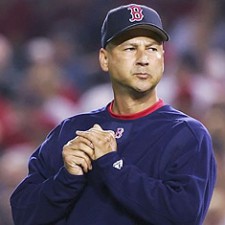
After the Red Sox blew themselves out of the playoffs by losing 20 of their final 27 games, the Boston Globe published a story about pitchers drinking beer and eating fried chicken in the clubhouse during games and saying that Francona was distracted during the season by, among other things, his use of pain medication.
The beer-and-chicken tale, I figured, very likely came from clubhouse attendants, who are often good for dispensing such tales. I know that from my experiences when I covered baseball on a daily basis.
The pain-medication part of the story, though, was different. That part, to me, sounded like it was coming from someone intent on denigrating Francona and justifying the decision not to exercise the 2012 option in his contract. That had the distinct smell of front office.
Last week Francona did a Boston radio interview in which he spoke about the medication allegation. “The people that know me that well knew that what was said in the paper wasn’t true. It was obviously said to hurt me,” Francona told station WEEI.
Francona said he was asked about the pain medication when he interviewed for the St. Louis Cardinals’ managerial job. “That probably aggravated me — not from St. Louis, I would have asked me, too – but the fact that I had to defend myself aggravated me,” he said.
I couldn’t agree more with Francona about the unfairness of the Globe report. Prescription pain medication, especially when used under a doctor’s care, is legal and needed by people who use it. Pain pills are not cocaine or heroin or even steroids but have been stigmatized out of ignorance.
I have had plenty of experience with pain medication. I know what it does and how necessary it can be. I live with someone who unfortunately requires pain medication. She doesn’t manage a major league baseball team, but she manages our house, and she manages me.
It’s true that pain pills can affect people in different ways, but that’s what doctors are for, to monitor their use and their effect.
Francona told the radio station that he could have had the Globe reporter talk to the Red Sox internist, Dr. Larry Roman, about the issue but added, “I was under the impression that wasn’t part of the story.”
But it made the story a much stronger story and so it was used – at Francona’s expense.