Maybe Ron Santo belongs in the Hall of Fame, but I never voted for him in the 15 years he was on the writers’ ballot and neither did most of the voters. The highest percentage of votes the Chicago Cubs’ third baseman received in one year was 43.1 percent in 1998, his last year on the ballot.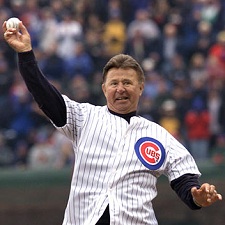
In none of the other 14 years he was on the ballot did he receive as much as 40 percent of the vote (election requires 75 percent). Cumulatively, over 15 years he received 26.6 percent of the votes.
But a 16-man committee reviewed his career, very likely considered his poor health that devastated his post-playing life (he died last year of diabetes and assorted resulting ailments a year ago) and elected him.
When the Hall of Fame, frustrated at having the veterans committee rebuffing it with its failure to elect anyone several years ago revised the format but still got no one elected, Joe Morgan, the Hall of Fame second baseman and the Hall’s vice chairman, concluded that maybe the writers got it right in the first place.
But Hall officials persisted in their effort to have new members elected and kept changing the voting format. Now they have succeeded with Santo, who received 15 of the committee’s 16 votes. Too bad. Election to the Hall of Fame should be based on career performance, not sympathy.
Despite the constant shuffling of voting groups and committee makeup, Hall officials have failed to elect the man most deserving of membership who remains a pariah to them.
By now I have lost count of the number of veterans committee elections that have passed without Marvin Miller being elected. His latest failure to gain election came last year. His next opportunity will come up next year or the year after, whenever the roulette wheel is scheduled to spin in his category’s direction.
There is really nothing about the election process that is fair to Miller, who because of his unique status as the players’ union leader is not viewed objectively for his remarkable, unparalleled contributions to the development of the game baseball is today.
 Officials keep saying they have done what they can to enhance the election chances of the 93-year-old Miller, but they have only ensured his repeated rejection, not election, by stacking the voting committee with owners and other management executives, few of whom will vote for him out of spite for what he did to them and for the players.
They could substitute Donald Fehr and Gene Orza, former union officials, for a couple of those anti-Miller management people, but they shamefully adhere to the membership they know will not insult the owners, whose funding they need to exist.
Meanwhile, executives like Bowie Kuhn, who contributed nothing but negativity to baseball, are elected, and the Hall salutes them while shunning Miller and making a mockery of its raison-d’être.
In the latest veterans committee election, which covered what the Hall called baseball’s golden era, the Hall almost got luckier than having Santo elected. Gill Hodges, the Brooklyn Dodgers’ fine old first baseman, missed election by only two votes.
Dodgers’ fans, who are quickly dying off, have been lobbying for Hodges’ election for years through all sorts of veteran-committee structures, but have been unable to get him enough votes.
I was never a Hodges voter when he was on the writers’ ballot; I felt he a great player who fell into the just-missed category. If the Dodgers and the Santos are elected, it dilutes the elite greatness of the really best players.
And I have never bought the argument if so-and-so is in the Hall, this or that comparable player should be in. If voters made a mistake with one player, that mistake shouldn’t be repeated with other players. As we used to say, two wrongs don’t make a right. I suspect Santo’s election could produce that effect.
This brings me to Jack Morris, a pitcher I have believed for years should be in the Hall but who has failed to receive more than 53.5 percent of the writers’ vote in his 12 years on the ballot.
Bert Blyleven, a pitching contemporary of Morris, was elected last year in his next-to-last year on the writers’ ballot. He benefited from the new use of sabremetrics in gaining election, publicly proclaiming one particular practitioner of sabremetrics for showing why he belonged.
As readers of this site know, I am not a fan of statistics such as WAR and VORP. I use statistics, but the old-fashioned ones have worked for me and most other writers who have covered baseball for years and are not relative newcomers to the baseball beat.
I saw Blyleven pitch, and I saw Morris pitch. If I had to pick one or the other to pitch one game or regularly in a rotation, Morris would be my man. He might not have sabremetrics in his favor, or even a sterling old-fashioned earned run average (3.90), but the only statistics he pitched for was to allow fewer runs than his team scored.
It was no accident that Morris was the most dominant starting pitcher in the 1980s, gaining more victories than any other pitcher in the decade. But forgive me; I am using a statistic that some viewers of the game now proclaim is the least relevant barometer of a pitcher’s success.
Wins no longer count. According to proponents of this cockamamie idea, there are too many variables that render wins meaningless. The name of the game used to be winning. Now it’s a quality start or a good WAR rating.
Give me a pitcher who can emerge from a game as the winning pitcher.
Morris did exactly that in Game 7 of the 1991 World Series, pitching a 10-inning, 1-0 victory in perhaps the greatest game anyone ever pitched. A player shouldn’t be elected to the Hall of Fame for a single-game performance, a perfect game, for example, or even a single-season effort, say Roger Maris’ 61 home runs in 1961.
But Morris’ brilliant Game 7 performance epitomized what he did as a pitcher. It was the standout performance of a standout career.
Morris’ Hall of Fame problem, however, is the ballot. He simply hasn’t received enough votes to think he can get to 75 percent in the next three elections.
Blyleven benefited last year from the increase in the number of votes he gained from the year before. In the 2009 election, he had 338 votes, or 62.7 percent. The following year he received 400 votes, or 74.2 percent.
It was obvious he would make it in 2011 especially with no star-studded players on the ballot for the first time. Morris, though, went up only from 52.3 percent in 2010 to 53.5 percent in 2011.
That was not enough of a boost to generate voter momentum for Morris’ remaining years on the ballot. A more sizable increase in the last election might have boded well for Morris in this election because the ballot is not top-heavy with first-time elite players.
If Morris doesn’t make it this time, he could face a virtually impossible task in his last two years on the ballot. The next election will feature Barry Bonds, Sammy Sosa, Roger Clemens and Mike Piazza. That will probably be the most intriguing and controversial election in Hall history because of steroids.
Bonds and Clemens have been legally implicated in the use of performance-enhancing substances while Sosa and Piazza have avoided implication but not strong suspicion.
Poster children of the steroids era have not fared well in elections. In his first four years on the ballot Mark McGwire received approximately 23 percent of the vote each year, then fell to 19.8 percent in his fifth try early this year. Rafael Palmeiro, a first-timer a year ago, received 64 votes, or 11 percent of the record 581 writers who voted.
Juan Gonzalez, another first-timer, was named on 30 ballots. One fewer vote, and he would not have made the 5 percent cutoff and continued to be eligible. Kevin Brown did not make the cut. All have been implicated in the use of performance-enhancing drugs, though Gonzalez has only been suspected.
Jeff Bagwell presents a more complicated case. He is not automatically a Hall of Famer in the view of many voters based on his record, but he, too, has been suspected of using steroids and his vote total very likely suffered. Yet his 242 votes, 41.7 percent, exceeded the combined total for McGwire and Palmeiro.
If Morris doesn’t make it despite the quagmire of steroids, he will arrive in his last year of eligibility facing first-timers Greg Maddux and Tom Glavine. Two cleaner players cannot be found, they are pitchers, both 300-game winners, and the voters will not elect Morris with them.