In a matter of days, Joe Nathan, Huston Street and Andrew Bailey encountered injuries that knocked one of the closers out for the entire season and set back the other two in their preparation for the season. Other pitchers and other players suffered injuries as well as spring training moved inexorably toward the start of the 2010 season.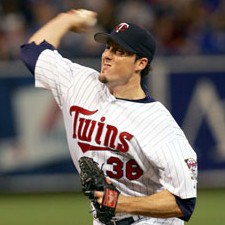
I must have missed something. I didn’t see any articles or television reports or highlights of games in the World Baseball Classic. As far as I knew, the Classic wasn’t scheduled to be played this year. The second was played last year, and the third, I thought, is scheduled for 2013.
But if there was no World Baseball Classic this year, how did all of those players get hurt?
Last year’s Classic brought out many critics over the number of players who the critics believed were injured as a result of playing in the Classic. The critics seemed to forget or ignore the fact that players are injured in spring training every year, with or without the WBC.
Is it better that, say, Dioner Navarro, Tampa Bay’s catcher, injured his leg in a collision at home plate with Jacque Jones in an exhibition game in Florida against Minnesota than had he suffered the injury playing for Venezuela in a WBC game against the Dominican Republic?
Another catcher, Yadier Molina of St. Louis, may miss the start of the season while he recovers from a strained oblique he suffered sliding into second base. Is the injury more acceptable because it happened in a regular exhibition game and not the WBC?
Yet another catcher, the Dodgers’ Russell Martin, suffered a strained groin, and club officials feared he might not be ready to start the season. However, developments last week indicated he may be ready.
No spring has passed without players facing rest or rehab on opening day. Four to six weeks of spring training and exhibition games is guaranteed to produce injuries.
“Injuries are caused by playing the game; this year proves it,” said Gene Orza, the union’s chief operating officer, who has been one of the driving forces behind the World Baseball Classic.
Orza provided statistics that the union and Major League Baseball compiled on injuries. In the past decade, the number of players on the disabled list on opening day was lowest in 2006 (66) and 2009 (73), the years the WBC has been staged. In the two intervening years, the disabled list population was 99 and 106, which was the highest 10-year number.
Expanding the study to the entire month of April last season, 17.8 percent of major leaguers who did not play in the Classic (140 of 786) spent time on the d.l. the first month of the season while 9.6 percent (11 of 115) who played in it were on the list.
No d.l. figures were available for this year because this year’s disabled list didn’t go into effect until last Friday, and teams don’t have to put players on it right away because they can backdate their first day.
 “That’s so stupid; it’s ridiculous,” Orza said of the idea that the WBC has caused injuries. “People lose all logic. It’s just nonsense. Some general managers buy into this thinking, but what causes injuries is playing the game, whether you’re playing in the U.S. or in Japan.”
“Why would we care less than other people about the players?” Orza added. “Isn’t it logical that we would care more? They are our constituents. They pay us. We would never do anything where players would be at greater risk.”
This spring’s most devastating injury belongs to Nathan, the Twins’ talented closer, who has averaged 41 saves a season the last six years. He tore an elbow ligament, had Tommy John surgery last Friday and faces a year of rehabilitation. His absence could affect the Twins’ playoff chances.
Of other injured closers, Street (Rockies) has a sore shoulder, Bailey (Athletics) an ailing elbow, Bobby Jenks (White Sox) a calf injury and the Cubs’ oft-injured Kerry Wood has a back ailment that could keep him out for a couple of months.
Several starting pitchers have had physical problems this spring, most notably Cliff Lee, whose start with Seattle will very likely be delayed by an abdominal strain, which followed foot surgery. At week’s end, the Mariners had shut the left-hander down for five days, and it appeared likely that he would have to open the season on the disabled list.
Scott Kazmir (Angels) suffered from muscle fatigue, his teammate Ervin Santana from an ailing elbow, Roy Oswalt (Astros) from a late-spring strained hamstring, Gil Meche (Royals) from a stiff shoulder, Daisuke Matsuzaka from back and neck problems and rookie Aroldis Chapman, the Cuban defector, had his quest for a starting role with the Reds interrupted by a stiff lower back.
Albert Pujols, the St. Louis slugger, also had a back problem recently and had an anti-inflammatory shot. The Cubs’ Aramis Ramirez had a sore triceps, and Ian Kinsler of Texas was struggling with a sprained ankle that has kept him idle since March 11.
Last week Dustin Pedroia (Red Sox) sprained a wrist making a diving stop of a grounder and Justin Upton (Diamondbacks) sprained an ankle running out a hit. Pedroia and Upton didn’t have to play in a World Baseball Classic game to incur those injuries.
ROOKIES ROLL IN
Stephen Strasburg, last year’s most celebrated minor leaguer, will start this season in the minors, but Aroldis Chapman, this off-season’s most celebrated player, may yet gain a major league job and be in the Reds’ rotation at that.
The most intriguing player classified as a rookie, though, is Alcides Escobar, the Brewers’ shortstop. Escobar remains a rookie by virtue of falling two at-bats short of losing his rookie status.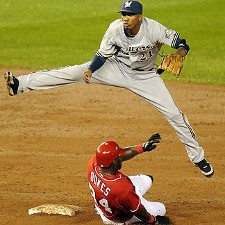
To be classified as a rookie, a batter cannot have more than 130 at-bats in any season or all of his seasons. Escobar had four at-bats in 2008 and 125 last season. It’s not as if the Brewers acted deliberately last season to preserve his rookie status. The 23-year-old Venezuelan started 11 of the team’s last 13 games and batted four or five times in 10 of the games.
He so impressed the Brewers with, among other things, his .304 batting average that they made shortstop available for him by trading J.J. Hardy.
Escobar will not be the only rookie who will be a starting position player when the season begins. The Tigers are expected to have two rookies in their starting lineup – Scott Sizemore at second and Austin Jackson in center field. Jackson, 23, went to Detroit from the Yankees in the Curtis Granderson trade.
Jason Heyward has been named the Braves’ starting right fielder and Michael Brantley the Indians’ starting left fielder. Heyward, the 14th player picked in the 2007 draft, is only 20 years old. “He’s done everything we’ve asked him to do,” general manager Frank Wren said. “He’s performed very well.”
Brantley, 22, is the son of former major leaguer Mickey Brantley. He was the player to be named in the July 2008 trade that sent CC Sabathia from Cleveland to Milwaukee.
“He has an unusual level of poise and maturity for a player his age,” general manager Mark Shapiro said. “He has above average speed and stolen base instincts. He’s an above average outfielder with an above average arm. He only lacks power and that nay come.”
David Freese started five games at third base for the Cardinals last season and now will have a chance to start a lot more. The Cardinals obtained him two years ago from San Diego for Jim Edmonds. The Marlins will have a rookie first baseman, either Gaby Sanchez or Logan Morrison.
Rookies will be represented in starting rotations, too. Brian Matusz is scheduled to start for the Orioles, and Wade Davis has been designated Tampa Bay’s fifth starter. Neftali Feliz has not won a spot in the Rangers’ rotation, but he apparently will start the season in their bullpen. Starting could come later.
Then there is Chapman, the Cuban defector the Reds signed for $30.25 million. The Reds want the 22-year-old left-hander to be their fifth starter, and he looked good enough to seize the assignment until he developed a back problem in a game March 22.
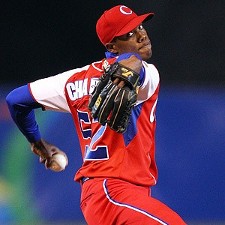 Asked at the end if last week how Chapman was doing, Walt Jocketty, the Reds’ general manager, said, “Physically he’s doing fine. He’s scheduled to pitch an inning Monday and again Wednesday, and we’ll see where he’s at. It might be tough to get him stretched out to start the season, but we’ll see.”
If the Reds don’t deem Chapman ready, they apparently will still have a rookie in the fifth spot. The other two candidates for the job are 23-year-old rookies, left-hander Travis Wood and right-hander Mike Leake. Had Chapman not had the back problem, would he have been the clearcut choice for the spot?
“I don’t know if he would have been the clear winner,” Jocketty said, “but the way he was going he might have been the guy. The only thing I’m concerned about is whether to start him in the big leagues right away. It might be better to start him in the minors.”
Chapman’s back, and not his left arm, might have made that decision much easier.
ELIAS AND SIWOFF BOTH NO. 1
The book came in the mail last Friday, the United States mail, not e-mail. It came in a small brown box, and I knew instantly what it was. It was a book whose arrival I welcome every year at this time. Let the season begin. I have my copy of the 2010 edition of the Elias Book of Baseball Records.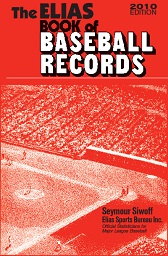
A telephone call to Seymour Siwoff was in order. Seymour runs the Elias Sports Bureau; he has seemingly forever. He is well known in the sports world because Elias is the statistician to the sports world. But he and it are best known for their baseball work. Seymour holds card No. 1 in the Baseball Writers Association. He has been a member since 1952.
“People ask ‘are you still there?’” he said. “The point is I’m here and working. I’m alive.”
Siwoff won’t say how old he is. “My age is unlisted,” he said. But he is easily in his 80s, and he hasn’t slowed down. Call the Elias office Saturday morning, and Seymour will answer. “I’m a fortunate man,” he said. “I have somewhere to go every day of the week.”
He runs the business, and he publishes the record book. “It is the only baseball record book,” he said. “The Sporting News gave theirs up. It’s been around a long time. All this bull about on-line. I’m never going to do it. What’s with a generation that doesn’t want to read? It’s all about cell phones and text messages.”
“But you have to admit,” he added. “We probably wouldn’t be here if I hadn’t gone into the computer world in 1963.”
The record book, before Siwoff, was originally called “The Little Red Book of Baseball.” It was first published in 1926. In the early years the book had 150 pages. Now it has more than 400. The sports bureau, Siwoff said, was operated by Al Munro Elias, and he worked there as a boy, then became an accountant and subsequently returned to Elias.
“The business was on its way out,” he said. “I resurrected it and formed a company called the Elias Sports Bureau.”
Though he has spent his life in statistics, Siwoff is not a fan of the new age of statistics.
“It’s a game played by humans,” he said. “It’s not an exact science. It involves human frailty.”