Some day, some year, some decade the National Football League Players Association may get it right, but it apparently won’t be this year. The players are searching for a new executive director to replace the late Gene Upshaw, and they are looking in the wrong place.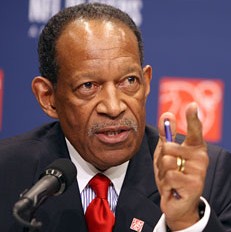
According to a recent column by William Rhoden in The New York Times, the union had been focusing on eight candidates. That number was then reduced to seven. Six are former players; the seventh is the chief executive of a gas and electric company. That’s right he’s management, just what the N.F.L. players need heading into negotiations for a new labor agreement.
Now readers might ask why am I writing about the N.F.L. when this Web site is about baseball. The link is the Major League Baseball Players Association. The baseball union has always been the strongest, most successful union in professional sports. The N.F.L. union, a disaster by comparison, could learn a lot by copying its baseball brethren.
One thing the football players can’t do is hire Marvin Miller, the former leader of the baseball union, but they could listen to him and learn from him. One of Miller’s great strengths was educating his members after he became their labor leader in 1966. No leader of the football union has ever educated its players, and that oversight is probably at the heart of the union’s weakness.
The list of finalists for the union job reflects the players’ labor ignorance. They have just gone through 25 years of questionable leadership of a former player, and they are bent on hiring another one.
Miller, who was a trade unionist, not a former baseball player, had a few thoughts on former players as union leaders.
“The record in all professional team sports is a miserable one whenever they have had a former player,” he said in a telephone interview. “Why anybody thinks that’s the essence of a good director I don’t understand. It is true that somebody who has had experience in the ranks knows initially more about the life and problems and obviously the aspirations of the players than other people, but that’s a learnable set of facts.
“More important there is such a lot of evidence that professional players, regardless of the sport, always bear the hammered 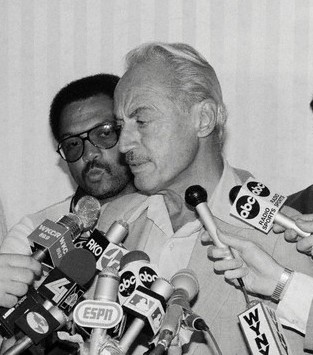 down feelings that players get when they’ve had to deal with owners, who paid no attention to them as individuals, who had no concerns about them as people. I don’t think that’s the best training for what has to be done.”
Miller recalled a question players asked him constantly when he was assuming command of the baseball union. “They had read about me and my life as a trade unionist and an aggressive negotiator,” he related. “They wanted to know can you and will you be able to get along with the owners. That was their paramount question.”
Miller said he assured them that he had gotten along with management officials and owners his whole professional life but added, “That’s not the object of the job.”
“It’s an adversarial relationship,” he told the players. “If we got to the point where the owners were sincerely praising me and saying great things about me to the players, they ought to fire me because that doesn’t go with a union official who has to represent players.”
I asked Miller, who at the age of 91 remains sharper than maybe any union leader in any other industry, if he ever found a former player who was an effective union leader. He ran through a mental list of former players who became heads of their sport’s union. These were his assessments of leaders of the football union:
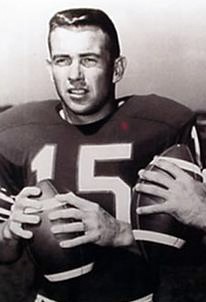
- Jack Kemp, Buffalo Bills quarterback, who in his post-playing life became a Congressman: “He was the worst company unionist you’ve ever met. He was management incarnate. He was to the right of management.”
- Creighton Miller, another former football player; he became a lawyer and then director of what Miller called the N.F.L.’s “company union:” “Nice guy, pleasant man but a bust in the job. He didn’t have any idea of how a union should operate.”
- Upshaw, a all of Fame guardHall of Fame guard, who after he retired worked with Ed Garvey, the union’s director, before replacing Garvey: “They had some bad experiences with a membership that would not support trade union action. These were players who scabbed on each other several times.”
“I think partly as a result of that,” Miller added, “Upshaw felt the only way he was going to get anywhere was to become cuddly with the owners. The players were incorrigible. Unlike baseball, the star players were the worst on turning their backs on the union. The quarterbacks were the first to volunteer to be replacement players.”
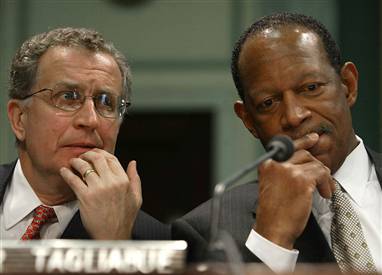 Upshaw was notorious for his cozy relationship with N.F.L. commissioners. The union enjoyed labor peace but at a price. Upshaw demonstrated his lack of labor understanding with his reaction to baseball’s free agency.
“At the time, he was one of the worst critics of our free agency settlement,” Miller recalled. “He later gave what amounted to an apology. I ran into him at somebody’s funeral or memorial service, and in a very embarrassed fashion he brought it up himself and said he had misspoken.”
Garvey reacted similarly when Miller negotiated free agency in 1976, giving up the complete free agency the union gained from an arbitrator, Peter Seitz, and settling with the owners on a six-year requirement for players to be eligible for free agency. Garvey ridiculed Miller and the union for their settlement.
Yet baseball free agents became the freest and best paid of the free agents of all sports. After N.F.L. players subsequently gained free agency and only one player changed teams in the first year, Garvey ran to the judge who was overseeing the N.F.L. labor dispute and complained that the owners weren’t playing fairly.
“I never got over the fact,” Miller said, “that what football became in this country was the most successful financially of all the sports. It had the greatest revenue, the greatest profits and the largest television contracts. Yet in spite of all that, it had the lowest salaries of any team sport, the shortest career, the most dangerous conditions on the field, the worst pension and disability provisions, the worst contract provisions over all. This in the most prosperous of all team sports.”
If Garvey and Upshaw thought Miller blundered when he negotiated free agency with baseball owners, he was not impressed with what the football union did when it had a court decision – the Mackey case – in its favor. The Mackey decision outlawed the Rozelle rule, under which the commissioner determined compensation for lost free agents, but in subsequent negotiations, the union accepted many of the free-agent restrictions.
“It was such a painful history, awful,” Miller said.
A major problem, Miller said he suspects, is that football players don’t know the league’s labor history. “That’s a guess,” he said, “but I think it’s true. The only history they’ve got is Upshaw. By all accounts they didn’t like him. Why would you go back to the same category? It’s hard to figure.”
Miller said it’s also hard to figure why football players accept their contractual situation. “No player has a contract,” he said. “They can be let go at any time. Football players know it. What they say among themselves is what you don’t get as a signing bonus you may never get, no matter what the contract says.”
In baseball, multi-year contracts are guaranteed. If a player has a five-year contract and gets hurt in the first year and can never play again, he receives his salary for the next four years. Nothing is guaranteed in the N.F.L. A player can sign a five-year contract, but he has to make the team each year to get his salary.
“There’s no real way for players to have rights that are enforceable under the setup they have,” Miller said. “I don’t understand how players can go year to year like that.”
And now players will most likely select someone from their ranks to contend with these issues and find himself overmatched by the league’s labor professionals.
“I was asked recently if I would talk to the players about the situation,” Miller said. But it was Rhoden, the Times columnist, who asked, and Miller has heard nothing further. Rhoden did not respond to an e-mail seeking information on his idea.
As critical as Miller is of N.F.L. players, he doesn’t claim that baseball players are perfect. He recalled a 25-year-old experience to demonstrate that they, too, can go astray.
“When I told the players I was retiring the next year, they formed a committee of players to find a successor,” Miller related. “One player came in with a recommendation of a management executive. This was not an ignorant player. He was someone who had been involved in union activities and struggles we had. I asked him why would you think a management executive would be the right man for this job. He thought he was a bright guy.”
But Miller was there to help the baseball players avoid making a mistake. The N.F.L. players have no one to prevent them from making another mistake.