Cole Hamels, Roy Halladay and Brandon Webb would form a strong nucleus of a starting pitching rotation. Jake Peavy, Roy Oswalt and John Lackey aren’t a bad trio either.
The pitchers in the second group are on the provisional roster of Team USA for the World Baseball Classic. The pitchers in the first group could have been on the roster but said no, thank you, to their invitations from USA Baseball, the governing body of United States participation in international baseball tournaments.
The second World Classic is scheduled to begin March 5 in Tokyo and run through March 23, ending in Los Angeles. Team USA will try to wipe out memories of its failure in the inaugural classic in 2006 when it failed to make the semifinals, losing in the second round to Korea and Mexico.
Omar Minaya, the Mets’ general manager, who has long been a strong proponent of a classic-type of competition, said it wasn’t necessarily embarrassing for the United States to be knocked out as early as it was.
But he added, “They’ve always been thought to be the favorite and when the favorite doesn’t get to the semifinals it’s disappointing. But that’s the beauty of these competitions. It’s not about who you are or what your name is. It’s not about great talent. It’s playing as a team. International play is different. It’s a different style of game. You almost have to play small ball.”
The prevailing view last year was that Team USA wasn’t as well prepared for the tournament as teams from other countries, where baseball is played throughout the winter or teams naturally began their spring training earlier. As a result, three exhibition games have been scheduled against major league teams.
Observers of American players believe that they are the best no matter what kind of shape they are in, but there are plenty of major leaguers who play for other countries and there are countries that produce players who can compete with Americans on a short-term basis.
The Koreans, for example, were an absolutely dazzling team that breezed through the first two rounds in 2006, beating Japan twice before losing to Japan in the semifinals.
Having the best players available would help Team USA, but Americans don’t seem to have the same fervor for the classic as foreign players do. Foreign players seem to be more nationalistic, eager to wave their country’s’ flag more enthusiastically than Americans.
Perhaps the difference in emotion stems from what players become accustomed to. The focus in this country is on Major League Baseball and the World Series with all of the competition in North America. In other countries, the height of competition is more international, whether it’s the Caribbean World Series in February or international tournaments throughout the year.
Perhaps the fervor prompts foreign players to play for their countries more readily than Americans desire to play for Team USA. Besides Hamels, Halladay and Webb, players who declined invitations to play for Team USA were Ryan Howard, Mark Teixeira, Matt Holliday, Josh Hamilton, Brad Lidge, Jonathan Papelbon and Scott Downs.
Among the players who have accepted invitations to play for Team USA are Derek Jeter, David Wright, Kevin Youkilis, Dustin Pedroia, Ryan Braun, Chipper Jones, Jimmy Rollins, Curtis Granderson, Grady Sizemore, Brian McCann, J.J. Putz, B.J. Ryan and Joe Nathan.
Casey Close, the agent who represents Howard, Halladay and Downs, wouldn’t discuss specific reasons for his clients’ decision not to play, but speaking generally, he said, “Mainly guys who don’t want to play are talking about their routines and how they want to get ready for the season. Whether it’s weight lifting, conditioning or running, it’s hard to duplicate when you’re going from Toronto to Miami to Los Angeles.
 “For hitters it’s the extra hitting, extra drills, a particular skill set they’re working on. It’s hard enough for players to stay focused for six or seven months, let alone an extra month. I certainly understand how those who play this for a living don’t want to do it and want to keep to their schedule.”
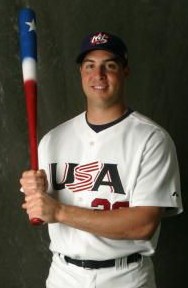
When Teixeira signed a $180 million contract with the Yankees, he said he wouldn’t be playing for Team USA, explaining that it was important for him to get to know his new teammates and the team’s manager and coaches.
“I would feel terrible,” Teixeira said, “if I showed up to spring training and two days later said, ‘See you guys, see you in three weeks.’ I want to be a part of the team in spring training. That was my choice, and I told every team that was my plan.”
Lidge had a different reason for opting not to play in the WBC.
“He’s got a brand new child, a boy named Rowan,” Jim Turner, the closer’s agent, said. “That entered into it. Rowan was born about a month ago, and he wants to be around. He has done it before and he felt his time would be better spent at home with his son.”
Gene Orza, the union’s liaison to the classic, said some players don’t play because they’re coming back from an injury or have a chronic injury. He explained that injury protection rules were adopted after the first classic.
“The clubs wanted protection against that,” he said. “By far and away the players who aren’t playing are players with chronic conditions.”
Orza sometimes talks to players, not just Americans, who initially say no without an injury problem. “We help the federations if they ask us to,” he said. “It’s fair to say I spoke to a number of players about the federations’ interest in getting them to play. I asked them to reconsider their decision. Some I was able to convince, some I wasn’t.”
But, Orza acknowledged, most of the players who say no are Americans. “It seems to be a cultural thing,” he said. “Some players on the American side are committed to a typical spring training routine. But this is not going to be a typical spring training. It starts Feb. 14 and lasts all the way through April 6. Even if you play in the tournament, you’d have a lot of time under the watchful eye of your team.”
Paul Seiler, the executive director of USA Baseball, said he understands why some players don’t want to play. “Guys say I have to get ready for the season,” he said. “You have to respect their professional integrity to do their jobs. The strains and demands put on players are so numerous. They have families. When a player says I can’t work it out, I understand it.”
Ideally, of course, officials who select the players would like everyone they invite to play. “You get caught up in that fantasy baseball mentality,” Seiler said, “but at the end of the day we respect it and we move on to the next guy.”
As far as Orza is concerned, the biggest disappointment isn’t “the players who don’t want to play but the players who are injured and can’t play.”
One of those players is likely to be Johan Santana, the Mets’ pitcher, who had knee surgery last October. A Venezuelan, Santana has said he wants to play but has to abide by the Mets’ position.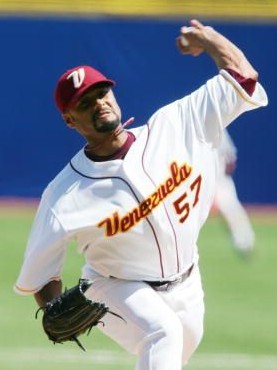
“We’re probably going to have to wait until spring training,” general manager Minaya said. “We’ll wait to see how he feels. He feels great now and everything is fine, but his preparation might have to be different, especially if he wants to play in the classic.”
Minaya would like to see Santana play in the WBC, but he also doesn’t want to take a chance on Santana’s rushing himself to be able to pitch meaningful games in March.
“We believe in the classic,” Minaya said. “We always promote our players to play in the classic, but because of preexisting conditions we’re not going to put him in a situation that won’t allow him to be ready for the season.”
Santana has said he might start spring training early to get a head start, but Minaya said, “Starting him early after minor knee surgery is a risk. We’re not going to start him early after the surgery.”
Some teams are concerned that their players could get hurt playing in the WBC, but Minaya said, “You can get hurt in spring training just like you can get hurt in the classic.” The tournament, he added, is actually good for the players. “Spring training is too long as it is,” he said. “Most of the guys who played in the classic had great years.”
As for the players who don’t want to play in it, Minaya said, “Some guys love representing their country. They like holding the flag. Some guys it doesn’t do anything for them.”
Braves Scrap Smoltz, Lasso Lowe
The Atlanta Braves have added insult to John Smoltz’s injury. Because Smoltz is coming back from shoulder surgery that he had last June, the Braves offered him a one-year contract with a $2 million salary. Smoltz, who had pitched for the Braves for 20 years, rejected the offer and signed instead with Boston.
 Smoltz represented only the latest failure the Braves have suffered this winter in their attempt to bolster their starting rotation. They tried to acquire Jake Peavy from San Diego but wouldn’t give the Padres the sizeable package of players they wanted. Then they tried to sign A.J. Burnett as a free agent, but the Yankees got him.
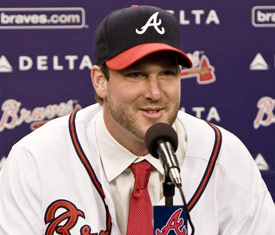
Desperate, they offered a 35-year-old pitcher a four-year contract for far money than the Mets had offered him. The Mets, the only other team in the bidding, offered Derek Lowe $36 million for three years, the Braves $60 million for four. The Mets would have increased the money to maybe $14 million a year, but they were not prepared to offer a fourth year. Lowe will be 36 next June, and it is believed that no player that age ever got a four-year contract.
Smoltz has said he will be happy pitching for the Red Sox, but he initially had no plans to leave the Braves, the only team he has pitched for. For another $2 million or $3 million guaranteed, Smoltz would most likely still be a member of the Braves. But the Braves weren’t willing to guarantee him the additional money. They were, on the other hand, willing to give an aging free agent many more millions.
When Lowe signed last week, it was pointed out that he has never been on the disabled list. The point was made to suggest that the Braves got themselves a pitcher with a healthy history. That fact, however, could be a blessing or a curse. Maybe Lowe is overdue and will incur a disabling injury early in the contract.
The Braves don’t have to look too far for an example of an aging free-agent pitcher being injured and missing a lot of time. Tom Glavine, whom the Braves signed as a free agent a year ago, had never been on the disabled list in 21 seasons. Then he encountered elbow and shoulder problems, wound up on the disabled list and started only 13 games.
Bargains Abound in the Bronx
Last week The New York Times had an article about the Yankees’ hiring a New York real estate brokerage to help sell the unsold seats and luxury suites at the new Yankee Stadium. An executive of the firm was quoted as saying that fans could still buy a 20-game package for $7,000 a seat.
“It’s obtainable,” the Times quoted the executive as saying. “In this economic time people are still looking for things to take their children or grandchildren to.”
I initially wanted to run out and but at least two of those 20-game packages. A bargain at $700 a game, right? But I caught myself in time. Instead of buying those absurdly expensive tickets, I would invite my grandchildren to watch the games on television with me. That way they can have all the peanuts and ice cream they want.
The Angels of Here, There and Everywhere
Beaten in court twice in two tries, officials of the city of Anaheim, Calif., are abandoning their fight to have their baseball team called by its right name and fix southern California geography while they’re at it. Too bad.
Arte Moreno, the Angels’ owner, concocted a plan four years ago that he thought would generate increased revenue. Hijacking the name of another team’s city, he changed the name of his team from the Anaheim Angels to the Los Angeles Angels of Anaheim.
By no stretch of geographical imagination can Anaheim be considered part of Los Angeles. The Angels didn’t move to Los Angeles or even closer to Los Angeles. Their name changed, but their home remained right where it had been since 1966, a few blocks from Disneyland in the heart of Anaheim. Los Angeles wasn’t part of the picture.
But Moreno, a sharp businessman, figured the name Los Angeles would enhance the Angels as an attraction for residents of Los Angeles and suburbs. Not only might they be lured to Angel Stadium of Anaheim, but they would also buy Angels’ paraphernalia and watch the Angels on television, increasing the ratings and the rates for commercials.
Some owners would have fought the intrusion into their teams’ territory, but the Dodgers’ owner, Frank McCourt, is not a fighter. When I asked him at the time why he didn’t oppose Moreno’s name grab, he said he had other matters to deal with that were more important.
Commissioner Bud Selig could have and should have quashed Moreno’s plan, but he lives by a rule of thumb: If an idea can generate greater revenue for a team and not detract from the economy of another team, no problem. If the Angels have benefited from their name change and the Dodgers haven’t suffered, it’s good for baseball. It’s Selig’s version of no harm, no foul.
Incidentally, the Angels themselves seem to have an ambivalent feeling about the name. Nowhere in their 468-page information guide does the name Los Angeles Angels appear. Toward the front of the guide is a six-page section on “Angels in the community.” Los Angeles is not mentioned as part of the community.
The Commissioner Makes Corrections
Bud Selig has called in a correction seven years after the information he was correcting first appeared in print. The commissioner was responding to a column on this Web site about Carl Pohlad, the Minnesota Twins’ owner who died recently, but the information he was correcting had appeared in several newspapers in January 2002.
At issue was a loan the Milwaukee Brewers, whom Selig owned at the time, made from a financial firm Pohlad owned. Reports at the time put the loan at $3 million. Selig said the other day the loan was actually $750,000.
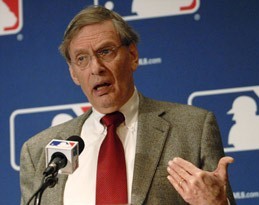 The reports further said that Selig, who was the interim commissioner as well as a club owner, did not submit the loan to the other owners for their approval, but Selig said, “There was no attempt to hide it. It was registered with the secretary of state in Wisconsin.” And, the commissioner added, “The executive council knew about the loan.”
Whatever the amount of the loan and when it was made, it became an issue because in late 2001 and early 2002 Selig was considering eliminating two teams. With Pohlad’s enthusiastic support, the Twins were a leading candidate for contraction. Pohlad was eager to be paid $150 million to fold his team, and critics pointed to the loan as a reason that Selig had a conflict of interest.
But Selig scoffed at that notion. “It was for 13 days,” he said of the loan, “and he charged me 10 ½ percent interest.”
In an added element to the contraction controversy, John Conyers Jr., a Democratic Congressman from Michigan, called for Selig to resign as acting commissioner over the so-called conflict.
In his correction call, Selig said he did not recall anyone asking him to resign, but after receiving the letter in 2002, Selig replied to Conyers, who was the ranking Democrat on the House Judiciary Committee. “The suggestions made in your letter are wholly unacceptable,” Selig wrote.
Selig said in his call the other day he got the loan in 1997, not 1995, as was reported in 2002, but in 2002 he explained the loan by saying that in the aftermath of the players’ strike in 1994, the Brewers had “very serious cash flow needs” and that the team’s survival “was in question.” A person familiar with the loan said at the time the Brewers needed it to meet their payroll.