Commissioner Bud Selig was a history major in college and has been a history buff post-college. When it comes to certain aspects of baseball history, however, he has a peculiar sense of that history. He often recalls it differently from what really happened.

He will not like reading that (he said earlier this year I used to spoil his Sunday mornings), but I have to say the same thing he did when I tried to discuss these matters with him the other day: “All I can say is I have to recite the history of the past decade the way it was.”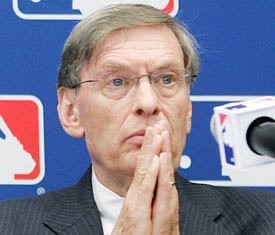
The commissioner wouldn’t say much else on the record despite my urging him to. I wanted to have a full discussion with him for the 100th column of this Web site about certain developments of the past 25 years relating to drug testing:
- The 1980s joint drug agreement
- Mark McGwire and androstenedione
- Selig’s alleged effort to get the union to agree to steroids testing 15 years ago
- Amphetamines
But the commissioner said he had already said all that he wanted to say on the subject of testing. “I’ve said all I want to say and I don’t want to say any more,” he said.
It was what he had said that prompted me to want to have the discussion with him. He had made some comments to reporters during an exhibition game in Arizona last weekend, repeating what he had said previously about steroids testing and his efforts to have it included in the labor agreement with the union.
He blamed the union for blocking the initiation of testing, but his remarks seemed to be self-serving, an attempt to stifle criticism of him for not having done anything about steroids. Selig has rejected charges that he knew or should’ve known that players were using steroids, and I accept his explanation.
We have talked more than once about what we didn’t know, the “we” being he, I and other reporters. I am not excusing my ignorance, but I had less reason to care about steroids testing than most people. I am philosophically opposed to testing of any kind other than testing for reasonable cause.
I don’t believe that people, baseball players, high school football players or anyone else, are obliged to prove they are innocent. If you think I use illegal drugs, state your case to a medical panel and let the doctors decide if I should be tested. Major League Baseball had that kind of program for 16 months in the mid-1980s, but the owners, exercising their right under the agreement, unilaterally terminated it during the 1985 World Series.
Peter Ueberroth, then the commissioner, wanted the program ended because it didn’t include mandatory random testing. Without a testing agreement with the union, Ueberroth wanted testing provisions included in individual player contracts. The clubs implemented the provision, but it did not withstand the union’s grievance challenge on the grounds that it had to be collectively bargained.
I mention the 1980s joint drug agreement because in his recent remarks Selig, as quoted by mlb.com, which is sort of like the old Tass quoting a Russian premier, said “the union was fighting us at every turn” on testing.
“To support the point,” the article continued, “Selig talked about the MLBPA fighting a drug testing program even throughout and after the cocaine scandal of the 1980s.”
But the union had agreed to the joint drug agreement. The owners didn’t like it because it required them to turn in their own players, and there was no way they wanted to do that. In our conversation, Selig didn’t seem to have a clear recollection of the agreement but didn’t want to talk about it anyway.
The commissioner didn’t want to talk about Mark McGwire in 1998 either.
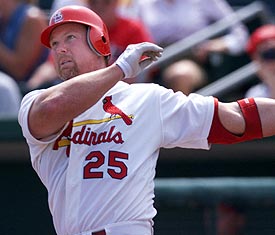 That was the year that McGwire slugged 70 home runs and broke Roger Maris’ single-season home run record. That was also the year McGwire made Andro famous. A steroids precursor, the supplement was not illegal in baseball, but it immediately became a suspicious substance that Selig was slow to question.
He subsequently joined the union in having it studied to determine whether baseball should ban it, but he wasn’t going to act too quickly.
“I’m not going to do anything to tarnish Mark’s accomplishment,” he said to me late in the season when I asked him about McGwire and andro.
I couldn’t help but think Selig suspected there was something evil about andro. When I reminded him of his comment, he didn’t deny it but declined to discuss it. He recalled that baseball and the union asked researchers at Harvard to study andro.
Baseball eventually banned it – after the excitement McGwire and Sammy Sosa created subsided – but McGwire himself tarnished his accomplishment by refusing to talk to Congress about performance-enhancing drugs at a 2005 hearing. “I’m not here to talk about the past,” he said in a pitiable performance.
Selig has made a big deal out of talking about the past. In his comments to reporters in Arizona, other interviews and in a statement a month ago commenting on the Alex Rodriguez revelation the commissioner has emphasized that he tried to eradicate performance-enhancing substances from baseball for a decade but was blocked by the union.
The clubs, Selig has recalled repeatedly, tried to get steroids testing in the 1994 labor negotiations. In reality the attempt was nearly non-existent.
The Mitchell report quotes Donald Fehr, the union’s executive director, as recalling that a drug-testing proposal “never even reached the main bargaining table during the negotiations.” Rob Manfred, the chief management negotiator, told Mitchell “the drug program was not as high a priority as economic issues.”
One union negotiator told me the other day that he attended every bargaining session from the start of the strike until the two sides reached a settlement and “steroids were never mentioned.” So much for Selig’s earnest effort to get the union to agree to testing.
Remember, too, that in December 1994, four months into the strike, the owners unilaterally implemented new work rules, but testing wasn’t among them. The National Labor Relations Board and a federal judge later ruled that the owners could not implement what they did, but the point is the owners took a free shot at creating the rules they wanted, and they omitted that all important testing program so how earnestly did Selig want it then, as he says now that he did?
I also have to wonder how serious Selig was about amphetamines. According to mlb.com, Selig said at the Arizona session with reporters “a team doctor told him three years ago he was more concerned with amphetamines than he was with steroids. According to Selig’s recollection, the team doctor said someone would die if a move wasn’t made concerning amphetamines.”
The little green pills have since become illegal in baseball, and their use calls for suspension, just as use of steroids does.
But Selig has been in baseball as an owner since 1970, an owner who was not a stranger to his players and the clubhouse. Amphetamines were as common in clubhouses as chewing tobacco and coffee, and Selig had to know players routinely used them.
In fact, the same mlb.com story quotes Selig as saying about steroids, “Nobody was closer to their players than I was (as an owner), in every way. (Robin) Yount, (Paul) Molitor, (Cecil) Cooper, I literally grew up with those guys, and I went back and talked to everyone of those guys and no one knew.”
But they knew about amphetamines and if Selig was so close to them, he knew, too. Yet he did nothing about them until three years ago when Congressional and public criticism prompted him to become Mr. Clean.

The commissioner didn’t want to talk about amphetamines either. “I’m proud of what we’ve done,” he said, speaking generally about baseball’s testing and cleanup. “The record is clear when it happened.” The record may be even more clear about things that didn’t happen.
Selig’s claim that he tried as early as 1994 to introduce testing into baseball raises an interesting question, perhaps the most interesting question of all. If, as he says now, he didn’t know about players using steroids in the 90s, why was he so eager to have them tested for steroids? Either it’s “I didn’t know about steroids so don’t blame me” or “I wanted testing because I knew.” You can’t have it both ways, commissioner.
ONE VIEW OF THE CLASSIC
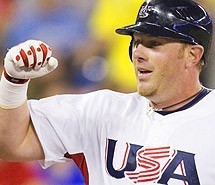 Players obviously have different views about and different reasons for playing in the World Baseball Classic or shunning it. Since I like the idea of the classic, I especially liked the reactions of two Team USA players:

“If this is like the playoffs, I have to be in the playoffs,” Adam Dunn (left) said. “Every pitch matters. In that ninth inning, if your blood’s not boiling and your heart’s not pounding, you don’t have a heartbeat. This is the best experience I’ve ever had in baseball, and it’s only one game.”
“I watched the highlights and watched those guys storm the field,” Jake Peavy said of the Netherlands’ players after they defeated the Dominican Republic. “That’s good for the game of baseball, and I wouldn’t miss being part of this tournament for the world.”
BERT’S PITCHING SHOW
If there was an annual award for pitching coaches, this year it would have to go to Bert Blyleven even before the major league season begins. Producer of 287 wins as a major league pitcher, Blyleven is the pitching coach of the Kingdom of Netherlands team in the World Baseball Classic. He qualifies as a Dutch coach because just about 58 years ago he was born in Zeist, Holland.
What Blyleven has done with the Dutch pitching staff is magical. The Netherlands has pulled off the two biggest upsets in the classic, beating the Dominican Republic twice in the opening round and knocking one of the favorites out of the tournament. Blyleven’s pitchers were responsible. After the first round they had the fourth lowest earned run average, 2.50, among the 16 teams.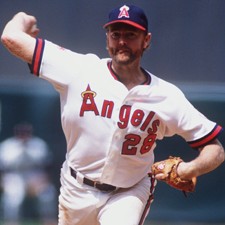
“We don’t have much of an offensive ball club so we have to win the way we did against the Dominican Republic,” Blyleven said in a telephone interview before the classic’s second round began Saturday.
The Dominican team, loaded with major leaguers though missing some stars such as Alex Rodriguez and Albert Pujols, scored three runs in 20 innings against the Netherlands pitchers.
“I was lucky to have these kids since the middle of February,” Blyleven said when asked how he was able to develop inexperienced pitchers into effective winners. “Every day we worked and worked and worked. We fine tuned what they had. Each pitcher is different. I moved some guys’ finger placement on the ball a bit.”
Blyleven, who when he pitched threw the best curveball in the majors, offered examples.
Alexander Smit, who allowed no runs in 2 1/3 innings in 3 games: “Smit never threw a two-seam sinking fastball to a right-handed batter to get strike one. He’s in love with that pitch right now. All the time he’s been throwing a four-seam fastball.”
Berry Van Driel, former shortstop, whose 9.00 earned run average (1 run, 1 inning) was the staff’s highest in the first round: “I moved his fingers onto the seams for a slider and now he has a nasty slider. I worked with each pitcher to see what I could do to make them better.”
Rick VandenHurk, a Florida Marlins pitcher, who allowed no runs in 3 1/3 innings in a first-round start: “He’s confident now, with my tutoring, going back into camp with the Marlins. He’s going to go into camp a different person. He’s got a very good curveball and he’s got to throw it more, have more confidence in it.”
In a game against Puerto Rico, Blyleven said, VandenHurk had a 1-2 count on Bernie Williams and threw a fastball. “I told him later that was the time to throw a curveball. That at-bat turned out to be eight pitches, too many pitches in the classic. He could’ve got him on four pitches.”
Williams grounded out to shortstop on the eighth pitch. Blyleven’s point was with pitchers working with pitch limits in the classic, those four extra pitches were critical.
Speaking of pitch counts generally, Blyleven said young pitchers last only five innings because they throw 100 pitches in that span “because they’re afraid to attack the strike zone. They don’t attack the strike zone early. They don’t trust their stuff. They give hitters too much credit. I’m trying to teach them to be more aggressive.”
Blyleven was a pitching coach once before, in 1993, the year after he retired as a player. He served as the roving minor league pitching coach in the Angels’ organization.
“But I had some personal matters to deal with so I didn’t continue that,” he said. “When I came back I had a broadcasting opportunity and took that.”
Blyleven has worked as an analyst on Minnesota Twins’ telecasts for 13 years. Would he ever go back into uniform and be a pitching coach?
“I guess I’d have to look at that if the opportunity came,” he said. “But I like what I do.” Anyway, he added, “I’ve always been a pitching coach. Up in the booth I’ve been a pitching coach. It’s in my blood.”
NUMBER 100
This is No. 100, the 100th column that has appeared on this Web site. Some of you have been here from the start last July 15, and I extend my appreciation for trying it and liking it enough to hang around.
The site could be put together better technically; it could have an archive of columns, for example. But we will get there sooner rather than later so newcomers will have an easier time reading previous columns.
I don’t know how many readers or viewers the site has, but I know new people come to the site all the time because they write to tell me what they liked or didn’t like. I appreciate that input, and I have tried to answer all of the e-mail. There’s one batch of mail I haven’t answered – comments on the Mike Piazza column – because I got so much of it. I need some time to get to it, which I plan to do.
Beginning with this one, the columns will be picked up by and linked to heralddeparis.com, whose publisher and editor, Jes Alexander, describes it as an Internet newspaper named Herald de Paris. I like that because newspapers have always been my first love in the news media and always will be.
I also recommend two other sites, mlbtraderumors.com and stonecoldsports.com, both of which have done interviews in the past few days with the columnist and proprietor of this site.
When this site began eight months ago, I said I planned to try to recruit other writers for the site, colleagues who had retired but still, I felt, had something to offer. However, the half dozen or so whom I asked preferred retirement so that idea didn’t work. But I plan to keep writing. How long I don’t know. Right now I’ll shoot for No. 200.