On one hand, there is nothing confusing about the Pittsburgh Pirates. They are a losing team and have been a losing team for more than a decade and a half. In fact, they are on the brink of breaking a major league record with their 17th consecutive losing season.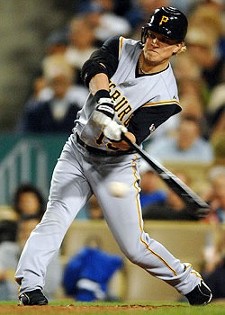
On the other, they are one of the most confounding teams in the majors. They trade players before they have to sign them to expensive contracts, they trade players after they sign them to mildly expensive contracts and they trade players whose contracts are still under their control.
At different times under different general managers and different managements, the Pirates have traded their most promising young players, belying the idea that they are building from within by developing good young players. The Pirates have developed good young players, but they have developed them for other teams.
In the first week of June and again last week, the Pirates made trades that prompted their fans, as well as officials of other teams, to say, “There they go again.”
With the two deals the Pirates wiped out two-thirds of their young starting outfield, sending center fielder Nate McLouth (at right) to Atlanta and left fielder Nyjer Morgan to Washington. Morgan, 29, was at least two years away from salary arbitration and five years from free agency. McLouth, 27, signed a three-year, $15.75 million contract last February.
The twin trades fit the pattern the Pirates have followed throughout their losing years. The Pirates have changed front-office regimes several times in that period, but their practice has remained the same. The below-30 players the current regime traded a year ago were Jason Bay and Xavier Nady.
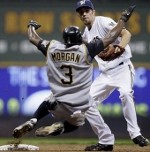 “It’s pretty simple,” Frank Coonelly, the Pirates’ president, said, explaining the McLouth and Morgan (at left) trades. “We need more premier talent here. In Nate we had a player highly sought by Atlanta and we had an opportunity to get three high-ceilinged players for the future. We weren’t looking to move Nate, but the opportunity arose.”
In addition, Coonelly said, the Pirates had a ready replacement for McLouth in Andrew McCutchen. “He demonstrated he was ready to help us,” Coonelly said of the 22-year-old rookie.
For McLouth, who was the team’s representative in the All-Star game a year ago, the Pirates received three players. Charlie Morton was the primary player, and he has made four starts for his new team and emerged with a 1-1 record and a 2.65 earned run average. In his latest start, last Friday night, he held Florida scoreless on one hit for six innings. Going to Pittsburgh with Morton were two minor leaguers, outfielder Gorkys Hernandez and pitcher Jeff Locke.
For Morgan and a reliever, Sean Burnett, the Pirates received outfielder Lastings Milledge and reliever Joel Hanrahan.
“We saw an opportunity to buy low on both players and saw a potential upside,” Coonelly said. “Milledge and Hanrahan at the beginning of this year would never have been available for the cost of Morgan and Burnett. Milledge was frankly regarded as one of the best prospects in baseball.”
In discussing Milledge (at right), though, Coonelly was using outdated information. When Milledge was with the Mets, he was considered one of the best prospects. But the Mets saw the flaws in the young outfielder and traded him to the Washington Nationals, who saw him play only seven games in April before demoting him to the minors.
“We understand there’s some risk involved in Lastings, but we believe the upside warrants the risk,” Coonelly said. “We have confidence that our program will provide a positive structure and he’ll be able to fulfill his potential here. I think he also knows this is his best chance to prove himself in the major leagues.”
Milledge is not ready to play for the Pirates. He is recovering from an operation for a fractured finger, and when he is finished with that chore shortly he will go to Indianapolis to work his way to Pittsburgh.
Coonelly said the Pirates feel Hanrahan is an upgrade in the bullpen over Burnett, but he seems to be more pleased with two of the players from the McLouth trade.
“We’re very excited about what Morton brings to our starting rotation,” he said. And the young outfielder, Hernandez, Coonelly added, is a player the Pirates tried to get almost two years ago. “He’s an extremely exciting outfield prospect with outstanding speed.”
The McLouth and Morgan trades were not identical, Coonelly said. McLouth was a more established major leaguer than Morgan, and Morgan was traded for a player closer to his level of major league readiness, though the Pirates obviously rate Milledge’s future more highly than Morgan’s. That assessment, however, could turn out to be just another of their mistakes.
What the McLouth deal wasn’t, Coonelly said, was a salary dump. “Absolutely not,” he said emphatically. “If I was concerned about the contract I wouldn’t have included a $1.5 million signing bonus, which we have paid.”

 But the Pirates have a history of contract-considered trades. Bay and Nady were traded a year ago for that reason.

Bay went to Boston in the three-way deal that sent Manny Ramirez from Boston to Los Angeles. The Pirates received four players in return: Andy LaRoche, who is their third baseman; Brandon Moss, a regular in their outfield; Craig Hansen, a reliever, who has been on the disabled list most of this season, and Bryan Morris, still a minor league pitcher.
For Nady and Damaso Marte, the Pirates got Ross Ohlendorf, who has been a mainstay in the Pirates’ starting rotation; Jeff Karstens, a starter until a month ago; and two minor leaguers, outfielder Jose Tabata and pitcher Daniel McCutchen.
The fact that the Pirates are starting to get some usable players could be seen as an improvement in their ability to identify talent.
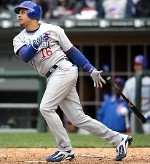
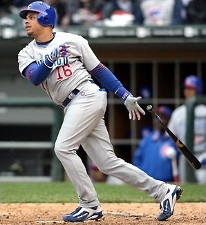
Among current major leaguers whom the Pirates traded away, the most prominent player the Pirates traded before his time was Aramis Ramirez (below), whom they bequeathed to the Cubs at the trading deadline in 2003. The Pirates could have had the slugging third baseman’s services for two more years before he could have been a free agent, and Dave Littlefield, the general manager who traded him, subsequently acknowledged that he pulled the Ramirez trigger too soon.
Whom did the Pirates get in the trade for Ramirez and Kenny Lofton? Bobby Hill, a second baseman, who would hit .267 in parts of two seasons with the Pirates; Jose Hernandez, a shortstop, who hit.223 in 58 games in 2003, then was released after the season, and Matt Bruback, a pitcher, who has never pitched for the Pirates or any other major league team.
 “I think what we’re doing is much different from what has been done here in the past,” said Coonelly, who named an inexperienced Neal Huntington as general manager. “If the thought is we are so good we can’t be trading players, the record belies that.”
The Pirates face the very real prospect of a 17th successive losing season. No major league team has ever accomplished that dubious feat. At times last month they made moves toward .500, then characteristically fell back.
Asked about the drive to win more games than they lose, Coonelly said, “We’re trying to win as many games as we possibly can. We’re not making our baseball decisions based on what has gone on here in the past. We’re not making baseball decisions with the hope of winning 82 games.”
In the meantime, Pirates’ fans can be certain of only one thing: the team will trade away some of their favorite players and start over.
“We’ve heard from some fans who are sad to see players who were popular in town go somewhere else,” Coonelly said.
The Pirates have heard from their players, too. After the Morgan trade, shortstop Jack Wilson, the team’s senior player, criticized the Pirates for their trades, saying he was “beyond tired of such moves” and “I’ve seen these trades two or three times a year and we still haven’t had a winning season.”
He later apologized for making the remarks, saying he was frustrated. Of course, he was frustrated. The Pirates’ hierarchy has given him reason to be frustrated.
PIRATES’ CENTER FIELDERS
 Nate McLouth and Nyjer Morgan played next to each other in the Pittsburgh outfield for the first two months of the season. Last weekend, playing for different teams, they were opposing center fielders and leadoff batters, McLouth for Atlanta , Morgan for Washington.
Meanwhile, Andrew McCutchen (at left) was the Pirates’ center fielder and leadoff batter, meaning 20 percent of the starting center fielders in the National League had links to the Pirates. Three other teams had center fielders leading off: Kosuke Fukudome (Cubs), Aaron Rowand (Giants), Michael Bourn (Astros), Dexter Fowler ( Rockies).
Morgan is the eighth player to start in center field for the Nationals.
HANSON PITCHES IN FOR BRAVES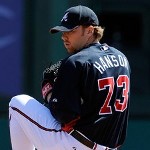
Six starts into the pitching career of Tommy Hanson, those of us who were critical of the Atlanta Braves’ treatment of Tom Glavine in releasing him have to at least acknowledge that they made the right decision for their benefit.
After watching the 43-year-old Glavine pitch minor league games, the Braves opted to release him instead of giving him a chance to pitch in the majors and add to his career total of 305 wins. They said they didn’t think Glavine could get major league hitters out any longer, and anyway they thought the youngster Hanson was ready to pitch in the majors.
The 22-year-old right-hander has done nothing to show the Braves they were wrong. In his first six starts he has a 4-0 record and a 2.25 e.r.a., and he extended his scoreless streak to 26 innings before Adam Dunn led off the Nationals’ seventh inning Saturday with a home run.
LOSING WITH WINNING TEAMS
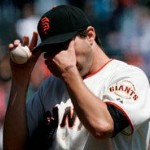 No matter how well he might pitch in the remaining four years of his $126 million contract, Barry Zito will probably always be the poster boy for free-agency excess. When the San Francisco Giants signed the left-hander to that seven-year contract Dec. 29, 2006, it was a ridiculous contract, and it will always be a ridiculous contract.
In his first two and a half seasons with the Giants, Zito has a 25-38 record and hasn’t helped the Giants win even a consolation prize. In fact, Zito is serving as a severe drag on the Giants this season.
Zito has a 4-8 record in 16 starts. His won-lost percentage of .333 compares most unfavorably to the Giants’ won-lost percentage in other decisions, which is .582. The difference of .249 is one of the largest in the majors between starters who have losing records pitching for teams with winning records and their teams’ record in other games.
These are the largest differences (games through Friday):
|
PITCHER |
RECORD |
PCT. DIFFERENCE |
| Chien-Ming Wang, Yankees |
1-6 |
.482 |
| Daisuke Matsuzaka, Red Sox |
1-5 |
.477 |
| Jonathan Sanchez, Giants |
2-8 |
.394 |
| Jose Contreras, White Sox |
3-7 |
.258 |
| Barry Zito, Giants |
4-8 |
.249 |
| Hiroki Kuroda, Dodgers |
3-4 |
.229 |
| Francisco Liriano, Twins |
4-8 |
.203 |
With two members of the Giants’ rotation on this losers’ list, the team’s other starters have carried the pitching load: Matt Cain 9-2, Tim Lincecum 8-2, Randy Johnson 8-5. Based on their earned run averages, the two losing pitchers and the two top winners have earned their records: Sanchez 5.30, Zito 4.82, Lincecum 2.37, Cain 2.48.
KEEP THOSE 1-0 GAMES COMING
I’ve said it before and I’ll say it again. My favorite game or score of a game is 1-0. I find it fascinating that with all of the scoring that teams do a game can end 1-0. It doesn’t take much for the team that is behind 1-0 to score a run and tie the game. From a home run to error-wild pitch-groundout-sacrifice fly, a team has many ways to tie the game.
But in 23 instances this season, teams have been unable to score that tying run. The Milwaukee Brewers have become intimately familiar with 1-0 games. They have played five, winning three and losing two. Their latest, a loss to the Mets, came last Wednesday, a day of three 1-0 games, most since three were played Sept. 19, 2004.
The Mets’ victory over the Brewers was their third 1-0 win of the season. But it was the first Johan Santana didn’t pitch. Mike Pelfrey played Santana’s role. That same night the Los Angeles Dodgers edged Colorado for their third 1-0 victory, the second started by Clayton Kershaw (above), who didn’t get the win either time despite pitching 12 shutout innings in the two games.
