Considering that their owner is a frequent user of Twitter, of course the Boston Red Sox used it to solicit votes for their players for the All-Star game. Not only are the Red Sox one of the best teams in the American League, if not the best, but they are also very good at promoting their players and getting fans to vote for them.
Except for Kevin Youkilis’s last-minute loss to Mark Teixeira of the Yankees in their fierce back-and-forth competition for first base, the Red Sox showed themselves to be resourceful and dynamic in pushing their All-Star candidates.

Dustin Pedroia will be the starting American League second baseman, and Jason Bay will start in the outfield after collecting the most votes among A.L. outfielders in his first appearance on the A.L. ballot.
But Bay’s outfield mates, Jacoby Ellsbury and J.D. Drew, placed among the top eight, both finishing closer to the third and last starting spot (Josh Hamilton) than Ichiro Suzuki and Hamilton came to Bay.
Jason Varitek was runner-up to catcher Joe Mauer and Mike Lowell was third among third basemen. And don’t overlook Jed Lowrie. The fans didn’t. Lowrie played only five games in the first week of April before having wrist surgery but nevertheless placed fifth among shortstops.
Given all of those unlikely developments, it was surprising that Youkilis lost to Teixeira in the final week of voting. At the same time, though, Pedroia edged Ian Kinsler of Texas in the final week in an even tighter finish.
“We have Twitter so we did Twitter to get out the vote on the last day,” Pam Ganley, the Red Sox media relations director, said. “With Red Sox Nation we have rabid fans throughout the country and the world. People subscribe to Red Sox Insider on Twitter and we sent a message to these thousands of people. We said vote for your Red Sox for the All-Star game.”
And they did. I can just see all of those Red Sox fans sitting at their computers late at night and dutifully voting for their heroes the maximum 25 times.
On June 9 Kinsler led Pedroia by 250,000 votes. In weekly voting updates, that margin shrank to 200,000, then to 60,000, then to 7,000, and in the final week Pedroia surged in front and won by 73,000.
 “That’s a function of online voting because that came in after both teams had completed the in-park voting,” said John Blake, Ganley’s predecessor in Boston, who now is executive vice president for communications in Texas. “I was not surprised that Pedroia overcame Kinsler. When it got down to 60,000, I was afraid that would happen.”
Blake said the ability of Red Sox fans to use the Internet to the Red Sox advantage is evident from the outcome of the voting for the extra player on each all-star team that Major League Baseball has conducted in recent years.
Blake pointed out that when the Red Sox have had one of the five players on the Internet ballot, that player has won – Johnny Damon in 2002, Varitek in 2003 and Hideki Okajima in 2007. The Red Sox did not have a player among the candidates this year. For that voting, there is no maximum number of votes per e-mail address so fingers fly over the keyboard.
“You can do all you want in the parks,” Blake said. “We do a lot more here than we did in Boston to get the vote out. I think we do a good job here. But it’s the online voting that makes a difference.”
However, as good as the Red Sox are at the online game, they lost Youkilis, who alternated with Teixeira virtually each week of the voting.
On June 9 Teixeira led by 1,209, a week later Youkilis by 1,315. On June 23 Teixeira was back in the lead, this time by 35,632, but again a week later Youkilis had charged in front by 40,047. Yet when voting ended a week later Teixeira won by nearly 240,000 votes.
“I have no idea,” Ganley said when asked to explain the outcome.
The Yankees also went the online strategy route. Voting at Yankee Stadium had ended June 8, but the Yankees had 9 more home games before the online voting deadline so they set up laptop computers around the stadium for fans to use for online voting.
“And we sent out e-mail blasts to people who had signed up on Yankees.com reminding them to vote,” Connie Schwab, media relations coordinator, said. “We didn’t do anything over the top like last year with Giambi and the mustaches.”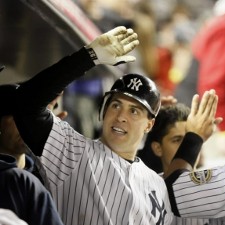
Nevertheless Youkilis is on the All-Star team, selected by manager Joe Maddon as a reserve. He is part of a six-man squad of Red Sox players, the league’s largest contingent, which means the Red Sox have the weapons to assure themselves homefield advantage in the World Series should they get there.
The All-Star game is all about homefield advantage in the World Series, isn’t it? It used to be a game that matched the best players in each league, but it has become a game of television ratings. Fox, which televises the game, wasn’t happy with its ratings so it devised, with Major League Baseball as a willing co-conspirator, the gimmick of linking the outcome of the exhibition game to the World Series.
Commissioner Bud Selig says he likes the idea, but I would bet if he were given truth serum, he would say, “Who are you kidding?”
But the linkage enables Fox to run commercials for the July 14 game saying, “This one counts.” A look at the ratings, however, shows that the game counts for nothing where Fox’s self interest is concerned.
While the average audience of 14.5 million for last year’s game was the largest in the eight years of the World Series link, it was nevertheless smaller than the audience for any pre-link game for which ratings are recorded (since 1972).
Fox and Selig could argue that without the link, the audience could have been smaller still, but I have yet to see a survey of viewers who said they have watched the All-Star game because the winning league would get homefield advantage in the World Series.
At the other end of the ratings spectrum an argument could be made that a few more people watched the game last summer because it was played at Yankee Stadium in the historic park’s final year.
“I’d like to try to get everyone in the game, but the game has a meaning to it,” Charlie Manuel, the Philadelphia manager, said. “It’s nice to have homefield advantage for your league.”
Maddon, the Tampa Bay manager, acknowledged that the link “makes you think differently on how to work the game, the fact that it has implications attached to it. I just know you have to approach it entirely differently, especially figuring out the way you use the pitchers.”
A Fox researcher said that Stats Inc. has found that players who start the game are playing an inning longer than they did before the link was created, but if longer-lasting starters create a larger television audience, couldn’t the commissioner simply instruct the all-star managers to keep the starters in the game longer?
That idea would be more legitimate than a hoked up link to the World Series.