The Yankees and the Phillies received invitations but didn’t stay at the party long. The Red Sox weren’t invited, snubbed for the second successive season. Invitations were not extended either to the Angels, Mets, Cubs, White Sox, Giants or Twins.
Those nine teams spent the most money this year preparing for the big party, and their fancy duds hang in the closet, for the most part unworn. Their problem is they can’t return them. The stores where they bought them have a strict no-return policy.
The Red Sox, for example, cannot return Carl Crawford to Tampa Bay with his ill-conceived $142 million contract. He and it are theirs.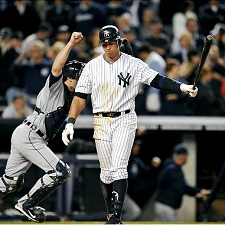
The Phillies have invested the equivalent of the gross national product in a starting pitching rotation, including Roy Halladay and Cliff Lee, that many thought guaranteed them a World Series triumph every year.
When Alex Rodriguez opted out of his already ridiculous contract a few years ago, the Yankees initially said they wouldn’t play his questionable money-grabbing game, then dived head first into his game and gave him an even more ridiculous new contract that pays him $143 million for the next six years.
Yet the Yankees, the Phillies and the Red Sox are not playing this week despite combined payrolls of about $536 million, approximately the total amount paid by the teams with the 11 lowest payrolls.
That circumstance is only part of the most intriguing economic development of the year. The eight teams that reached the post-season had the lowest collective payroll rankings of any group of eight playoff teams in the wild-card era, of which this is the 17th season.
Adding the payroll rankings of the eight playoff teams, 1 through 30, we get a total of 107, one higher than the previous high of 106, the total of the playoff-team rankings in 2002 and only the third time the total has reached 100.
Significantly the only other time the total has reached 100 was last year when the total was 102. That means the last two seasons have produced two of the three years of the greatest economic diversity. That, in turn, indicates that poorer teams have a chance against the wealth of the Yankees and the teams that have followed them into the financial stratosphere.
Commissioner Bud Selig doesn’t like to talk about payroll figures or payroll standings. For one thing, clubs don’t like their payroll figures tossed about publicly. For another, Selig doesn’t want to be in a position of comparing payrolls and risking alienating owners.
When I raised the subject with him on the telephone Wednesday, he held to his reluctance.
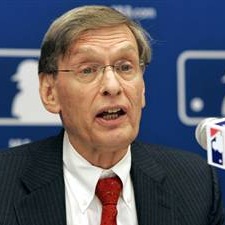 “It’s been quite interesting this year,” he said, “but I don’t have anything to say.” But he added, “All I’ll say is our system is working.”
The system is revenue sharing, in which the wealthy teams, those with the highest revenue, contribute (reluctantly) a percentage of their revenue to a pool, and that money is divided among the teams with the lowest revenue.
The idea is to increase competitive balance, and when Selig sees the Diamondbacks, No. 24 in the payroll rankings, and the No. 29 Rays, in the playoffs, he likes what he sees, whether or not he’ll acknowledge it.
Besides the Diamondbacks and the Rays, the No. 16 Brewers emerged from the lower half of the payroll rankings to reach the playoffs. The Yankees (1) and the Phillies (3) made cameo appearances, and the other teams still playing, as I write this, are the Tigers (10), the Cardinals (11) and the Rangers (13).
Last year’s post-season lineup had the Yankees (1), Phillies (3), Twins (10), Giants (11), Braves (16), Reds (19), Rays (20), and Rangers (22).
Although the Rays went out this year in a first-round knockout by the Rangers, their accomplishment was the most impressive of the season. The Rays won the American League wild card (with a furious finish) despite having cut their payroll nearly in half, slashing it from $77.5 million to $42 million.
The three biggest spenders were the most shocked, the most disappointed and the most unimpressive.
The Yankees always expect to win, and the only difference between this year and past disappointments was the silence of Hal and Hank Steinbrenner compared with the public outrage expressed by their father when the Yankees failed to win.
The Yankees, though, were not part of the consensus World Series pairing last spring. Six months hence it was supposed to be the Phillies and the Red Sox.
The Phillies, with their premature, division-series exit, stunned themselves, their fans and just about everybody else. Their vaunted pitching was supposed to take them to the World Series and, better yet, win it. But as Yogi Berra must have said at one time or another, “You gotta be in to win it.”
The most devastated of all, though, had to be the Red Sox. Following their failure to make the playoffs in 2010, they spent abundantly to insure that failure would not be repeated. But it was, and the aftermath reminded me of the climax of my favorite ballet, Swan Lake.
When the white swan realizes she will never be able to become human and marry her beloved prince, she leaps from a cliff, killing herself. The prince follows her. The swan’s death breaks the spell the evil Rothbart (Bad Bart, I call him) has cast on the swans, he dies and his castle (in some productions) comes crashing down.
As far as I know, Fenway Park still stands, but two of its major characters are gone. Manager Terry Francona walked away, and general manager Theo Epstein fled to Chicago for a new stage and enough money to build his own castle.
Theo as the swan queen? Why not? The first time he left the Red Sox, in 2005, Epstein left Fenway in a gorilla suit.
This is one way of showing the payroll levels of playoff teams in the wild-card era. The second column is the sum of the numerical rankings of the eight playoff teams in each year. The higher the number the lower the payroll rankings:
|
YEAR |
CUMULATIVE RANK |
|
2011 |
107 |
|
2002 |
106 |
|
2010 |
102 |
|
2003 |
98 |
|
2006 |
95 |
|
2007 |
94 |
|
2000 |
92 |
|
1995 |
91 |
|
2001 |
86 |
|
2008 |
82 |
|
1997 |
78 |
|
2009 |
76 |
|
2005 |
66 |
|
2004 |
63 |
|
1998 |
61 |
|
1996 |
60 |
|
1999 |
52 |