If teams believe they have the right to decide when to call up players from the minor leagues, why won’t they acknowledge that major league service time is a primary factor, if not the only factor, in determining the call-up date?
The Pittsburgh Pirates’ top officials, for example, in explaining why they are not yet promoting a player, always say the player needs more minor league experience, more plate appearances, more work at an unfamiliar position.
President Frank Coonelly and General Manager Neal Huntington never say, “If we keep him in the minors another few weeks we gain a year in salary arbitration.”
Coonelly and Huntington are not alone in their reticence. None of the clubs speak about the subject with candor. The pattern prompts speculation that the commissioner’s office issues a script for clubs to follow. Interestingly, Coonelly used to be in the position of fashioning scripts for clubs to follow as general counsel for labor in the commissioner’s office.
However, Dan Halem, executive vice president for labor relations, denied that he or his office has anything to do with clubs’ call-up practices.
“We don’t do that,” he said in a telephone interview Wednesday night. “We don’t get involved in when a club calls up a player. That’s a club decision. It’s up to the clubs why they do it, when they do it.”
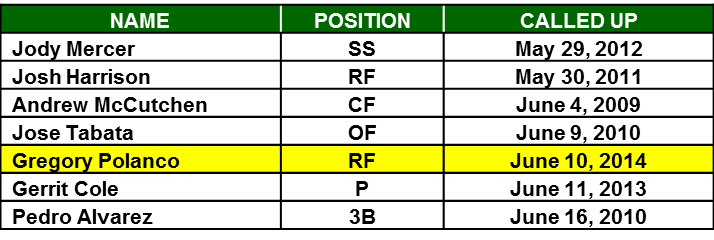
The Pirates have their system down pat. In the past six seasons they have promoted seven top prospects in a three-week period May 29-June 16. Gregory Polanco’s June 10 call-up fit right in.
Halem said the clubs’ right to determine the timing of the promotion of their players stems from decisions in two grievances, the more prominent being Dennis Lamp vs. the Blue Jays in 1986.
Lamp contended that the Blue Jays didn’t use him in relief in September that season to avoid having his option for 1987 become guaranteed. The arbitrator, George Nicolau, said he wouldn’t tell a manager when to use a player.
The union obviously accepts the clubs’ interpretation of the ruling because it hasn’t challenged the clubs’ promotion practice despite the obvious link between call-up timing and ramifications it has on service time and impact on salary arbitration. Union officials keep saying they are watching, but that’s all they’re doing.
I question the delayed call-ups even if they are permitted because I believe they strike at the integrity of the game. Fans expect teams to do what they can to produce a competitive, if not a winning, team.
That doesn’t mean the Pirates should be expected to match the Dodgers’ $235 million payroll; that’s not realistic, and the fans know it. But if a team has a Gregory Polanco at its Class AAA minor league level and he’s tearing up the league offensively, wouldn’t it be reasonable for the fans to expect the team to call him up to see if he could add a spark and some offensive production?
Yasiel Puig did that for the Dodgers last season even though they didn’t call him up until June 3.
Whenever he is summoned, the young player doesn’t arrive with a guarantee, certainly not with the likelihood of the 2013 Puig production. But if he’s leading his minor league in total bases, hits, runs batted in and runs scored and ranks in the top four in batting average, on-base and slugging percentages and stolen bases, wouldn’t you like to see what he could do in the majors?
He might help his team win some games and even catapult it into the playoffs as a wild-card entrant. But in Polanco’s case, he needed more experience and development. That’s what Coonelly told reporters about two weeks before Polanco suddenly had gained enough experience and development to play major league baseball.
At no time did Coonelly or Huntington say the Pirates were keeping Polanco in the minors to prevent him from qualifying as a “Super Two” for salary arbitration. If Polanco plays in the majors the rest of this season and the entire 2015 and ’16 seasons, he will finish 2016 with two years and 111 days of major league service time.
That total will not make Polanco a “Super Two,” one of the 22 percent of players with more than two years of service but not as much as three. The last player eligible for salary arbitration earlier this year had two years and 122 days.
By the time the outfielder reaches that point of his career, salary arbitration may be moot. Chances are the Pirates will have signed Polanco to a multi-year contract. They offered him one in spring training, reportedly a seven-year deal worth about $25 million. The 22-year-old Dominican said no, thank you.
Had Polanco accepted the contract, it’s possible that the Pirates would have called him up earlier than June 10 because service time would not have been a factor. But then again, there was that lack of experience and development.
Why won’t Coonelly and Huntington say they base their call-up decisions on service time? For the second straight week neither executive returned telephone calls seeking answers to that question. If they had called, they wouldn’t have been forthright anyway.
A Pittsburgh area baseball reporter told me he has never heard Coonelly or Huntington mention service time as the reason for the timing of their call-ups.
Honesty, candor and transparency would go a long way toward letting fans know why the clubs aren’t doing everything they can to make themselves better and worth the price of tickets fans pay to see them play.