The Red Sox have joined the growing number of clubs that want to establish a payroll cap. Will the Yankees be next in line?
All right, the Yankees aren’t about to call for a cap. But the fact that the Red Sox owners say a cap is needed is almost as funny as it would be if the Yankees did join the cap crowd.
When owners of teams like the Pirates and the Brewers call for a cap, it’s understandable because their payrolls are dwarfed by the payrolls of teams like the Yankees, the Mets and the Red Sox. But the Red Sox? A cynic might say the Red Sox want a cap to save themselves from themselves. They’re like a serial killer who keeps killing because he wants to be caught.
These are the same Red Sox who this winter offered Mark Teixeira a contract for about $170 million, and who in a 10-day period in 2006 spent $103 million to add Daisuke Matsuzaka to their pitching staff and $70 million to put J.D. Drew in their outfield.
Those numbers don’t put the Red Sox on the same level as the Yankees’ $423.5 million signing of Teixeira, CC Sabathia and A.J. Burnett this winter, but both teams are spending the money they have. If the Red Sox revenue were in the Yankees’ ball park, they would most likely spend much more than the $147 million that gave them the second highest payroll last season.
The Red Sox spend what they have to spend to get the team to the World Series, which they have won two of the past five years. The Yankees haven’t won the World Series for the last eight years so they keep spending to make their team good enough to win the championship again.
The Red Sox have obviously done a better job of building a championship team so they are in position to sound magnanimous and selfless. They have figured out that with their judgment and ability to identify winning players they can operate within a payroll zone whose upper level would not be far from the payrolls they have used to their benefit in recent seasons.
Payroll zone is the term that was used in the Blue Ribbon Panel’s 2000 report on baseball’s economics. The study was done by a panel of four, two of whom have since played other roles in baseball. George Mitchell conducted the steroids investigation, and Paul Volcker spoke to the owners last November, serving as Bud Selig’s bogeyman on the nation’s economy.
The panel didn’t propose a payroll cap but a payroll range with a ceiling and a floor. That’s the concept the Red Sox owners raised last week when they spoke to reporters at the team’s training camp in Fort Myers, Fla.
Larry Lucchino, the Red Sox chief executive officer, declined to discuss their plan when he returned a telephone call Friday. “I said all I intend to say on the subject of salary caps or payroll zones,” he said. “I’m not going to have any more public comment on it. I think we’ve said enough about our feeling.”
The curious thing is if the Red Sox owners are so proud of their idea why wouldn’t Lucchino want to talk about it? He didn’t say.
There was one thing he commented on. At the owners’ appearance in Fort Myers Lucchino was quoted by mlb.com as saying that the payroll zone idea was “being addressed at the highest level by baseball and its labor negotiators.”
Asked if such meetings were actually taking place, Lucchino said. “I probably said more than I intended. We are bringing it to their attention. I don’t know now what they’re considering. The Red Sox are calling it to the attention of the people at the highest level.”
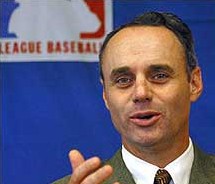 Rob Manfred, who as baseball’s chief labor executive sits at the highest level, declined to address Lucchino’s comment to mlb.com. “I have no comment with respect to that particular story,” he said.
Donald Fehr, the players’ chief executive, said he wasn’t aware of Lucchino’s comment but speaking generally said, “Basically we have an agreement, everybody says it has been working well, we have a number of years before we have to bargain again and I hope everyone waits until that time comes. We’ve gotten away from the bargaining that we did for 30 years. I’d be pretty cautious about getting us back to that kind of bargaining.”
Five strikes and three lockouts punctuated labor negotiations between baseball and the union in the union’s first 30 years of existence. The last two agreements have been achieved without a stoppage. The current agreement runs through the 2011 season.
The owners have tried desperately in the past to get a payroll cap, going so far as to force the disastrous World Series-killing strike of 1994-95. But the players have always resisted a cap despite its existence in the other three major professional sports. There has been no indication that the players would be any more willing to accept a cap now than before.
Baseball, meanwhile, has established record revenues and attendances since the last negotiated labor agreement in 2006. Selig, in fact, has proudly boasted of those records. Neither side should want to derail that direction, but the Yankees got everyone’s attention with their financially gargantuan triple play, and some of the owners, with a knee-jerk reaction, have reverted to the call for a cap.
“The clubs have views as to what should happen from a bargaining perspective,” Manfred said. “Sometimes they get expressed publicly. As we get closer to the negotiations we’ll develop a position that will be the industry’s bargaining position. I don’t care to say more about it at this point. When the time comes, we’ll talk to all of the clubs to hear what they have to say and we’ll form a bargaining position.”
Asked if owners’ public comments make his job more difficult, Manfred said, “Players say things; we had players talking about changes that should be made to the drug policy. I take that for what it’s worth. I assume the union takes owners’ comments for what they’re worth. I think the relationship has matured enough that both sides have learned not to make comments on everything that is said.”
Past cap disputes have created an odd but yet understandable alliance between the union and the Yankees. Not that the Yankees have ever publicly opposed the management position and endorsed the union’s, but the Yankees have always quietly rooted for the union to win the cap debate.
Some might see that as treasonous, but the Yankees adopt that position in their own self-interest. It has always been George Steinbrenner’s practice to put the money the Yankees make back into the team because he has always felt their fans deserve the team’s best efforts to win.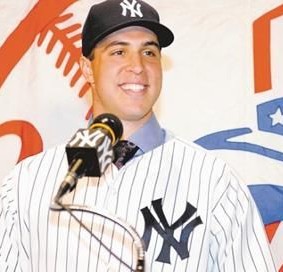
That’s how the Yankees got to a record $222 million payroll last season, and that’s why they signed Teixeira, Sabathia and Burnett. If a payroll zone were in effect now, the upper level would very likely be in the $140 million-$150 million range, which, gee whiz, just happens to be where the Red Sox finished last season.
They had the second highest payroll, $147 million, while the Mets were third at $144.7 million. Could the Yankees get down to even $150 million? Better question: How could they get down to $150 million?
Where would the lower level of a payroll zone be? It couldn’t be as high as $100 million because 19 of the 30 teams were below that number last season and to get there they would have to add payroll ranging from $2 million to $73.5 million.
“If there was a way to put together an enlightened form of a salary cap, I think everybody among the owners would probably support that,” John Henry, the Red Sox principal owner, said in Fort Myers. It is unrealistic, though, to think the Yankees would find any cap system worth supporting, no matter how enlightened.
“I think there are 29 teams that exist within a certain band, and there has been, in the last several years, one outlier that has been much higher,” Lucchino said. “The outliers both at the top and the bottom would be most severely affected by a payroll zone.”
Lucchino said a payroll cap would affect the Red Sox but felt they could handle it. The Yankees, he acknowledged, “would be impacted even moreso than we would.”
But Lucchino offered another observation that raised a question germane to the whole discussion of the Yankees’ payroll. The Red Sox executive talked abut his team’s commitment to winning, saying it “requires that you reach into the free-agent market and try to acquire the best available pitching talent and position-player talent in that year’s market.”
That’s precisely what the Yankees did this winter in acquiring Teixeira and Sabathia. Should they be punished for succeeding in that quest?
And Lucchino added: “So we thought if we could still justify that in light of the expectations we had for the revenue of the franchise, we saw it as an effort to improve this team for our fan base.”
That’s all the Yankees were trying to do, improve their team for their fans. So what did they do that would justify a call from their primary rival for a cap?
Maybe the Red Sox have an ulterior motive. A payroll cap might lead to the elimination of revenue sharing, a plan in which the Yankees contribute the most money – about $90 million for last year. But by paying much of the construction cost of Yankee Stadium, the Yankees in future years will get a reduction in their share of revenue sharing. The Red Sox, who paid about $50 million for 2008, may see their share rise because the Yankees and the Mets will pay less.
 Maybe revenue sharing has nothing to do with the Boston payroll plan, but those Red Sox owners are clever guys who are always thinking of ways to trump the Yankees.
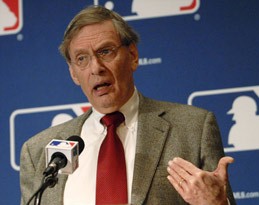
I don’t like payroll caps of any kind, but if the owners want to try to cap their player payrolls, let them establish another cap first. Let them place a cap on the commissioner’s salary. Selig earned about $17.5 million in 2007 and is said to have earned more than $20 million last year.
The owners think he deserves that kind of money, and I have no problem with his earning it. But put a cap on his salary and see if he accepts it as quickly as the owners want the players to.
Latest Threat not Disheartening for Hampton
Mike Hampton has already threatened to increase his lead over A.J. Burnett, and the season is still six weeks away. Fortunately for Hampton, his heart scare turned out to be a false alarm and he won’t have to miss any playing time.
Hampton, a 36-year-old left-handed pitcher, has missed plenty of playing time in his 15-year career. In fact, that is the category in which he leads Burnett, a right-hander, who is 4 years his junior and whose career has been six years shorter.
Hampton has spent 685 days on the disabled list, Burnett 589. Hampton’s missed time is the equivalent of three and three-quarters seasons, Burnett’s three and a quarter. But because of Burnett’s shorter career, his time on the disabled list represents 37 percent of his career while Hampton’s disabled time is 26 percent of his career.
All but 39 days of Hampton’s disabled time have occurred since he became a free agent after his World Series season with the Mets in 2000 agent. That prompts a suggestion about the source of his back, calf, forearm, oblique and multiple elbow problems.
A player who has been injured so often must be cursed, and if he wonders why he is cursed, Hampton need look only to his explanation for why he took the Colorado Rockies’ offer of 8 years for $121 million.
It was the money, right? Not at all. Hampton said he had heard “nothing but good things” about the lifestyle in Colorado. Asked for an example of what he had heard was so good about the Denver area, he said “the school system.”
But sons Gage and Griffin didn’t get to attend schools in that system for too long. The Rockies traded Hampton to the Braves after only two years. The cursed injury cycle began even before he started his first season with Atlanta and quickly spiraled out of control.
News Media See Errors of A-Rod’s Way But Not Their Own
The news media clearly dislike Alex Rodriguez so he will never get the benefit of a doubt in his steroids escapade or anything else he does, but they can at least get the facts as he has told them correct.
 If they don’t want to believe his timetable of steroids use, that’s their prerogative, though they have no evidence that he used them at times other than when he said he did. If they accept his admission, however, they should get it right.
Most of the reports about Rodriguez’s steroids use say he did it for three years, 2001, ‘02 and ‘03. But he said he quit using them during spring training in 2003, which means he used steroids for two years plus whatever part of spring training he had them injected in 2003 before he quit.
Typical of the reporting was one columnist’s reference to Rodriguez’s “three-year flirtation” with steroids. Make that a two-year flirtation.
At the Mets’ camp last week reporters asked Carlos Delgado how he felt about finishing second to Rodriguez when he won the 2003 most valuable player award now that Rodriguez has admitted using steroids that year.
But Rodriguez didn’t admit using steroids in 2003. He said he quit in spring training of 2003. Unless the effect of steroids lasts for six months, that would suggest that Rodriguez’s m.v.p. victory over Delgado was not chemically aided.
Does it matter if Rodriguez used steroids for two or three years? Not really. Two years would be just as bad as three. But it matters journalistically. The same reporters and columnists wouldn’t write that Manny Ramirez hit 55 home runs if he hit 45 so they should get it right on what Rodriguez said about his steroids dalliance.
Free Advice for A-Rod: Don’t Talk to M.L.B.
Major League Baseball investigators want to talk to Alex Rodriguez about his admitted steroids use, but there’s no reason he should talk to them.
The positive test Rodriguez supposedly had in 2003 was part of an anonymous, confidential, penalty-free testing regimen established jointly by the commissioner’s office and the union. The commissioner’s office agreed that players who tested positive would not be identified, and it should honor its agreement by not pursuing Rodriguez even if just for a chat.
The commissioner’s investigators would argue that the Yankees’ third baseman talked publicly about the circumstances surrounding his steroids use, and therefore is fair game. Anyway, they would say, they have no interest in punishing Rodriguez; they only want to find out if his steroids use involved an illegal breach of the clubhouse.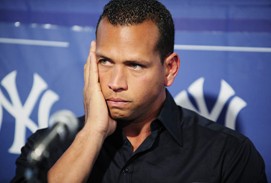
Rodriguez, however, acknowledged his use only because someone, presumably a government agent, leaked his name, leaving him with a choice of saying nothing and coming across as being guilty, lying and denying that he used the banned substances or admitting it, as everyone wanted him to. He chose to tell the truth and shouldn’t be subjected to an interrogation for his honesty.
He might have cheated, and he might have been stupid, but he doesn’t have to answer questions investigators would not have known to ask him had his privacy been honored.
When Commissioner Bud Selig directed Jason Giambi to meet with George Mitchell, the steroids investigator, in 2007, it was clear that if Giambi refused to talk to the former United States senator, Selig would take disciplinary action. Giambi had no choice because he wasn’t part of an anonymous testing regimen.
If Rodriguez talks to the investigators, anything he tells them could wind up in the hands of the authorities because it could be subpoenaed. His cousin, who Rodriguez said injected him and whom he initially didn’t want to identify, could wind up in trouble with the law.
Since they initially expressed interest in talking to him, investigators now can claim another reason for wanting to meet with Rodriguez. News reports have linked him to a Dominican trainer banned in M.L.B. facilities, Angel Presinal.
But other players also have been linked to Presinal, and Robinson Cano of the Yankees and David Ortiz of the Red Sox have acknowledged having worked with him. Will investigators seek to speak with them, too? If not, they have no reason to talk to Rodriguez about him.
Rob Manfred, baseball’s chief labor executive, declined to comment on the Rodriguez matter. Gene Orza, the union’s chief drug-testing lawyer, said of a meeting, “We haven’t even discussed it. It’s not on my radar screen now. I haven’t even talked to the player.”