When the Phillies lost to the Yankees and the Mets defeated the Indians in the opening games of their most recent interleague series, the margin between the teams became three games. It was the first time since Sept. 12, 2008, that the Mets had led the Phillies by as many as three games.
It is one of the most unexpected developments of the season. The Mets go ahead of the Phillies? Maybe a few years down the road, but now, with the Phillies in their prime and the Mets struggling to keep up with the Nationals, not very likely.
Yet a series of unexpected circumstances has resulted in a reversal of their positions.
The Phillies inexplicably stopped scoring runs, suffering five shutouts in an eight-game span, including a remarkable scoreless sweep by the Mets in a three-game series. Those shutouts were an integral segment of a stretch in which they lost 17 of 25 games and tumbled out of the National League East lead.
The Phillies have discovered that you can take the pitcher out of the American League East but you can’t take the American League East out of the pitcher. Roy Halladay was performing for the Phillies as advertised – six victories in eight decisions and a 1.64 earned run average – until he encountered a couple of old foes from the A.L. East.
Then the Red Sox and the Yankees battered him for 12 earned runs in 11 2/3 innings and two losses.
Beset by injuries, Jimmy Rollins has played in only 12 games this season. Raul Ibanez hasn’t been the productive hitter he was last season. Chase Utley has had his own hitting problems.
The Mets, meanwhile, have had their own out-of-body experiences. They have received positive production from players they didn’t even know when the season began would be on the team.
Ike Davis is one of those players. The Mets had planned to start the season with Daniel Murphy at first base, hoping he would hit well enough to create a market for him. But he was injured in spring training, and the Mets had to go to an emergency plan, using Mike Jacobs at first.
Jacobs, however was non-productive, and the Mets went to Plan C. That was Davis, their minor leaguer whom they hoped would be up to the challenge. He has been.
The 23-year-old son of former major league pitcher Ron Davis has been a clutch hitter for the Mets and has made some spectacular plays at first base. He is, of course, a product of the minor league system that critics said was so weak.
So is Ruben Tejada, the 20-year-old Panamanian, who has filled in capably at second base for the injured Luis Castillo.
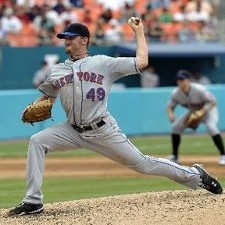 And Jonathan Niese, the 23-year-old left-hander in whom general manager Omar Minaya believed so strongly that he opted not to overspend on a questionable free-agent pitcher.
Did I mention 20-year-old Jerry Mejia, a very effective reliever this season who is heading for next season’s starting rotation?
That’s a fair collection of young players for an organization that didn’t have any prospects.
But they are not the Mets’ only new producers. Add two new catchers’ Rod Barajas and Henry Blanco, two new starting pitchers, R.A. Dickey and Hisanori Takahashi and an eight-year minor leaguer, Chris Carter.
None of these have become household names, but they have all contributed to the Mets’ remarkable resurgence. A six-game winning streak and 10 victories in 11 games (through Wednesday) had the Mets only half a game from first place. Who would have thought it?
More than half of the games remain on the schedule so there’s time for anything to happen. The Mets finished April with an eight-game winning streak and led the division by a game. But that lead was short lived, and the Mets fell under .500 again.
Give the Mets credit, though. They didn’t let that losing stretch undermine their season. And now they have given their skeptical fans reason to think that maybe they can be legitimate contenders.
If they fall apart or fall short, Minaya and his staff will nevertheless have made the resurgence possible.
When the Mets endured an incredible string of injuries last year, those same people were blamed for not having or finding replacements for the disabled. But the number of injured was too great and the quality too talented for anyone to find sufficient replacements.
Given time and maneuverability, however, the Mets apparently stocked themselves well for this year. Of course, the Phillies could come to life, revert to their previous explosiveness and take command of the division. They are more likely to do that than have the Mets and the Braves scrap for the division title.
But at least all of my friends who are Mets fans can enjoy the season. They haven’t always been able to do that.