Fortunately for Rickey Henderson and Jim Rice, the criteria for election to the Hall of Fame do not include a requirement for candor. Judged on their responses to questions yesterday, they would have failed the candor test and not made it.
Henderson and Rice were elected to the Hall Monday, Henderson with plenty of votes to spare on his first appearance on the writers’ ballot, Rice with few votes to spare on his 15th and last time on the ballot.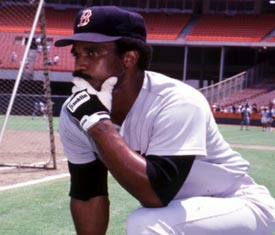
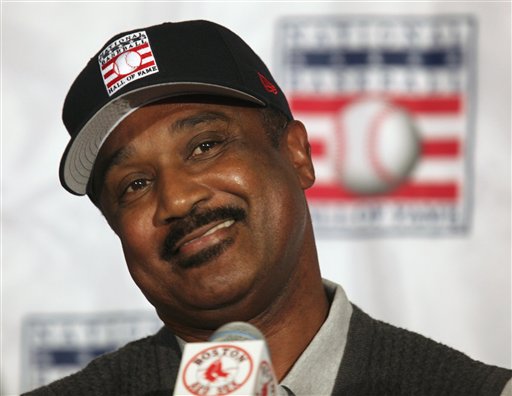
Henderson had been considered a lock, and the 94.8 percent of the votes (511 of 539 who voted) reflected that. Rice, who fell 16 votes short a year ago, made it by eight votes this time. I suspect the additional 24 votes he received came from writers who, like me, were not completely convinced that he was a Hall of Famer but felt that he had so much support, why withhold votes and deprive him of election.
Hearing his comments on the post-election conference call with baseball writers, though, I was prepared to take back my vote.
Why, I asked Rice, was he so difficult for writers to deal with? There was, in my nearly 50 years of covering baseball, no player more difficult to deal with.
“I don’t think I was difficult to deal with for the writers,” Rice responded. “I think the writers were difficult to deal with me. If you have a point to get across you go to the individual. If you want to ask questions about certain players on your team, I’m not in a position to talk about them. I wasn’t going to badmouth my teammates.
“You look at a lot of guys who liked talking about their teammates and stabbing their teammates in the back, but I looked at this like a family.”
On ESPN Peter Gammons, a Rice supporter, offered another view of the former outfielder. Gammons said Rice just didn’t like talking about himself. So on the one hand, Rice didn’t like talking about his teammates, and on another, he didn’t like talking about his teammates. The combination doesn’t leave much to talk about.
Politics? Cooking? The weather?
A writer on the call recalled that when Eddie Murray was elected to the Hall a Few years ago, he explained that he was not writer friendly because that’s what he had to do to succeed.
“Eddie and I are entirely different,” Rice said. “I was the way I was because I didn’t want to talk about my teammates. If you asked anything pertaining to me, I’d talk all day long.”
His last statement wasn’t simply a lack of candor; it was a lie. Excuse me for repeating myself, but I related a story here a few weeks ago in which I told about Rice’s demeanor as I tried to interview him at his locker at Fenway Park in the 1970s.
Despite having agreed to do the interview, Rice kept walking away to get or do something or other and when he finally stayed at his locker and I began asking him questions – all about himself incidentally, none about his teammates – he stood with his back to me and remained in that position throughout the interview.
My colleagues were seldom more successful in getting him to talk to them. But it was good of Rice to say, “I’m not going to bad mouth any writers.”
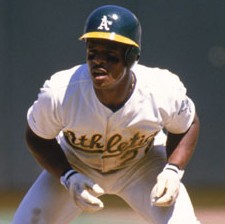 Henderson was not like Rice. He loved to talk, though his pattern of speech often made it difficult to understand him. But he could be fun to talk to. His lack of candor came in response to a question about the skeptical view some managers had at times about his desire to play. But managers, Henderson said, did not think like that.
“Sometimes the media got in the way,” he said. “If I didn’t go out there looking like a racehorse or if I had a slight injury and couldn’t run all out, they said I didn’t want to play. But I went out every day wanting to win the game. I loved being out there whether I had a slight injury.”
But Lou Piniella was one manager who had a problem with Rickey, and in August, 1987, with the Yankees in a fight for a division title, Henderson got caught in the middle of a spat between the manager and the owner, George Steinbrenner.
According to Steinbrenner, Piniella called general manager Woody Woodward and said, “He’s a dog. I want him out of here. Trade him.” Henderson was on the disabled list at the time with a hamstring ailment.
Woodward confirmed that Piniella “did express dissatisfaction” with Henderson and “absolutely did encourage trading him.”
As good and as valuable as he was, Henderson infuriated other managers as well. It was an annual ritual for managers not to know when Henderson would arrive for spring training. They breathed more easily when he did show up.
Managers aside, Henderson deserved the vote he received. Not so Jack Morris. The pitcher, whose election I have strongly advocated, saw his vote total and percentage rise but not enough to forecast his eventual election in his final five years of eligibility on the writers’ ballot. Morris received 237 votes, 44 percent, compared with 233 and 42.9 percent a year ago.
The voting this year was so consistent with last year’s that only one player other than Rice gained more than five additional votes. That was Tommy John, who in his last year on the ballot picked up 13 votes but still had only 31.7 percent.
As they were last year Andre Dawson was third and Bert Blyleven fourth, Dawson at 67 percent, Blyleven at 62.7 percent. Blyleven has three years left, Dawson seven. With no obvious first-timers coming up on the ballot in the next three years, Dawson should make it. Blyleven’s chances are shakier.
The most attractive first-time candidates next year will be Roberto Alomar, Barry Larkin, Edgar Martinez, Fred McGriff and Robin Ventura. Two years hence the ballot will have Jeff Bagwell, John Franco, Juan Gonzalez, Rafael Palmeiro and Larry Walker, in three years Vinny Castilla, Javier Lopez, Bill Mueller, Ruben Sierra and Bernie Williams.
The name that jumps out from that three-year group is Palmeiro, who finished his career with 569 home runs, 3,020 hits and one suspension for steroids use. Palmeiro has Mark McGwire’s experience of the past three years to think about.
In this year’s balloting McGwire received 118 votes, or 21.9 percent. He lost 10 votes from last year. Some voters don’t think McGwire’s career made him a Hall of Famer. They believe he was a one-dimensional player who hit a lot of home runs.
But there’s no doubt that most voters take his declaration at a Congressional hearing four years ago that “I’m not here to talk about the past” as an admission of steroids use.
Palmeiro vehemently denied using steroids, dramatically wagging a finger at that same hearing, then tested positive. He is certain to have the same experience as McGwire.
Palmeiro will become eligible for the Hall of Fame in 2012. The next year’s ballot will be perhaps the most interesting election lineup ever. The ballot is expected to include Barry Bonds, Roger Clemens and Sammy Sosa.