The Hall of Fame, which this week learned it will have two new players to induct in July, collects all sorts of artifacts from hundreds of players. Its officials are familiar faces at All-Star games, post-season games and other newsmaking and historic events.
The Hall, however, has missed a significant development, and it may be too late to correct its oversight. There might not be any mementoes of Steve Howe’s career to put in a glass case in Cooperstown.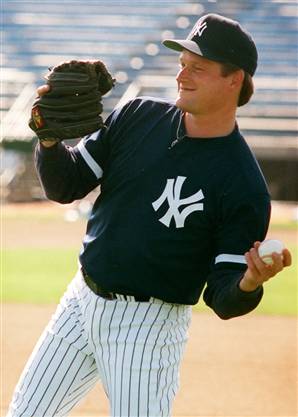
As developments of the past two years have shown, Howe was a pioneer. Though he was occasionally an effective relief pitcher, Howe didn’t do anything in his 12-year career to warrant a glass case, but he was years and years ahead of his time. As an arbitrator found in 1992, he was a player with attention deficit disorder when no one else would be diagnosed as such or admit to it for 15 more years. Last season 106 players suffered from attention deficit disorder, or so they and their friendly doctors said.
The affliction, known as ADD, has hit baseball in a big way. Players with ADD, if there were players with ADD, didn’t have to disclose their ailment until 2007 because the drugs they took for their problem, if they had a problem, would not get them in trouble with Major League Baseball’s testing program for performing-enhancing substances.
They could take their Ritalin or their Adderall or their Concerta, if indeed they really had to take any of those drugs, with no fear of testing positive because baseball had not begun testing for amphetamines and other stimulants. They began testing for them in 2006, and as part of the program players could apply for therapeutic-use exemptions, meaning they could seek permission to take their medications, which are considered stimulants.
The existence of these exemptions, known as t.u.e.’s, was disclosed a year ago at a Congressional hearing into steroids use in baseball. At that time we learned that 103 players had been granted exemptions in 2007. It was one of the most stunning disclosures in years.
Who knew so many baseball players had ADD? I had never heard any player, manager or general manager talk about a player with ADD. Neither Bud Selig nor Don Fehr had ever mentioned the term in relation to baseball players. No agent ever said one of his clients had ADD.
No hitter had ever blamed ADD for his strikeouts. No pitcher had blamed ADD for the home runs he allowed. No fielder blamed ADD for his wild throw to first base. Who knew?
Incidentally, the comments in this column should not be construed as making fun of anyone with ADD. If there are players who genuinely have ADD, I am sorry they have to deal with it. I feel also for anyone with ADD.
But when 103 players are allowed to take otherwise banned stimulants because they say they take them for ADD, excuse me for being skeptical. That number rose to 106 in 2008, though I’m not going to look aghast at that total and cry oh my goodness, even more players have the problem than a year ago.
What I am going to do is look at all of the number. According to Rob Manfred, the commissioner’s chief labor executive, the new exemptions dropped from 77 in 2007 to 58 in 2008. That appears to be progress, but it wasn’t good enough for the steroids zealots. They’re the experts who can always be counted on to belittle the progress baseball makes in its scrutiny of steroids users.
The zealots yelled and screamed that baseball needed a tougher testing program, and baseball adopted a tougher testing program. Then when baseball showed that relatively few players tested positive, indicating that the testing program had prompted players to quit using, the zealots complained that the testing program couldn’t be good enough because it wasn’t catching enough players.
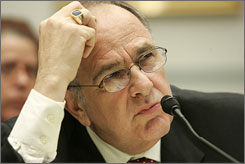 Dr. Gary Wadler, an official of the World Anti-Doping Agency, is the chief zealot. He is the most widely quoted “expert” in newspaper steroids stories. He is everybody’s go-to guy. No one questions whether he has a conflict of interest, promoting more stringent steroids testing while working for an agency that doesn’t do testing but nevertheless is a commercial operation.
I have never spoken with Dr. Wadler, and I don’t like quoting him, but in the matter of ADD, I unfortunately find we have similar suspicions.
“This is incredible. This is quite spectacular,” Wadler told the Associated Press. And he wasn’t being complimentary. “There seems to be an epidemic of ADD in Major League Baseball,” he added, also recommending that an independent panel be established to deal with applications for exemptions.
But baseball has an independent administrator for its testing program, Dr. Bryan W. Smith, a medical doctor and a PhD.
Manfred and Michael Weiner, the union’s general counsel, staunchly defend the exemptions and the way they are granted.
“Bryan Smith doesn’t approve t.u.e.’s for players unless there’s both a current diagnosis and one rendered by an expert in the field,” Weiner said. “People say any doctor will write a prescription for Ritalin or Adderall. That doesn’t fly in our program. If you present a prescription from an internist, an orthopedist or a podiatrist he’s not going to approve it. You’re going to be sent to a psychiatrist and someone who deals with these things.”
Manfred said Dr. Smith reviews a player’s prescription and his medical records because he has to be satisfied that the medication is necessary. “He applies the same standards as the Olympics,” Manfred said.
Dr. Smith, Manfred added, is the only one who sees the medical records and is the only person who can grant exemptions and grants them only when he feels they are necessary.
“There have been players who have been denied,” Weiner said. “Whatever the numbers come out they come out. I know guys are not getting t.u.e.’s without a lot of scrutiny.”
While I remain skeptical about the number of players who allegedly have ADD, I seriously doubt that Dr. Smith plays fast and loose with his responsibility. Yes, there are doctors who do shady things for professional athletes, whether it’s giving them phony prescriptions or compiling fictional medical records.
But Dr. Smith knows his work will be closely scrutinized by both baseball and the public. Baseball doesn’t allow him to speak publicly about the testing program, but he has said privately that the records he has received appear to be legitimate, that they cover treatment many players have received since they were teen-agers.
I won’t question Dr. Smith’s veracity or his judgment, but I am nevertheless skeptical. The Howe case doesn’t help make me any less so.
In 1992 then Commissioner Fay Vincent banned Howe for life for his acquisition of cocaine. Howe had previously been suspended six times for cocaine use. But Howe’s lawyer, Richard Moss, filed a grievance and persuaded the arbitrator, George Nicolau, that the pitcher should be reinstated.
“‘We now know,” Nicolau wrote in his 54-page opinion, “‘that Howe has an underlying psychiatric disorder that was never diagnosed or treated; that this disorder has been a contributing factor to his use of drugs; and that absent treatment for the condition, he remains vulnerable to such use.”
Howe, two psychiatrists testified, had attention deficit disorder and had never been properly treated for it. Howe was killed in 2006 with methamphetamine in his bloodstream when his pickup truck drifted off a desert highway in California and rolled over. He didn’t live long enough to see baseball allow players to use banned drugs.