Spring training has yet to start, but already I think I know what issues will create the most intrigue for me this coming season: 
- Can the Philadelphia Phillies get to the World Series – win it, too – after having forsaken the opportunity to have both Roy Halladay and Cliff Lee in their starting rotation?
- Will the Seattle Mariners depose the Angels of Anaheim as American League West champions after acquiring Cliff Lee to team with Felix Hernandez in their starting rotation?
To be sure, there will be other matters of intrigue, and the entire season will not revolve around Cliff Lee. But these two are pretty good for starters. They will command attention all season long because the Phillies will be trying to win their third consecutive National League East title and the Mariners will be trying to end the Angels’ division-winning streak at three.
Even without Lee, the Phillies should be strong enough to reach the playoffs. General manager Ruben Amaro Jr. has made a seamless transition from Pat Gillick, executing sharp moves last year in his rookie season and maintaining the championship caliber team that Gillick established.
But one of the good moves he made was the acquisition of Lee from Cleveland on July 29. The left-hander won his first five starts with a 0.68 earned run average and finished with a 7-4 record and 3.39 e.r.a. in 12 Phillies starts.
That two-month performance, as it turned out, was only the appetizer for a sumptuous meal. Lee started four post-season games, won them all and did it with a 1.56 e.r.a. The Phillies didn’t win the World Series, as they had done the previous year, but their loss to the Yankees was not connected in any way to Lee, who could not have done more for his third-of-a-season team.
In 16 starts for the Phillies, basically half a season’s worth of starting, Lee produced an 11-4 record and a 2.78 e.r.a. Can they reasonably expect better from Halladay? Will they get as much?
Amaro’s explanation for not keeping Lee to team with Halladay was that the Phillies needed to replenish their cache of prospects because they had traded a bunch for Halladay, and if they were to remain competitive for years to cone, they needed the minor leaguers.
You will find at least as many general managers who disagree with Amaro’s reasoning as agree. In the minds of many club executives, if they had a chance to win now they would take it and worry about the future in the future.
Amaro has denied that economics had anything to do with the decision to trade Lee, who can be a free agent after the coming season. Perhaps the Phillies didn’t want to pay lavishly to retain both Halladay and Lee. They have a history of parsimonious treatment of their payroll and maybe this is just the latest example.
On the other hand, the Phillies have a right to make their own decisions, and time will tell if they made a bad decision by trading Lee. Their fans will certainly let them know if they made a bad decision.
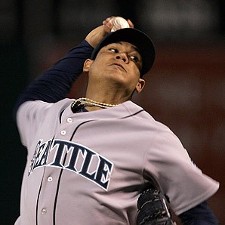 Fans in Seattle, meanwhile, are delighted with the Mariners’ decision to trade for Lee. In joining Hernandez, Lee gives the Mariners as strong a 1-2 at the top of the rotation as any team has. Most interestingly, the Mariners are not afraid of losing Lee and getting nothing in return should he leave as a free agent. Or perhaps they might even consider signing him and keeping him with Hernandez.
I should point out, if you haven’t thought of it already, that the Mariners are in a different position from the Phillies. The Phillies won the World Series in 2008 and played in it again last year. They say they want to compete every year but apparently feel their fans will forgive them if they don’t win the World Series every year.
The Mariners have never played in the World Series and in fact, have seldom made it to the post-season. They have been a stranger in that environment since 2001 and might be more prepared to take more drastic steps than the Phillies.
Lee, who last week had a floating bone spur removed from his left foot in what the team described as minor surgery, is not the only player the Mariners have added to fortify themselves for a post-season run. They signed Chone Figgins to play third base and team with Ichiro Suzuki for a sizzling 1-2 pair at the top of the lineup. They added Milton Bradley for their outfield despite his hot-headed history. And they added a pair of platooning first basemen, Casey Kotchman and Ryan Garko.
Their bulkup coincides with a possible weakening of the Angels, who have lost Figgins and Vladimir Guerrero from their lineup and John Lackey from their rotation. The Angels have signed Hideki Matsui for their lineup, Joel Pineiro for their rotation and Fernando Rodney for their bullpen.
The A.L. West does not figure to be a two-team race. The Texas Rangers were improved last year, and Oakland has a platoon of young pitchers who could improve the Athleticcs.
But without a game being played, I like what Jack Zduriencik has done in Seattle, especially his acquisition of Lee to be Hernandez’s mound mate. The better Lee and the Mariners do the worse the Phillies will look, unless, of course, the Phillies are winning in their own right.
For the Phillies to be right, though, they have to win the World Series. The Yankees won it last year with three starters, and the Phillies were in position to do it with Halladay, Lee and Cole Hamels, whose comeback from an unexpectedly mediocre season would have been easier with Lee on the scene.
One thing is certain. If the Phillies do not win, they will not get a do-over.
Meanwhile, I have an added intrigue to throw in here, having nothing to do with pitchers or any other players. The Minnesota Twins will open a new park this year, abandoning the indoor playground that served them so well as an advantage over visiting teams.
Will the loss of that homefield advantage affect the Twins? That, too, will be something to watch all season.