Between their second and third consecutive World Series championships in the early 1970s, the Oakland Athletics took a winter break and engaged in intramural economic warfare. Nine of their players, headed by Reggie Jackson, took the team’s irascible owner, Charles O. Finley, to salary arbitration.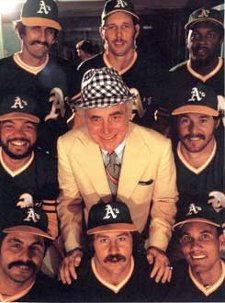
Later that year, 1974, Jim (Catfish) Hunter, the team’s top pitcher, would take Finley before another arbitrator and be declared a free agent because Finley had breached his contract, but this arbitration business was strictly about the players’ salaries. The procedure had been negotiated the year before in bargaining between the owners and the players and represented the first time the players would have a say in what their salaries should be.
Jackson, Sal Bando, Joe Rudi, Gene Tenace, Ken Holtzman, Rollie Fingers, Darold Knowles, Ted Kubiak and Jack Heidemann formed the largest contingent from one club to try the new scheme. Jackson submitted a bid for a $135,000 salary, highest of the 29 players in hearings that first year; the Athletics countered with $100,000.
“Charlie Finley tried the Oakland cases himself,” Richard Moss, then the union’s general counsel, recalled Friday. “In Reggie Jackson’s case, at the end of Jackson’s presentation the arbitrator said, ‘Thank you, Mr. Jackson; Mr. Finley, are you prepared to present your case?’”
According to Moss, Finley said, “No goddamn baseball player deserves to make $100,000 a year,” then stopped.
“Yes, Mr. Finley, go ahead,” the arbitrator said.
“That’s my case,” Finley said.
Jackson won. So did Holtzman and Fingers as Finley took a curious approach in his arguments before the arbitrator, who was the same for both pitchers.
Arguing against the reliever Fingers, Moss said, Finley told the arbitrator the reason the A’s relievers were so good was that they were well rested because the starters pitched deep into games. Then Finley turned around the next day in his case against the starter Holtzman and said the starters had good records because the relievers were good and could take over for them and finish the game.
 In those arbitrations, Holtzman sought and won $93,000, Fingers $65,000. The salaries submitted by all 29 players who went to hearings totaled $1,685,750. Today Tim Lincecum seeks $13 million from the San Francisco Giants, who would pay the pitcher $8 million.
I asked Marvin Miller, the Union’s original Executive Director, if he could have envisioned a player seeking $13 million when he and Moss negotiated salary arbitration in 1973.
“No,” he said, “unless you told me what the industry’s revenue growth and revenue figures would be at this time. I might have come close.”
Besides larger salaries, the biggest change in arbitration over the years has been the inducement it has served for clubs and players to settle their salary differences before players file for arbitration, before players and clubs exchange salary figures or before they reach hearings.
“Settlement is a purpose of salary arbitration,” Miller said.
Miller and Moss had been running the union for seven years when they achieved the arbitration breakthrough. They had been pushing for a change in the reserve rules, under which players had no control over their careers or even a say in their salaries. Miller was never certain why the owners relented in 1973, but he suspected what the reason was.
“My conjecture at the time was their attorneys advised them that some movement would be necessary,” the 92-year-old Miller said. “They couldn’t rely on courts upholding the reserve clause or not violating antitrust laws. Their lawyers knew they were. At some point I sensed they were looking for something that would satisfy us.”
At one bargaining session, Miller recalled, one management negotiator asked if he could list in writing the chief elements of the reserve rules that worked against the players’ interests.
“I included many things,” Miller said, “but prominently that under the reserve rules no matter what they called the discussions of a player’s salary it wasn’t negotiations. It can’t be negotiations if one party has no option but to accept what the other offers. No court would find that is freedom of choice. A player had no bargaining leverage. The club could renew the contract and at a cut of 20 percent. That represented no freedom of negotiation or bargaining power. The owner could take a player with a tremendous performance and cut his salary. It had occurred with Jimmie Foxx at one point.”
Not long after that session, Miller said, the owners’ negotiating team came to the table with a “very veiled long-winded feeler that if we could devise a fair means of determining salary, would that suffice?”
“I said how would you determine salary,” Miller added, “and they said ‘we thought you might have some ideas on that.’” Miller said he proposed impartial arbitration of salaries rather than the club having sole discretion. “We began a discussion of salary arbitration and it went on for weeks or months.”
But even before they had agreed to a new system, Miller said, the clubs were trying to weaken it. A player, management negotiators proposed, would not be able to go to arbitration every year but every other year. Miller and Moss rejected that idea.
“A million things had to be agreed to,” Miller said.
But agreed to it finally was, not that everyone on management’s side was pleased.
Nearly 30 years later, in an interview with me about the creation of salary arbitration, Frank Cashen, who as a Baltimore Orioles’ executive had served on the clubs’ labor board, still blamed John Gaherin, the clubs’ labor negotiator, for allowing it to happen.
“He came up with this idea of salary arbitration,” Cashen said in 2001. “We screamed bloody murder, but he had done it.”
Gaherin, who was a good man and a sharp management negotiator, always got blamed for things the owners didn’t like. They blamed him, for example, for free agency even though, he urged the owners to listen to signals from the arbitrator Peter Seitz but they instead listened to Commissioner Bowie Kuhn and his lawyer Lou Hoynes, whose advice turned out to be disastrous.
As development demonstrated, the confluence of salary arbitration and free agency, which came three years later, was costly for the clubs.
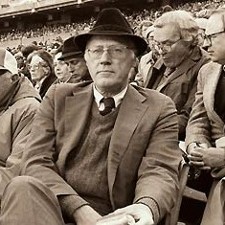 “In a better world,” Kuhn said in a 2001 interview, “we wouldn’t have negotiated salary arbitration with free agency. If that simple thing had been changed, I don’t think the system would be what it is.”
There has long been speculation about whether the clubs could have persuaded the union to give up arbitration when it got free agency. No way, Miller said.
“Both things deal with salary, but they occur at different times in a player’s career,” he said. “If you were to seriously consider removing salary arbitration, the only way to do it equitably is to say the players could be free agents after two or three years and that would not have been acceptable to the owners.”
The owners indeed proposed elimination of salary arbitration, Miller said, “but they had no comparable substitute.”
One of the thorniest elements of salary arbitration, both sides found, Miller recalled, was determining how the salaries both sides submitted would work. Arbitrators tended to cut the difference in half, which would have encouraged players to come in at very high figures and clubs at very low figures.
“That would be the opposite of trying to reach agreement on salary,” Miller said. “So I proposed that the arbitrator not be empowered to cut the baby in half but to pick one figure or the other and that would encourage people to be prudent.”
Miller said he borrowed that idea from his pre-baseball experience in which contract disputes in local transportation industry would be settled by impartial arbitration.
While on the subject of salary arbitration, I need to make a correction 36 years later. Larry Hisle, a Minnesota outfielder, who was the second player to have his salary decided by an arbitrator, did not gain a $29,000 salary in his 1974 hearing, as I reported then. The salary he won was $28,800.
“When we decided to go to arbitration, I told Larry I’ve looked at comparable salaries and a good number to put in would be $35,000,” related Moss, who as the union’s general counsel was representing Hisle. But the player, Moss recalled, said the figure was too high; he had told Calvin Griffith, the Twins’ owner, he would settle for $28,000.
“’I figure my share of the arbitrator’s fee is going to be $800,” Moss quoted Hisle as saying, “so the only thing I’m comfortable with is $28,800.’ So we went in at $28,800 and won. We could have won $35,000.”
AMARO AND A LOT OF BULL
Ruben Amaro Jr., the Philadelphia general manager, has unwittingly placed bulls eyes on the backs of pitchers J.C. Ramirez and Phillippe Aumont and outfielder Tyson Gillies. If those three youngsters don’t grow up quickly and lead the Phillies to the World Series at the least but preferably a World Series championship, Amaro will be inviting Phillies fans to blame them.
They are the three players Amaro acquired from Seattle Dec. 16 for Cliff Lee, and their anticipated future contribution to the Phillies’ championship efforts is the reason Amaro traded Lee in perhaps the most controversial deal of the winter.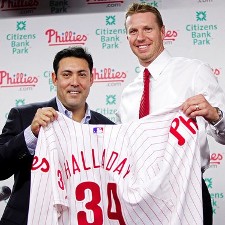
With Lee in the starting rotation with Roy Halladay, the Phillies were practically assured of the post-season and once there, the World Series. The Phillies watched the Yankees win last year’s World Series with CC Sabathia, A.J. Burnett and Andy Pettitte, and they had a good chance of doing it this year with Halladay, Lee and Cole Hamels.
But Amaro, who in his brief tenure as the Phillies’ general manager has done an outstanding job, didn’t think a third successive World Series would be sufficient fodder for Phillies’ fans so he restocked his minor league system by trading Lee for three prospects. He explained that reason on the day of the trade, and he reiterated it in recent remarks at a dinner in Philadelphia.
“We cannot be the New York Yankees,” Amaro told the Philadelphia sports writers dinner. “We have to have people that we can bring to the big leagues from our system. The guys who are our core players are guys from our system.
“Yes, I’d like to have a championship, but not at the cost of having our organization not be good for 10 years. Absolutely not. That’s not the goal. The goal is to be a contender every year. And once you get to the World Series or get to the playoffs, it’s really a matter of who’s playing the best baseball, who’s hottest, who has the karma.”
“It’s going to be difficult to look fans in the face and say two years from now, ‘You know, why we don’t have any players to supplant some of the guys we have now is because I went for it with Cliff Lee and now we have no players to fall back on.”
But what will Amaro say if the Phillies falter because of a pitching shortage this year when the fans believe they could win if they had kept Lee?
Ramirez, Aumont and Gillies have played a combined eight years in the minors. They did not come to the Phillies with a guarantee, and no one knows when they will be ready to play – and succeed – in the majors. But Amaro has made them the future of the Phillies. They will be scrutinized every step of the way.
Amaro, in effect, has promised Phillies fans that Ramirez, Aumont and Gillies will lead the team to perennial pennant status. Don’t bet the ranch on it.
GIVING SOMETHING BACK
The contracts of more than 100 players have clauses in which the players agree to donate a specified sum to their teams’ charities. Those clauses, the commissioner’s office has agreed, are improper and will no longer be permitted except in restricted instances.
The agreement comes as the result of a grievance filed last year by the union charging that the clauses were illegal because they did not provide a benefit to the players and were outside the scope of matters that can be negotiated individually with players.
 “The basic agreement only permits individual negotiations where clauses are of actual or potential benefit to players,” Michael Weiner, head of the union, said. “
The grievance had a precedent in the 1980s when Commissioner Peter Ueberroth wanted players contracts to include drug-testing clauses, but the arbitrator, Tom Roberts, ruled that they did not give players a benefit and therefore had to be collectively bargained.
In this instance, the union said it had no problem with players agreeing to give money to charity as long as it was a player’s choice and not designated by the club.
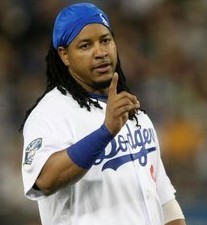
As examples of players who had such clauses dictated by their clubs, Manny Ramirez agreed to give $1 million to the Dodgers’ charity, Roy Halladay $100,000 to the Blue Jays’ charity, Scott Kazmir $75,000 each in 2009 and ‘10 and $100,000 in 2011 to the Rays’ charity, Alfonso Soriano $25,000 annually to the Cubs’ charity and Johan Santana $25,000 annually to the Mets’ charity.
Under the compromise agreement between the union and the commissioner’s office, a player who is a free agent can be required to donate to a club’s charity because he has the option of signing elsewhere. However, a player who is not eligible for free agency cannot be required to donate to a club’s charity because he isn’t free to sign with another team.
The irony of Ramirez’s agreement to donate $1 million to the Dodgers’ foundation is that he refused for years to give $10,000 or $20,000 to his old baseball team at George Washington High School in New York for new uniforms, balls and bats.
PLAYING BALL ON WELFARE
Bob Nutting has said he doesn’t  plan to sell the Pittsburgh Pirates, and his position should come as no surprise to anyone. How else can a guy from West Virginia be a welfare recipient and not have to spend the money on his children?
The Pirates have received about $40 million a year in revenue sharing and have never spent it on their meager payroll, extending their record major league streak to 17 successive losing seasons. They say last year they spent the money on draft choices and international free agents, but many of their major league fans will die from old age before those players, if any, will be ready to help the Pirates gain a winning season.
In a recent statement, Frank Coonelly, the Pirates’ president, said, “Bob is committed to bringing a championship back to Pittsburgh.”
He might try getting to 82-80 first.