In yet another column questioning Bud Selig’s use of the All-Star game to determine homefield advantage for the World Series, I recently proposed that it would be far better, fairer and more sensible to make that determination by results of interleague play. The champion of the league with the better record would get the extra game in the World Series.
Some readers wrote applauding that idea. Some didn’t like it. No one wrote defending baseball’s use of the All-Star game.
“AMEN!” one reader said. “I am disappointed that more baseball writers don’t write about this. When Bud’s plan was first announced, I thought it was ridiculous. Interleague play to determine home field advantage is the obvious solution.
“It also makes sense in terms of promotion. It is something which fans can follow all year and would generate more interest among baseball fans.”
From another reader:
No matter what they say, why would any major league ball player put himself on the line in the Allstar game. I like your idea because it is a real competition. The Allstar game has turned into a boring 3+ hour affair and I don’t care who wins….I’d rather go to the movies that night.”
Another reader suggested the homefield advantage be alternated by league every other season, and I replied that that’s the way it used to be.
“Precisely,” he responded. “Why fix something that wasn’t broke? Besides, they weren’t fixing the World Series, they were fixing the All Star game.”
I like that last sentence so much I would like to require the commissioner to read it over and over and over hundreds of times each day of the World Series; if he did something for which he had to be punished, I’d like to require him to write it 100 times on a blackboard.
Getting back to e-mail, one reader liked the idea of the interleague-outcome link, saying “your idea makes lots of sense, a lot more than” Selig’s.
But some other readers, while criticizing the All-Star link, did not like the use of interleague games either.
“Any system that allows an advantage for 1 team representing a league and yet decided by all of the teams seems unfair,” one reader wrote. “If this had been so, do you really think home field advantage for the AL for 10 years in a row is level? I don’t.”
Another reader wrote: “Interleague games have killed the All-Star game, free agency has killed the All-Star game and the fact that you can watch any team anywhere has also contributed to it. It was something worth seeing to watch Sandy Koufax face the top hitters in the American League when it didn’t happen during five or six starts a year against AL team in interleague play, or Willie (Mays) facing the best in the AL wasn’t a matter of course during a season.
“All of that has diminished the All-Star game. And I totally agree the link to the WS is absurd. Give home field to the team that has the best record in the WS. All other sports do essentially that.”
One more: “I agree that an exhibition game should not decide home field advantage for the World Series, yet I feel inter league play is also not the answer.”
What is, then?
Well, it just so happens that after writing about interleague results being the answer I was listening during the last week or so of the regular season to all of the talk about teams playing to gain the best won-lost record in each league to get homefield advantage throughout the playoffs, in other words, in the division and league championship series.
This season the Red Sox edged the Athletics by one game, 97 wins to 96, for the best record in the American League, and the Cardinals and the Braves duplicated those victory totals in the National League.
Those numbers gave the Red Sox and the Cardinals homefield advantage for the division series and for the league series if they advanced to the league championship series.
In the various wild card playoffs, teams also gained home games on the basis of overall regular-season record or, if tied, better head-to-head record.
If all of these series can have team records determine home teams, why can’t the same practice be followed for the World Series?
For some foolish reason, I used to buy baseball’s excuse that they had to know far in advance for logistical reasons where the World Series would be played. But that reasoning is fraudulent.
The league championship series are played a week to 10 days earlier than the World Series, and the sites aren’t determined until the division series are over.
As I write this on Monday, none of the eight teams remaining in the playoffs know where they will be playing Thursday and Friday, the opening days of the league series.
All of the other professional leagues use won-lost records to determine home teams, except the neutral site Super Bowl; why can’t baseball?
HOME RUNS AND ABERRATIONS
In another recent column, after Chris Davis broke Brady Anderson’s team record of 50 home runs for the Baltimore Orioles in 1996, I recalled the suspicion that steroids aided Anderson. Some readers felt that mention of that suspicion was unfair. What about other players who hit a lot of home runs in aberrational years?
Three players in particular were cited: Hack Wilson, Roger Maris and Davey Johnson.
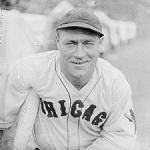 “Hack Wilson went from 56 homers in 1930 to 13 in 1931,” a reader wrote.
Indeed, the 1930 season was the apex of Wilson’s career. He preceded that season with seasons of 21, 30, 31 and 39 home runs. His runs batted in total ascended similarly, from 109 to 129 to 120 to 159 to a still major record 196 in the same year he slugged 56 home runs.
His career declined after the 1930 season, history books tell us, for various reasons. Off the field, Wilson reportedly increased his drinking and fighting. On the field, pitchers had a new baseball to use to thwart the increase in offense, a ball that was heavier and had raised stitching that made it easier for pitchers to grip.
Another reader brought up Maris’ “one big home run season” that “was pretty atypical of his overall career.” That season, of course, was 1961 when Maris clouted 61 home runs.
“Did he even hit ten his last year with the Cardinals,” the reader asked. No, Maris hit five, but that was seven years later in reduced playing time. In the years before and after 61 Maris hit 39 and 33.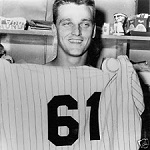
In 1961, Maris benefited from an in-house home run contest with teammate Mickey Mantle, who hit a career-high 54 while batting behind Maris and protecting him in the lineup.
When Anderson whacked 50, he had no Mantle threat hitting behind him. Cal Ripken, Roberto Alomar, Rafael Palmeiro yes but Mantle no. In four full seasons before Anderson’s 50, he hit 21. 13, 12 and 16; in four full seasons after he hit 18, 18, 24 and 19.
“Even though I am skeptical in hindsight of Anderson,” a reader wrote, “I don’t think it’s impossible he just had an incredible year.”
Telephone efforts to reach Anderson for a discussion of his “incredible year” were unsuccessful. However, one reader defended Anderson.
“If an aberration in Home Runs in one given year is a criteria for accusing or even implying that a player was a steroid user,” he wrote, “then why aren’t you writing articles about Davey Johnson and Roger Maris. Both had one year where their Home Run totals spiked.”
The reader then answered his own question.
“The answer obviously is there was no known steroid usage at the time. If they were able to have one year where their Home Run totals spiked, why couldn’t Anderson? Sometimes a player has a career year. It doesn’t have to be steroids”
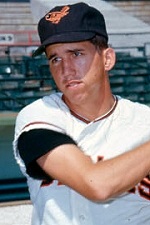 Johnson, meanwhile, briefly talked about 1973, the year he hit 43 home runs as the leader of the Atlanta Braves’ trio who hit 40 or more. Johnson’s pre-43 high was 18, his post-43 high 15.
While Anderson played in the era when steroids burst onto the baseball scene, which is why in retrospect he became a suspected user, Johnson preceded steroids.
“Back then,” the now former manager of the Washington Nationals said in a telephone interview, “we weren’t allowed to lift weights because we might get new muscles.”
So where did the home runs come from? “I was a good hitter,” he said. “I was a good home run hitter then. But I don’t like to live in the past.”
NO WAY TO WIN SERIES OR AWARDS
The Pittsburgh Pirates reached Game 4 of their National League division series against St. Louis with a two games to one lead despite questionable moves in Game 3 by two leading candidates for post-season N.L. awards
With the Pirates leading 2-0 in the fifth inning behind their best pitcher, left-handed Francisco Liriano, Jon Jay and Pete Kozma executed a double steal as Matt Carpenter struck out for the second out.
Their double steal left first base open for the Pirates to walk switch-hitter Carlos Beltran, who is a terrific post-season hitter, and pitch to right-handed Matt Holliday. But Clint Hurdle opted to pitch to Beltran, and Beltran singled home both runners for a 2-2 tie.
This is not a second-guess. It’s a first-guess. I didn’t think it was possible that the Pirates would pitch to Beltran. But they did, and Hurdle’s decision was costly.
Maybe, a baseball friend suggested, it was statistics thing based on pitcher-batter matchup.
However, according to Elias Sports Bureau, Liriano’s numbers with Beltran and Holliday are similar. This season Beltran had 3 hits in 10 at-bat against Liriano, Holliday 3 in 8. Beltran had not faced Liriano before this season while Holliday was 4-for-10 in his career.
Yet no one asked Hurdle to explain his decision. Just as surprising, reporters didn’t ask Hurdle at his post-game news conference about Andrew McCutchen’s base-running blunder in the eighth after a Beltran home run tied the game, 3-3.
McCutchen led off with a double but was thrown out trying to get to third on a grounder hit directly to the shortstop.
There are certain cardinal rules in baseball. One is do not make the first or third out at third base. Another says a runner at second base does not run on a grounder to short unless the ball is hit to the second base side of the shortstop, meaning behind the runner, not at him or in front of him.
Did you learn that at MVP school, Andrew?
The Pirates won in spite of McCutchen’s blunder and Hurdle’s decision to have Liriano pitch to Beltran. And votes for the awards were cast before the playoffs began.