Let the guessing game begin, though it won’t last nearly as long as its predecessor. Nothing could last that long, unless it’s Commissioner Bud Selig’s painful delay on his Athletics-to-San Jose decision.
That the guessing games I’m talking about involve the same Commissioner Selig should come as no surprise. Selig, a self-proclaimed history buff, has his own historical nature. The part I’m talking about here is his history as it relates to his job.
Selig, who announced last week that he will retire after one more season, took nearly six years to tell the owners, “All right already, stop twisting my arm; I’ll take the job,” even though everyone knew he had the job, wanted the job and would not relinquish it.
The owners wanted Selig to shed the “interim” from his title even though as the chief of their labor strategy he completely botched the 1994 negotiations, forcing the players into the most disastrous work stoppage in sports history and causing the unprecedented cancellation of the World Series.
As a prelude to those negotiations, Selig teamed with fellow owner Jerry Reinsdorf to engineer the ouster of Commissioner Fay Vincent. They wanted Vincent out of their way so he could not undermine their planned attack on the players.
Selig lost the labor war but won the job that eventually would pay him $25 million a year. Selig repeatedly insisted that he didn’t want to be commissioner, and anyone who took him at his word and acted on it paid a price.
Len Coleman was one. He was the National League president when baseball had league presidents, after hearing Selig’s repeated denials of interest let people know he was interested in the job. That pretty much killed Coleman’s future in baseball.
In 1993 the owners formed a commissioner search committee, and occasionally names of supposed potential candidates surfaced.
A year after Vincent resigned William Bartholomay, chairman of the Atlanta Braves and chairman of the search committee, said the committee had a list of six to eight names and would spend “much more time” interviewing and checking the candidates. “I think we’re on a fast course,” he said at an owners’ meeting. “I would expect we’ll be done by the end of the year.”
Eight weeks later Bartholomay said, “We’re into deep background checks now. We’re having smaller, more active one-on-one meetings with prospective candidates. We’re still on a timetable to have someone by early December or thereabout.”
The search, however, was a sham. I’m not sure if the owners who served on the committee knew their search was a sham or if they ever actually interviewed anyone.
I recall there was one candidate – his name escapes me – who at some point was said to be a leading candidate, but nothing came of his candidacy, he grew tired of waiting and withdrew his name.
Selig, meanwhile, continued issuing his periodic denials of interest in the job, and for those nearly six years he denied that he was interim or acting commissioner.
However, he approved a news release last week that in the first paragraph referred to him as interim commissioner from Sept. 9, 1992, until July 9, 1998, when the owners elected him commissioner.
Will Selig really retire? It’s possible, despite previous instances when he has said he would, then didn’t. But it’s also possible that he will find some owners who will prevail upon him to serve another year or two.
But what if he does retire? Who will replace him?
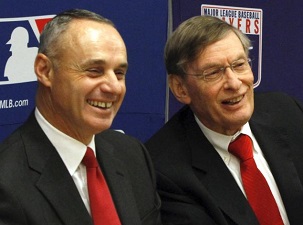 Selig made it obvious that his choice would be Rob Manfred, whom he promoted last Monday to chief operating officer. I say he made it obvious, but I offer a caveat with that view. Things are not always obvious with Selig.
Before Manfred, Bob DuPuy, who had been Selig’s lawyer in Milwaukee, was chief operating office and was viewed as Selig’s heir apparent. DuPuy, however, left that job three years ago, presumably because Selig told him that he would not support him to become commissioner. DuPuy denied it at the time, but it continues to be believed.
Nevertheless, Manfred will remain the leading candidate. His promotion from executive vice president for economics and league affairs effectively knocked two other high-ranking executives out of the running – Tim Brosnan, executive vice president for business, and Bob Bowman, chief executive officer of Major League Baseball Advanced Media.
Before the 55-year-old Manfred gets the job, though. it could change. One theory is already circulating in baseball circles.
That theory has Manfred, with no opposition, becoming commissioner but in a watered-down status. A council of perhaps four owners would make some decisions.
Selig said he wasn’t aware of any such plan.
“We haven’t talked about any procedure,” the commissioner said by telephone from Milwaukee Wednesday. “I haven’t thought about it. We’re in the transition phase. I’ve got 16 months. Why would we have to make those decisions now? I haven’t even thought about it.”
“The owners don’t want to talk about it. There’s a lot of time. There are no procedures. That’s a fact.”
A high-ranking club executive, with whom I spoke before I talked to Selig, would not have found the commissioner’s position questionable.
“There’s no way anyone can know that,” he said of the plan I mentioned to Selig. “That could be somebody’s idea. I don’t know what the owners are going to want to do. I’m sure they are going to want to have a say, but the process hasn’t begun. There are a lot of new owners and I don’t know what they’ll want.”
He had a good point about new owners. Only Reinsdorf (White Sox), Fred Wilpon (Mets) and Mike Ilitch (Tigers) owned their teams before Selig assumed command, Ilitch becoming the Detroit owner only 12 days before Vincent resigned.
The Steinbrenner family still owns the Yankees and the Pohlad family the Twins, but Hal Steinbrenner and Jim Pohlad are relative newcomers in the ownerships.
At the same time, Selig is all the newer owners know, and his indoctrination is all they know. Baseball has flourished in the Selig era, and newer owners are unlikely to challenge any ideas he may want to put in place for his successor.
“The odds are improving that he’ll retire,” the executive said, “but I’m sure Bud will stay around in some role.”
Another person suggested that Selig would be an eminence grise, which is defined as a powerful adviser. Selig most likely wouldn’t be paid $25 million for acting in that role, but what other sport has ever had an eminence grise?