Fans of the Pittsburgh Pirates, of whom I was one in my younger years, can look at their latest development in one of two ways. They can see the Pirates’ ascent over .500 as another tease, just like last year, or they can see it as a positive step forward in the team’s attempt to end its major league record streak of 19 successive losing seasons.
One-third through the season, the Pirates entered their game in Cincinnati Wednesday evening in second place in the National League Central with a 28-26 record, two games behind the Reds.
Their winning record and proximity to first place were reminiscent of their experience last season when on July 18 they beat the Reds, 2-0, and supplanted Milwaukee at the top of the division by half a game. A week later the Pirates led the division by one percentage point with a 53-47 record.
Then their fantasy ended. The Pirates lost 12 of their next 13 games and were not heard from again as they finished the season with a 72-90 record, 24 games from first in fourth place.
“This club had lost 204 games the previous two years,” said Clint Hurdle, who became the Pirates’ manager last season. “Last year we played well contested games. But we had some injuries and we used 52 players. We had young starting pitchers who had never faced that before. We had challenges you encounter when you’re building from the ground up.
“It was a great learning experience for us because we saw what we had to do to win.”
The Pirates have been winning this season in spite of an invisible offense in the first third. The team batting average, .223, was the National League’s lowest and next-to-lowest in the majors. The Pirates had scored the fewest runs in the majors.
“We have only one guy who we’re seeing our offensive expectations,” Hurdle said. He was talking about Andrew McCutchen, whose .333 batting average contrasted sharply with the averages of other players: Clint Barmes .191, Pedro Alvarez .194, Casey McGehee .204, Jose Tabata .220.
Alvarez is the Pirates’ major enigma. The second player selected in the 2008 draft, third baseman Alvarez marked the turning point in the Pirates’ operation. Getting nowhere under previous operators, a new ownership put together a front office regime that decided to spend money in signing drafted players and building a winner that way.
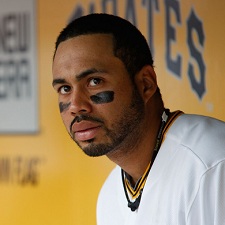 The irony in that decision was that to sign the higher draft choices the Pirates would most likely have to exceed the slotting bonuses recommended by the commissioner’s office, and the Pirates’ president and architect of the plan was Frank Coonelly. In his previous job as a labor lawyer in the commissioner’s office, Coonelly was one of the executives who set the slotting bonuses.
The initial part of the Coonelly plan worked. The Pirates signed Alvarez for what was then a signing bonus record $6.4 million. The second part, however, hasn’t worked so well.
Playing the final three and a half months for the Pirates in 2010, Alvarez showed great promise, slugging 16 home runs and driving in 64 runs in 95 games. That was the best the Pirates were to see of Alvarez. Last season the left-handed hitter batted .191
“Last year he had some early struggles,” Hurdle related by telephone Tuesday. “Then he had a couple injuries. It was a hard year for Pedro physically. The year before he was the talk of baseball. He caught everyone’s attention.”
That Alvarez, though, disappeared. An impostor took his place. “He is the one guy we have who’s a legitimate run producer and can shrink a ball park,” Hurdle said.
The manager said he tried changing Alvarez’s fortunes and his production by moving him up in the batting order “and it hasn’t worked out.”
What Hurdle hasn’t tried is feeding Alvarez whatever it was he gave A.J. Burnett when the woeful pitcher arrived from New York in a winter trade.
In the first three years of a four-year $82.5 million Yankees’ contract, Burnett had a 34-35. In his last year with the Yankees he won my own created award for the worst pitcher in the majors, the Sigh Young award.
But the Pirates couldn’t afford to be particular. They needed a pitcher, and they traded for Burnett, who has anchored a pitching staff that has a 3.26 earned run average, the majors’ third lowest.
Burnett and James McDonald, a third-year Pirates starter, have twin records of 5-2. The other three starters have losing records: Erik Bedard 3-6, Kevin Correia 2-5, Charlie Morton 2-6.
The Pirates, Hurdle said, are winning with pitching and defense. “We’re getting better,” he said. “We’re a work in progress.”
Can the work progress far enough this season to attain the Pirates’ first winning record since 1992? “We believe we can,” the manager said. “We can’t control external opinion. We have been close to doing things I think we’re capable of doing on offense.”
Some managers and baseball executives don’t like to talk about a .500 record being their goal. When a franchise hasn’t seen .500 for just about two decades, though, that percentage just might be an acceptable record on the way to better records.
“As we’re going to battle you,” Hurdle said, “our goal is to find a way to beat you. Five-hundred is a mile marker. One of the reasons I came here was to play a small part in bringing the Pirates back.”
With that goal in mind, Hurdle recalled the middle part of last season when Pirates fans woke up, looked at the sports section and saw the Pirates not just with a winning record but in first place, too.
“Last year for two months,” he said, “the city was an electric place to be.”