When is a search for a new baseball commissioner not a search? When baseball owners conduct one?
The long-time but retiring commissioner, Bud Selig, has named a seven-man committee to identify his successor, but its chairman, Bill DeWitt Jr. of the St. Louis Cardinals, said the committee does not plan to hire a search firm to aid in the search.
But wait. What the committee plans to do may not even qualify as a search.
A sharp-eyed lawyer with plenty of experience with baseball owners noticed the wording in the announcement after the owners’ meeting in New York last Thursday:
EXECUTIVE COUNCIL FORMS SUCCESSION COMMITTEE FOR NEXT COMMISSIONER
“It’s a succession committee,” the lawyer said, emphasizing “succession.” “There might not even be a search.”
The first sentence of the news release suggested that very idea:
“Baseball Commissioner Allan H. (Bud) Selig and the Major League Executive Council announced today the formation of a succession committee, whose work will include the selection process of the game’s next Commissioner.”
The committee, the release went on, will “act on behalf of the Executive Council in overseeing the succession process and collecting the input of all 30 Major League Clubs.”
There’s that word “succession” again. It’s not there by accident or coincidence. It’s there because Selig wanted it there, and he wanted it there for a reason.
Not only might there be no search, but the outcome might also have already been determined. That possible development was reported here more than three months ago, just before the start of spring training:
- Rob Manfred, baseball’s chief operating officer, would be the next commissioner, though in a different sort of structure in which Selig has functioned.
- Selig would not completely disappear but remain in the background as a senior adviser, or as one lawyer preferred, eminence grise.
- A committee of three or four owners would serve as an advisory board for the new commissioner, putting owners closer to the peak of power.
Not surprisingly, no one has acknowledged the existence of that succession plan, but then no one has denied it either.
A high-ranking club executive told me last week that while “everybody in baseball circles expects it’ll be Manfred,” he had heard that Manfred “wasn’t a slam-dunk.”
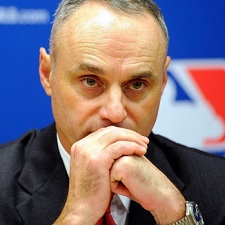 However, when I mentioned that to a well-connected businessman he reminded me that an owners’ vote on a new commissioner doesn’t have to be unanimous; three-fourths will suffice. In other words, seven owners can oppose Manfred, and he could still be elected commissioner.
Given their choice, the great majority of owners would most likely prefer to have Selig stay in office as long as he is breathing, even though he is on the verge of turning 80. What the owners don’t want is an outsider coming in and telling them what to do.
But if Selig is really retiring next January (don’t be so naïve, a little voice keeps whispering in my ear), the owners will take second best and right now that’s Manfred.
A lawyer with baseball’s Washington, D.C., labor law firm, the Harvard Law School graduate served as outside counsel during the 1994-95 strike and joined baseball full-time in 1998 as executive vice president for labor relations and human resources.
As the years went on, he worked more and more closely with Selig, who assigned him greater authority in the baseball office and last September named him chief operating officer. In that role, he is in position to duplicate Adam Silver, who was elevated from deputy commissioner to commissioner of the National Basketball Association when David Stern retired earlier this year.
Especially significant on Manfred’s resume:
- He has negotiated the last three collective bargaining agreements (2002-06-11) without a work stoppage, creating an unprecedented period of labor peace, of which Selig likes to boast because the other professional sports leagues can’t match it.
- He has negotiated, also with the players’ union, a succession of joint drug agreements that Selig also likes to tout as the strongest in team sports.
DeWitt, the succession committee chairman, said at the owners’ meeting that he will listen to Selig’s opinion. He didn’t say he will accept Selig’s opinion, but Selig’s opinion will carry a lot of weight with DeWitt (why else did Selig name him chairman?) as well as most of the other owners. Remember: Selig is to MLB owners what Stern was to NBA owners.
Would Selig recommend anyone but Manfred? Why would he? If the owners want to have an internal successor to Selig, Manfred is miles ahead of other prospective candidates. Even they would agree with that view.
Might the owners want to bring in someone from the outside? Why would they? They have done extraordinarily well under Selig’s leadership and ideas. Maybe if they could identify an owner among them who would be appealing, they could extend the owner-becomes-commissioner trick, but they would have no guarantee it would work a second time.
I’m not suggesting that Manfred is the only possible succession candidate, but I am saying he is the most logical candidate and the best one for what they need.
Furthermore, if they want to alter the structure of the office – with Selig as adviser and a council of owners – Manfred would work best there, too. That kind of job description would take a man whose ego would not be too big to handle it, and Manfred seems a good fit in that regard as well.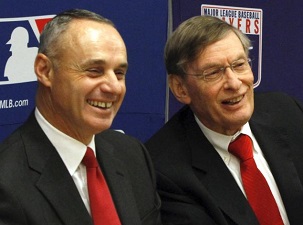
A tripartite type of commissioner’s office has never been tried, and it could become unwieldy so there would have to be a clear understanding of how it would work. MLB couldn’t have a former commissioner or a four-owner council overruling or undermining the commissioner. If that were to happen even once, the commissioner would have to vacate his office, and how bad would that be for baseball?
There’s one possible bit of irony in the Manfred mandate. As I noted in one of the aspects of Manfred’s resume, one of his strengths is in his relationship with the union, given the series of labor and drug agreements.
Manfred indeed has a good relationship with the union, but it was Fay Vincent’s effort to build a good relationship with the union that annoyed and angered some owners and helped fuel their opposition to Vincent’s continued stay in office.
During the post-season, for example, Vincent, who had trouble with his legs stemming from a college mishap, would sit in a golf cart on the field and talk to players. Noticing this practice, one owner told him it wasn’t his job to talk to players. Owners also found Vincent too friendly with players during labor negotiations leading up to and during the 1990 lockout.
Vincent’s growing relationship with the players, in fact, so concerned the owners that the more militant owners, Milwaukee’s Selig among them, decided they had to get him out of the office because they were certain he would interfere with their efforts to break the union in the 1994 negotiations.
They succeeded in ousting Vincent – he resigned under pressure – and the Selig-led owners succeeded in killing the 1994 World Series.
Selig subsequently saw the light, though, and now boasts of the game’s unparalleled peace.
TO JUMP OR NOT JUMP
After Fay Vincent resigned as commissioner in September 1992, the owners formed a search committee to find a new commissioner. While the committee interviewed candidate after candidate, Bud Selig was – take your choice – interim or acting commissioner, both titles of which he denied. He was, he said, only the chairman of the executive council, which in the absence of a commissioner runs baseball.
There were actually two searches, and both, in the opinion of some observers, including this one, turned out to be shams.
Bill Bartholomay, chairman of the first committee, denied that last Saturday in a brief telephone interview. He denied, too, another reported aspect of his search.
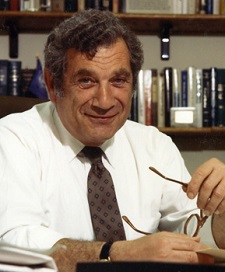 When that search was suspended in January 1994, one of the leading candidates was Arnold Weber, then the retiring president of Northwestern University. When Bartholomay called Weber to tell him the news of the suspended search, Weber supposedly told Bartholomay to go jump in the lake (Michigan).
I have never verified that remark and tried to the past week. I reached a spokesman for the 84-year-old Weber who asked him if he would talk to me about that search experience. “Mr. Weber said he’d prefer not to comment on this,” Alan Cubbage said in an e-mail.
I also asked Bartholomay, who is chairman emeritus of the Atlanta Braves, if Weber had told him to jump in the lake.
“No, no, no, he didn’t,” Bartholomay said, almost laughing.
Throughout that whole time, Selig was chairman of the executive council and denying that he wanted to be commissioner. George W. Bush, managing partner of the Texas Rangers, on the other hand, wanted to be and let Selig know.
Bush let Selig know more than once. Selig has denied knowing of Bush’s desire and availability, but too many people who know Bush and knew of his waiting for word from Selig have talked about it for it not to be so.
Finally, Bush could wait no longer. The Texas Republican Party wanted Bush to run for governor and needed to know if he would. Bush never heard from Selig, ran for governor and the rest is history. That’s why I credit or blame Selig for making Bush president of the United States.
Two terms later, Bush is available again to be commissioner. I heard last week that Bush’s health supposedly isn’t good enough for him to consider offering again to take that role, but Freddy Ford of Bush’s office sent me an email saying the former president is “consistently ranked in the superior fitness category during his physical examination each year.” Ford added that Bush “is not interested in the commissioner position.”
RUSH TO JUDGE, SLOW TO APOLOGIZE
This last item is about lacrosse. Well, it’s only incidentally about lacrosse. I don’t intend to make a habit of it.
 In last Saturday’s paper, The New York Times ran an article about a lacrosse coach, Mike Pressler of Bryant University in Smithfield, R.I., who has rebounded from a career-killing incident in 2006 when he was the lacrosse coach at Duke University.
A stripper who had been hired to perform at a team party accused three of Pressler’s players of raping her. In a classic case of rushing to judgment, the Times executed the most unfair coverage of any major news story I saw in my 39 years at the Times. Other publications followed the Times’ lead, but none exceeded the Times’ blatant aggressiveness.
The Times’ coverage, spearheaded by sports editor Tom Jolly, columnist Selena Roberts and reporter Duff Wilson, destroyed Pressler’s career. Despite the fact that the players were cleared of all charges and the case dismissed, Duke fired Pressler, ending his 16-year tenure there.
The problem with last week’s Times piece was it didn’t acknowledge its role in the journalistic rush to judgment on the Duke players. An article in the American Journalism Review in August 2007 quoted Daniel Okrent, a former Times public editor:
“The one thing I’m quite certain I didn’t see was an apology, which is certainly not one of the acts that the American media are particularly good at. It’s a matter of media organizations owning up to their responsibility, and when they do something wrong, they should acknowledge that they do something wrong.”
“Okrent,” the article continued, “envisions a mea culpa – an editor’s note, a front-page article, perhaps an ‘appearance on a platform in Times Square’ – that would say, candidly: ‘We blew it. We’re sorry. We accept responsibility for having blown it.'”
The Times, to my knowledge, has never done that, and it certainly didn’t mention itself in its article about the resurrection of Mike Pressler.