As umpires go, Al Clark was a nice guy, a friendly guy, who went out of his way to talk to writers, not avoid them, as most umpires do. It’s not that umpires dislike writers, but the only time they wanted to talk to umpires was when they have blown a call.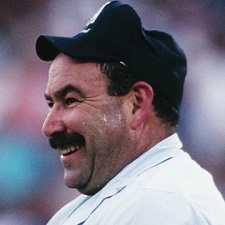
Clark’s different demeanor was understandable. His father was a baseball writer himself, a newspaperman in Trenton, N. J., and Herb Clark was a nice guy, too. So Al had a good beginning. The ending was something else. Where did he go wrong? He didn’t lose his job after 26 years and spend four months in prison for nothing.
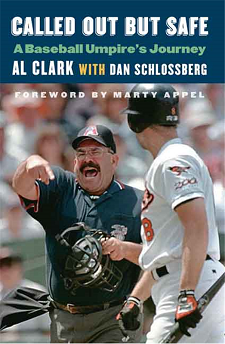
We find out in Clark’s new book, “Called Out But Safe, a Baseball Umpire’s Journey,” written with Dan Schlossberg, a New Jersey freelance writer, and published by University of Nebraska Press.
Clark lost his job and went to prison for different incidents, though it’s possible that he might have been more careful to avoid the second incident if he hadn’t experienced the first.
Now 66 and a retired resident of Williamsburg, Va., Clark was fired in 2001 and served his prison sentence in 2004 at a federal institution in Petersburg, Va.
“I never spent a night in a cell,” Clark said in a telephone interview Wednesday, seemingly proud of that fact (he was housed in a dormitory-type facility.). In the book, he writes, “There was no way in hell I should ever have spent a minute in the Big House.”
With those statements, Clark seems to be making light of his missteps. In another way, though, he acknowledges the mistakes he made with those missteps.
I got the impression from Clark’s book and our telephone conversation that he might be making light of his time in prison. I thought about that possibility when he referred on the phone to his incarceration rather than his time in jail or in prison. Incarceration is not a word that is commonly used.
His use of it in that instance reminded me that he had used it often in the book. I decided to check it compared with his use of jail and prison. The scorecard: jail 13 times, prison 20 times, incarcerate / incarceration: 33 times. I asked Clark why he preferred the last.
“I don’t know if it was deliberate or not,” he said. “I think the word incarcerated is more meaningful than being in jail or prison. In my thinking it’s more severe, means having your freedom taken away.”
Clark was sentenced to four months after pleading guilty to one count of mail fraud.
“I was accused of authenticating balls from David Wells’ 1998 perfect game at Yankee Stadium,” Clark writes. “I did not officiate at that game and did not sign any letters of authentication from it.”
What Clark admits to doing, however:
“My problems started when I signed some letters authenticating balls supposedly used in Nolan Ryan’s three-hundredth win, a game in which I was the home-plate umpire. I may have given him four or five baseballs but probably signed fifteen letters. I just didn’t think it was that big a deal. It wasn’t illegal to do that but it was morally wrong.”
Clark signed the letters for Richard Graessle, whom he described in the interview as “a friend of a friend,” saying “I knew I was doing something immoral and I didn’t like it. But he seemed like a good guy. I had no idea the depth of what he was doing or the amount of money he was earning. He had earned over $400,000.”
 Not only was Clark immoral, but he was also guilty of mail fraud because, he admits, he signed some of the letters of authentication at his Virginia home and mailed them. That constituted mail fraud.
I asked Clark what his father’s reaction was. Herb Clark died a few years after that episode.
“What were you thinking?” Al Clark said his father asked him.
“I knew it was morally wrong,” Al told me. “I accept full responsibility for it. No one forced me to do it. No excuses. I was dead wrong. I paid a big price for being dead wrong.”
Given his four-month dormitory life, Clark may have paid a steeper price for doing what he did that got him fired. With a day off between assignments in Atlanta and Boston, he was planning to fly with his wife to their home in Florida. He had downgraded his first-class Atlanta-to-Boston plane ticket to economy fare, which he said he was permitted to do.
But, he said, the game in Atlanta went extra innings, and he missed the flight to West Palm Beach. He had only his MLB-supplied credit card with him and used it to buy first-class seats on the only flight available.
“I used that to upgrade us both,” Clark said. “What I didn’t do was call the league office the next day and tell them what I did and send them a check. But I didn’t. I forgot. They could’ve fined me or suspended me.”
Some disciplinary action short of dismissal would probably have been more appropriate, but Clark was fired. Sandy Alderson was the major league executive in charge of umpires at the time, and he seemed to be ready to do anything he could to gain greater control over the umpires.
“Here I was a 26-year guy they could make an example of,” Clark commented. “They could put the umpires back in line.”
Clark currently serves as a motivational speaker. “I help people who get tangled in the legal system when they never expected they would. Tell them who to trust, who not to trust. When someone goes away for a while, it affects families.
“Who better to talk about being successful than someone who was at the top of his profession for 26 years? Who better to talk about making decisions than someone who has made good decisions and bad decisions?”
Better, though, to hear from someone who understands that signing phony letters authenticating memorabilia is not only immoral but also illegal.