It was so long ago that it could be considered ancient history, but the scene remains vividly imbedded in my mind, as clearly as if it happened yesterday.
As several of the reporters on the Yankees’ trip to Texas gathered for lunch on this hot July Saturday afternoon, they saw a Yankees outfielder, Johnny Callison, walking toward the manager’s bungalow at the sprawling hotel in Arlington, Tex.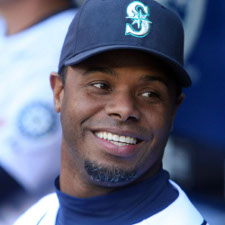
Having been summoned there with no idea why, Callison knocked on the door, waited for Ralph Houk to open it and, stepped inside. Minutes later Callison emerged, a shocked look on his face. He had been released.
How could this be? How could this have happened? Released? He was 34 years old, much too young to be released.
Twenty-four hours later Callison still seemed to be in shock – and denial. Rather than leave the team immediately, as other players would have done, he was still at the hotel, maybe hoping that it had all been a mistake and the Yankees would change their mind and tell him to continue his career.
It didn’t happen. The Yankees left Texas and didn’t take Callison with therm. His career was over.
Players are often the last to know that their careers have reached the end. Callison couldn’t believe that his had.
The question I raise in this regard has to do with Ken Griffey Jr. Has he reached the end of his 22-year career without knowing it? Or has he considered ending the career that he began at the age of 19? “He has no immediate plans,” Griffey’s agent, Brian Goldberg, said, “but he certainly is aware of the situation.”
The question about Junior’s immediate future is not prompted by the report that he was asleep in the Mariners’ clubhouse during a recent game and unavailable to pinch hit. It is prompted by the numbers next to his name – 16 hits, 80 at-bats, .200 average, 0 home runs, 6 runs batted in.
“It takes some guys longer to get started,” general manager Jack Zduriencik said. “You have to give him time to get started.”
Zduriencik was being diplomatic and also kind. What could he say, that Griffey was washed up and should retire? Zduriencik, remember, signed the 40-year-old Griffey to a contract with a $2.35 million salary and loads of bonuses after a season in which he hit .214 with 19 homers and 57 r.b.i. in 117 games and 387 at-bats.
“We brought Griffey back and that’s big.” Zduriencik said during the winter, discussing the Mariners’ prospects. “He had a big influence in the clubhouse last year and in the second half of the season he swung a big bat.”
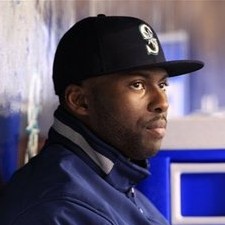 The Mariners especially looked for Griffey to exert a stabilizing influence on the incendiary Milton Bradley, whom they acquired from the Cubs with two years left on a $30 million contract. But earlier this month Bradley wound up on the restricted list with his .214 batting average.
Griffey remains active, but his troubles are reflected in his recent use by manager Don Wakamatsu. In the latter half of last week the Mariners faced three consecutive right-handed starters, and the left-hand hitting Griffey did not start any of those games.
Griffey initially wouldn’t talk about himself, but before the Mariners’ game at Tampa Bay Friday night he talked to Jim Street of mlb.com and told him he is not contemplating retirement.
“I haven’t gotten to that point,” he said. “What would it take? I don’t know. I haven’t thought about anything but coming here and getting ready for a game.”
“If I didn’t feel that I could compete, then why would I show up?” he continued. “Why would I take early batting practice? Why would I take batting practice, period? That’s just the way it is.”
“I’m not there yet,” he said, meaning retirement. “I will figure that out when I get there, but I’m not there. I’m just trying to do the things I have always done, stay in the same routine, take early batting practice when it’s available.
“I am still part of this team, so I have to prepare myself day in and day out. That’s it. There is a lot of baseball left, and a lot of things can happen. But right now, I don’t worry about anything but today. Tomorrow I will worry about tomorrow.”
Nevertheless, a person who knows Griffey well said he is well aware of his status and indicated he will know when it is time to retire, whether it’s today, tomorrow, next week, next month. It seemed certain the time will be sooner rather than later.
When it does come, it will be a bittersweet time. For one who saw Griffey in the Yankees’ clubhouse at Yankee Stadium when his father played there (1982-86) and then saw the always-smiling 19-year-old major league rookie in 1989, I find it unbelievable that he is 40 and on the verge of retirement.
He will retire as one of the greatest home run hitters of all time, one who was never tarnished by the suggestion of steroids use. His total of 630 is fifth, behind Barry Bonds’ steroids-stained 762 and 755 for Henry Aaron, Babe Ruth’s 714 and 660 for Willie Mays.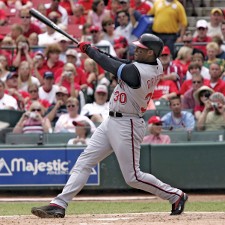
Before Griffey encountered a series of disabling injuries earlier in the past decade, he was given a serious chance to surpass Ruth before Bonds did. Many, including me, also considered him, and not Bonds, baseball’s best player.
Now, unfortunately, he will retire on the heels of a story that taints him. Last week a long-time Mariners beat writer, Larry LaRue of the Tacoma News Tribune, quoted two players as saying that Griffey was sleeping in the clubhouse during a game and was not available to pinch hit. The story created a firestorm in Seattle.
Griffey and his manager said it wasn’t true. Mariners players held a team meeting to support Griffey, and at least some stopped talking to LaRue. Meanwhile, a series of stories popped up about the “sleeping in Seattle” story:
- The reporter didn’t intend to send the story to his newspaper because he was still working on it but inadvertently hit the “send” key.
- The reporter wanted to write a subsequent story to explain the first one, but his editors vetoed that idea.
- The “players” he quoted weren’t players at all but perhaps others in the clubhouse.
I sought reaction from LaRue, but he did not respond to e-mail messages.
DRAFT HIM TWICE, TRADE HIM ONCE
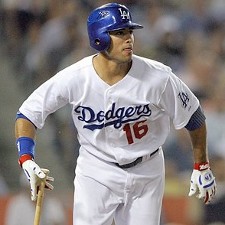 The Oakland Athletics really liked Andre Ethier. They drafted him out of high school in the 37th round in 2001 (he didn’t sign), and they drafted him out of college (Arizona State) in the second round in 2003 (he signed). And then on Dec, 13, 2005, they traded him to the Los Angeles Dodgers. They traded him for Milton Bradley.
“We thought we had a chance to go to the ALCS and we felt Milton could help us get there” explained Billy Beane, the Athletics general manager. Then speaking of Ethier, he added, “No question he was going to be a good player, but in 2006 we thought we had a chance to get to the ALCS.”
The Athletics won the American League West title that year and went to the A.L. championship series after sweeping Minnesota in the division series. However, Bradley wasn’t instrumental in their success.
He batted .276 in 96 regular-season games, serving significant time on the disabled list, a total of 10 weeks with knee and shoulder injuries in the first half of the season. He didn’t help the Athletics win the division series either, batting .077 (1 for 13).
Bradley, however, came to life in the ALCS, batting .500 (9 for 18) with two of the team’s four home runs and five of its nine runs batted in. Bradley’s production wasn’t enough to avert a four-game sweep by the Tigers.
While Bradley has played with four more teams in four subsequent seasons, Ethier has been an up-and-coming force with the Dodgers. Entering the weekend, the right fielder was leading the National League in the triple crown categories of batting average (.392), home runs (11) and runs batted in (38) as well as total bases (93), hits (49), slugging (.744) and total of slugging and on-base percentages (1.207).
Ethier, however, has had his dominance of National League pitchers interrupted. He broke the little finger on his right hand swinging a bat before Saturday night’s game and will miss a not immediately determined amount of time.
Beane, meanwhile, has felt Ethier’s absence but has resigned himself to the reality of the game.
“We got to the ALCS for the first time in some years and that was the attraction,” Beane said of the trade. “Unfortunately it’s part of the game. If you have never traded a guy who went on to become a good player you probably don’t belong in the game. Do I regret trading him? Yeah. Do I regret going to the ALCS? Not at all.”
STEINBRENNER VERSION OF NEW MATH
Newly told George Steinbrenner stories are always fun to find, and a whole new batch can be found in the latest Steinbrenner biography, “Steinbrenner, the Last Lion of Baseball” by Bill Madden, the long-time New York Daily News baseball writer.
Here’s one courtesy of Al Rosen, the Yankees’ former president.
It was September, 1978, and the Yankees and the Red Sox were on a collision course in their scrap for the American League East championship. Rosen was summoned to the Park Avenue office of Lee MacPhail, the A.L. president, to participate in a coin flip to determine the home team for a possible playoff game.
MacPhail flipped a half dollar into the air, Madden writes, and Rosen called heads. It landed tails.
“All the way back to his office,” Madden writes, “Rosen dreaded having to make the call to Steinbrenner about this unhappy turn of events. Though he fully anticipated a scathing rebuke, he was not prepared for the owner’s incredulous reaction.”
The ensuing dialogue went this way, according to Madden:
“I’m sorry to tell you, George, but we lost the coin flip.”
“You lost? How could you lose? What did you call?”
“I called heads. Why?”
“Heads? You %$#@^&* imbecile. How in the hell could you call heads when any dummy knows tails comes up 70 percent of the time? I can’t believe it! I’ve got the dumbest %$#@^&* people in baseball working for me!”
After hanging up, Madden writes, Rosen “shook his head in disbelief. “’Is he crazy?’” he thought. “’Did he just say what I thought he said? Is there anybody so irrational?’”