The Baltimore Orioles are American League East champions for the first time since 1997, and that’s not all they have accomplished under Dan Duquette, their chief baseball executive.
In his three years in that position – don’t dare call him general manager because the team’s principal owner, Peter Angelos detests that title and becomes irate if anyone uses it in relation to the Orioles but more about that later – Duquette has headed the once glorious but fallen Orioles back toward their many years of glory.
The Orioles have attained winning records in each of Duquette’s three seasons. The franchise had gone through eight – excuse the expression – general managers since the last time it had three full seasons with more wins than losses. The Orioles didn’t even achieve a three-year winning streak in the three-year term of Hall of Famer Pat Gillick.
Angelos, who won the Orioles in a 1993 bankruptcy auction, has gone through nine general manager types, one before Gillick and six more between Gillick and Duquette.
The last general manager to oversee three consecutive winning 162-game seasons was Hank Peters, who attained that distinction in the first half of the ‘80s. Roland Hemond, Gillick, Frank Wren, Syd Thrift, Jim Beattie, Mike Flanagan, Jim Duquette (Dan’s cousin) and Andy MacPhail had their chances and failed.
Dan Duquette, known in baseball circles as Duke, has achieved another Angelos-era distinction – peaceful co-existence with the owner. For example, even though the Orioles won a division title under Gillick in 1997, he left after he completed his contract a year later, having had his fill of Angelos interference.
MacPhail served as president of baseball operations with an advantage over his predecessors, Having held a similar position with the Chicago Cubs, MacPhail had served with Angelos on management’s labor committee for the 2006 collective bargaining agreement negotiations.
As friendly as their relationship might have become, MacPhail left the Orioles after the 2011 season when his contract expired. A month later Duquette was hired, ending his involuntary 11-year hiatus from Major League Baseball.
“From ‘66 to ‘83 the Orioles were the winningest organization in the majors,” Duquette said, responding to my comment about the Orioles once having the best organization. “We’ve been able to reclaim our place with the old Orioles teams. The resilience of the players and their attitude to do what it takes to win games are responsible.”
 So are manager Buck Showalter and Duquette.
“We figured you need 92 wins to make the playoffs; we were fortunate to accomplish that,” Duquette said last week after the Orioles eliminated the Yankees and the Blue Jays, then proceeded to gain victory No. 92 and raise their total to 93 at week’s end. One more victory will top the Orioles’ total of 93 wins in Duquette’s first year.
Not that Duquette felt he had to prove anything to anybody or that he would admit if he did, his success with the Orioles has to be seriously rewarding, given the treatment he received in his 11 years out of the majors. The only professional baseball job he had in that time was as player development director of the fledging Israel Baseball League, which lasted a single year.
Before his extended vacation while he was in his 40s, Duquette was an accomplished general manager with Montreal and Boston. In his three years with the Expos, they had a .584 winning percentage, which translates to 94 victories in a season.
When the John Henry-led ownership dismissed him in late 2001, he left the Red Sox with a well-stocked team that had won three division titles and would win the 2004 World Series.
With three World Series titles in the last decade, the Red Sox can’t be faulted for firing Duquette, but where were other teams looking when they sought new general managers? If Duquette harbors any ill feeling about being shunned for more than a decade, he keeps them to himself and lets the Orioles’ success speak for him.
“People said we didn’t have enough pitching, but it’s the best since 1979,” Duquette said. “Our starting pitching has been doing well since June 1.”
Elias Sports Bureau found that Duquette knew his stuff:
- Pre-June 1 Starting Pitchers: 18-20, 4.49 e.r.a. Team: 27-27, 3rd place, 4 ½ games behind
- Post-June 1 Starting Pitchers: 47-21, 3.15 e.r.a. Team: 66-34, 1st place, 14 games ahead
For the season, the starters have these records (through Saturday):
- Wei-Yin Chen 16-4 3.58 era
- Bud Norris 14-8 3.62 era
- Chris Tillman 13-5 3.26 era
- Miguel Gonzalez 9-8 3.28 era
- Kevin Gausman 7-7 3.57 era
The Orioles have more than pitching.
“We’ve played pretty good defense the last few years,” Duquette said. This season, he added, “We had some players step up and do good things for the team when they had the opportunity.”
Players have had opportunities because the Orioles have had three starting players suffer serious setbacks. Catcher Matt Wieters went out May 11 with an elbow injury that required a ligament transplant, third baseman Manny Machado has been on the disabled list three times and Chris Davis, first baseman, one of the team’s premier sluggers, was suspended Sept. 12 for use of a banned substance, forcing him to miss the last 17 games of the season and the first eight games of the playoffs.
The primary replacements have been Steve Pearce at first base for Davis and Caleb Joseph, promoted from the minors, and Nick Hundley, acquired from San Diego, for Wieters.
Nelson Cruz wasn’t a replacement this season but a Duquette addition and what an addition he has been. 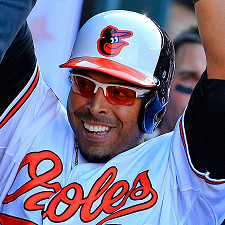 The Orioles signed Cruz, as a free agent at the start of spring training when other clubs were reluctant to offer an expensive contract to a player who was suspended for the last 50 games of last season for a performance-enhancing drug violation.
The Texas Rangers, for whom Cruz had played for six and a half years, made a $14.1 million qualifying offer to him, but he rejected it, most likely thinking he could get a multi-year contract. But it wasn’t offered, and he signed a one-year contract with the Orioles Feb. 22 for $8 million.
Cruz, who turned 34 in July, has proved he didn’t need steroids to hit home runs and drive in runs. He has rewarded Duquette’s willingness to gamble millions by slugging a league-leading 39 home runs and driving in a second-best 105 runs.
Cruz has teamed with Adam Jones (27 homers and 91 r.b.i.) and Davis (26, 72) in giving the Orioles a potent trio of sluggers even though Davis’ strikeout total (173) was almost as high as his batting average (.196). Only three strikeouts behind the Angels’ Mike Trout, Davis would have the strikeout title clinched were it not for his suspension.)
Jones, meanwhile, has added an intangible element to his contribution to the Orioles’ march to the World Series.
“Jones has taken a leadership role,” Duquette said of the 29-year-old center fielder.
As good, though, as Jones and Cruz and some of the other Orioles have been in returning the Orioles to championship status, Duquette’s current collection has some considerable playing distance to travel before moving into the territory populated by the Robinsons, Frank and Brooks; Boog Powell, Mark Belanger, Paul Blair, Jim Palmer, Dave McNally, Mike Cuellar and others.
Those guys could always be counted on to guarantee an annual October visit to the Herb Armstrong room at Baltimore’s Memorial Stadium for pre-postseason game desserts.
MARRIED TO GEORGIA, LIKENED TO GEORGE
I’m certain Georgia Angelos could provide a more comprehensive list of things her husband, Peter, the principal owner of the Baltimore Orioles, doesn’t like, but I offer here the start of a list. If Mrs. Angelos would care to add to it, I would be happy to do just that.
I’ll start with the simplest. Angelos has never liked being likened to George Steinbrenner. Now that the late owner of the New York Yankees is no longer with us, I’m sure Angelos would like it even less.
But when Steinbrenner was chipper and running the Yankees and I or anyone made the comparison, which was so obvious it couldn’t be ignored, Angelos would bristle or do worse.
 One way in which they were not alike was their view of the title general manager. Angelos didn’t like it, hated it, in fact. Steinbrenner had no problem with it. How could he? He was always talking about “firing my general manager.”
I don’t recall Angelos explaining his disdain for the title. It’s possible that he merely felt it was outmoded, but his reaction was too strong when anyone used the term for the explanation to be that simple.
I recall once when he was looking for a new … and the reporter used the term, he became outraged. At least he doesn’t have to look for one now. He should be pleased that he has a good one and resolve to keep Dan Duquette for a long time.
One final thing I know Angelos doesn’t like. He doesn’t like his general managers, or whatever they are, signing players without having them take comprehensive physicals. It is routine now for players to have to pass physicals before signings are official.
Angelos once fired a general manager for not making sure a pitcher was free of injury before signing him. The Orioles’ doctor said the pitcher had a shoulder problem, and Angelos cancelled the contract and fired the general manager.
In that instance, Angelos was saluted by his colleagues for taking responsible action.