There is no doubt in my mind or most likely in anyone else’s, even Brian Cashman’s, that if George Steinbrenner were alive and running the Yankees, he would have fired Cashman by now. And if not by now, tomorrow.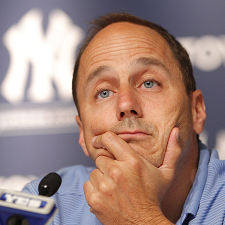
Cashman has benefited more from Steinbrenner’s demise than anyone else I can think of. I’m sure he knows it, too, though he declined, by his failure to return telephone calls, to discuss it.
“Let me check for you,” the general manager’s secretary said when I called Monday, then came back a minute later and said, “I’m sorry, Mr. Chass, I couldn’t locate him.”
The first thing a secretary learns is to lie for her boss. Cashman would rather have his secretary lie than get on the phone and have to talk to me.
The next day I called again. “No, he’s not here,” the secretary said. “He’s due in an hour, hour and a half. I’ll give him the message.”
The message was not answered.
I am not advocating Cashman’s dismissal because he wouldn’t talk to me. I had made up my mind before he wouldn’t talk to me. I am advocating his involuntary departure because I think he has had many years to demonstrate his ability as a general manager and hasn’t.
I don’t think I have advocated anyone’s dismissal since a college football coach many years ago when I was a college junior, and I felt bad about it afterward. I don’t feel bad about advocating Cashman’s dismissal because he has had his chances and has made millions while squandering many more.
For his entire 17-year career as the Yankees’ general manager Cashman has played on a different field from other general managers. That he didn’t screw up until the last two years is a tribute not to his talent but to his good fortune.
Money, as Cashman has proved, doesn’t guarantee post-season games, let alone World Series championships, but it gives the general manager who has it to spend a greater chance of winning than his counterparts who don’t have $200 million payrolls.
In the last 10 years, Cashman’s payrolls, nine of which have exceeded $200 million, have totaled $2.139 billion. In those years the payrolls closest to his have totaled $1.648 billion, 30 percent below Cashman’s expenditure.
The Yankees won one World Series in that period. They didn’t reach the playoffs last season and are on the brink of exiting the race for this year’s playoffs.
Cashman has not built teams in the sense that the Oakland Athletics have built teams and the Tampa Bay Rays have built teams and the Kansas City Royals have built their 2014 team and the Pittsburgh Pirates have built their teams.
Name a team that Cashman has built. The 2009 World Series championship team? 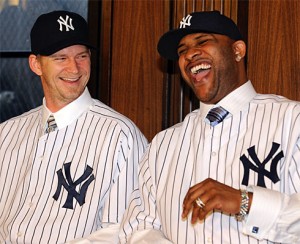 This is how Cashman built that team: In a two-week period in December 2008, he paid $423.5 million for three free agents – CC Sabathia, Mark Teixeira and A. J. Burnett.
Cashman’s construction was bathed in gold. It worked so well that year that after the Yankees failed to reach the post-season last October he tried it again. He signed Masahiro Tanaka, Jacoby Ellsbury, Brian McCann and Carlos Beltran for $438 million. This time, however, it was fool’s gold that he spent.
The Yankees have already been eliminated from the division race and are on the brink of wild-card elimination.
Cashman has had no choice but to spend millions for players. He hasn’t had the luxury of plucking prospects from a flourishing farm system because he has never built a flourishing farm system.
If anyone disagrees with that statement, show me a productive farm system that Cashman has built. The Yankees haven’t had a productive farm system since the one that produced Derek Jeter, Mariano Rivera, Andy Pettitte, Bernie Williams and Jorge Posada, and Cashman was a baby in the system at that time.
Cashman’s idea of a farm system has been to put money in the pockets of free agents and sit back and watch pennants sprout. When some of those players incur injuries and move from Yankee Stadium to the disabled list, the Yankees have no minor leaguers to replace them but instead have to scour the scrap heap of unproductive players.
The Yankees’ rash of injuries this season serves as a case in point. Needing players just to be able to field a player at each position, the Yankees added infielders Martin Prado, Chase Headley and Stephen Drew plus starting pitchers Brandon McCarthy and Chris Capuano.
When one of those players actually does something – note Chris Young’s recent spurt of home runs, for example – Yankees’ announcers and fans become ecstatic.
Mark Newman, the Yankees’ senior vice president for baseball operations, is probably 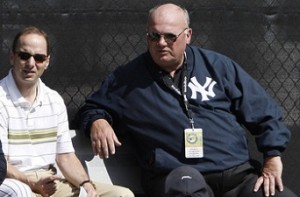 more guilty than Cashman for the farm system’s failure – he was head of player development and scouting 1997-99 before assuming his present position, in which he has had over-all responsibility for development and scouring. But Cashman is guilty for not having shed Newman years ago.
The 65-year-old Newman, who said last week he will retire at the end of the year, has had a charmed but questionable career with the Yankees. He has his supporters, but critics are more plentiful.
Under Newman, the Yankees have squandered high-round draft choices and have developed no position players who have been major league worthy.
For years the organization suffered from internal civil strife between the New York and Tampa offices, each fighting for its position of strength. When Cashman was negotiating a new contract in 2005, he threatened to leave if he wasn’t given complete authority over the baseball operation.
Steinbrenner gave it to him, but he never really used it, allowing Newman to continue doing what he had always done, hiring old friends to staff the scouting and minor league systems and making draft decisions.
Cashman supporters absolve him of blame for the organizational problems, but he’s the No. 1 executive in baseball operations and he has to receive the bulk of the blame for the team’s failures.
“He was in charge of everything on paper, but it didn’t work out’,” a baseball executive said. “Whether he wasn’t aggressive enough or didn’t exercise his authority, things didn’t work.”
The executive called the Yankees’ farm system “a disaster” and cited one example of the questionable judgment of Newman’s minor league staff.
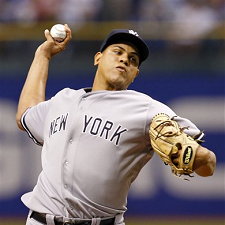 “They wanted to get rid of Betances,” he said, referring to reliever Dellin Betances, a 26-year-old right-hander, who is having a spectacular rookie season after eight years in the minors. He has a 5-0 record, a 1.35 earned run average, a .143 opponents’ batting average and 130 strikeouts in 86 2/3 innings, an average of 1.5 per inning.
Betances has provided one of the few highlights of the Yankees’ season, and they wanted to get rid of him?
A recent newspaper report said Cashman had agreed to a contract extension, but a baseball official familiar with the Yankees’ operation said that report was not true.
“There’s been no discussion,” he said. “There never is until the end of the season.”
That means there’s still time for the Yankees to decide to have a new general manager for the first time in this century.