Like Nick Adenhart was, Andrew Gallo is 22 years old. Adenhart will never turn 23. Gallo will, most likely in prison. If he is convicted of all counts against him, he could celebrate his next 55 birthdays in prison. His time there will be well deserved.
Adenhart was not supposed to be at that fatal intersection in Fullerton, Calif., that night, riding with friends in the Mitsubishi that belonged to one of them. Adenhart was not supposed to be in the Angels’ starting rotation, but injuries put him there, and that’s why he was at that intersection when a minivan, driven by Gallo, who was later charged with drunk driving, ran a red light and broadsided the Mitsubishi, police said.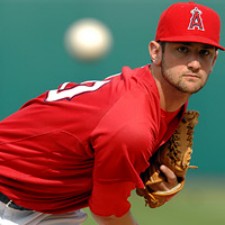
The 22-year-old Adenhart started the Angels’ third game of the season because John Lackey, Kelvim Escobar and Ervin Santana were on the disabled list. When they are healthy, they are the first three starters in the rotation, but the Angels had to summon replacements because Lackey had tightness in his forearm, Escobar had inflammation in his surgically repaired shoulder and Santana had a strained elbow.
No pitcher in a team’s minor league organization could ask for a better opportunity, and Adenhart took advantage of his, pitching six shutout innings against Oakland, though the bullpen squandered his 3-0 lead and handed the Athletics a 6-4 victory.
After the game, Adenhart spoke with his father, Jim, a retired Secret Service agent, who had flown to Anaheim from Baltimore for the game. Then the youngster went out with friends. Barely beyond his teenage years but with a bright baseball future ahead, Adenhart never got back to the hotel where he was staying with his father.
The accident occurred at about 12:30 a.m., not a late hour for baseball players who have played a night game. Police said the driver of the minivan had a suspended license as the result of a previous drunk driving conviction. They said preliminary results indicated the driver’s blood alcohol level was nearly three times the legal limit of .08 percent. He was charged with three counts of murder and one of drunk driving.
Adenhart, who started three games last May for the Angels, was not their first rotation replacement this season; Dustin Moseley was. But these things don’t always turn out the way they start.
Lackey, Escobar and Santana are not expected back until late this month or early next month. That was time for a lot of starts for Adenhart to show he belonged, though when all of the starters are healthy there’s no room in the rotation for replacements.
Deaths of sports figures are always magnified, as if their status makes their demise more tragic. But any parent whose 22-year-old child is killed in a traffic accident would feel the same way as Adenhart’s parents. All children are special to their parents.
All alcohol-related accidents are especially disgusting. Laws are never enough to deter them. People out for a night of drinking don’t usually think about the potential consequences of an alcohol-influenced mishap. It’s not going to happen to them but too often does. It’s what happens to their victims, though, that creates the tragedy.
Baseball fusses and frets about performance-enhancing drugs. Steroids zealots shake their heads and wag their fingers at Major League Baseball for not doing enough to get steroids out of baseball. There is no evidence, however, that steroids have ever killed a major league player. Alcohol has.
If the reaction to an athlete’s death is greater than to the death of a mere civilian, it is because the athlete is known by more people and therefore mourned by more. But just as his team and his sport suffer when a promising 22-year-old pitcher is killed, if a promising 22-year-old teacher is killed, her school and her profession suffer.
I note that reality not to render Adenhart’s death any less tragic but to add perspective to it. Athlete, teacher, lawyer or doctor, talent aborted is talent lost. The young right-hander had a special talent, and it’s unfortunate that he will never have the chance to show it.
ZITO PICKS RIGHT UP
With orders from a new managing partner to improve the team that last year staggered through the season with a 72-90 record, one of the worst records in the league, the San Francisco Giants bolstered their pitching staff by signing Randy Johnson for their starting rotation and Jeremy Affeldt and Bob Howry for the relief corps.
 They also gave Edgar Renteria a surprisingly sizeable contract, $18.5 million for two years, to play shortstop and stabilize the otherwise young infield.
Would it have hurt anything, then, for the Giants to get a good start from the pitcher who was supposed to be their savior two years ago when they signed him for – talk about surprisingly sizeable contracts – $126 million for seven years but who was a bust for his first two years?
Barry Zito had a combined 21-30 record in 2007 and ‘08, clearly failing to lead the Giants anywhere good. Worst of all, Zito’s record was worse in his second season than in his first. His won-loss record went from 11-13 to 10-17, his earned run average from 4.53 to 5.15 and his walks total from 83 to 102.
One good start this season, though, could put a different face on Zito and the Giants. The San Diego Padres, a team whose 2008 won-lost record (63-99) was worse than the Giants’ record, and whose already weak offense had been weakened even more by a payroll slash.
The Padres, however, erupted for three runs in the first inning. Single, walk, double, groundout and single, and Zito and the Giants were down, 3-0. The left-hander made it through the fourth inning but needed 93 pitchers to get there, using up 39 pitches in the first inning alone.
“That was frustrating, because I felt great tonight,” Zito said afterward. “I had great stuff, great stuff in the bullpen and I felt good all spring. It’s just a shame to start this out here not being myself, not doing what I can do.”
But what can Zito do? He has had the worst two years of his nine-year career with the Giants, and his 20-win season – actually 23-win season – with Oakland in 2002 gets further and further away. If Zito felt great in his first start and had great stuff in the bullpen, what will happen on nights when he doesn’t feel great and doesn’t have great stuff?
As if Zito’s initial start wasn’t depressing enough for the Giants, in their previous game, their rookie reliever, Joe Martinez, was hit in the face by a Mike Cameron line drive one out away from a San Francisco victory.
Martinez, a 26-year-old right-hander, suffered a concussion and three hairline fractures on the right sides of his face. The Giants expect him to recover. But will they?
WHO’S ON FIRST?
Last year the players who started the most games at each infield position for the Giants were John Bowker at first base, Ray Durham at second, Omar Vizquel at shortstop and Jose Castillo at third. The starters at the start of this season are Travis Ishikawa at first, Emmanuel Burriss at second, Edgar Renteria at short and Pablo Sandoval at third.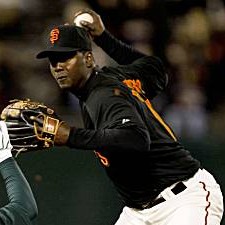
Renteria (at right), a 13-year veteran with his sixth team, is easily the most recognizable of the new incumbents. The Giants signed him as a free agent to a surprisingly large contract – two years for $18.5 million – surprising because they are his fifth team in the last six years.
The other three starting infielders are what teams call homegrown, a term they are proud of these days but usually don’t have many of on their rosters.
Ishikawa, a Seattle native, is a 25-year-old left-handed hitter, who played in 12 games with the Giants in 2006, wasn’t invited back for an encore the next season but played in 33 games last year.
Burriss started 66 games for the Giants at second and short last season and batted .283 with a .357 on-base percentage. This spring he competed with Kevin Frandsen for the second base job and won it.
Third base went to Sandoval, who like Ishikawa and Burriss came up through the Giants system. A 22-year-old switch-hitter, the Venezuelan played in 41 games for the Giants last year, batting .345 with a .357 on-base percentage and a .490 slugging percentage.
Besides being the starting third baseman, Sandoval will be the backup catcher early in the season. He has been described as a young Vladimir Guerrero, swinging at anything and hitting most everything.
QUESTIONABLE COMEBACKS
It would be a fair question to ask how Carl Pavano and Kris Benson are in the starting rotations of major league teams. Pavano has won a starting job with the Cleveland Indians, Benson with the Texas Rangers.
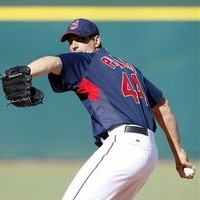 They don’t come to these jobs with sterling resumes. Pavano is best known for disabling his way through a four-year, $39.95 million contract with the Yankees. Benson is best remembered for his wild wife, Anna.
Pavano, who had an 18-8 record for Florida in 2004, made 26 starts in his four years with the Yankees, only nine of them in the last three years. Benson, the first pick overall in the 1996 draft, last pitched in the majors in 2006.
“He made every start all spring,” Mark Shapiro, the Indians’ general manager, said at the start of the season, offering a report on Pavano’s medical credentials. “He’s a guy that definitely has pride and was definitely impacted by what happened there. It’s clear he wants to do well.”
Pavano knew he couldn’t expect a large guaranteed salary so he agreed to $1.5 million and bonuses. He can make an additional $5.35 million, but by then the Indians will have received value in return because to get that amount the 33-year-old right-hander has to start 35 games and pitch 235 innings.
“We talked to him and we feel he’s motivated,” Shapiro said. “We thought he was clearly motivated. Physically he’s in good shape. We’re not deceiving ourselves. We feel he has the upside to be a veteran starter.”
The Indians are not dealing in fantasy baseball in adding Pavano. “We’ll see,” Shapiro said. “Clearly there’s a lot of risk. We’re not banking on anything.”
Likewise, the Rangers don’t know what to expect from Benson and are not deluding themselves about him.
“We had seen him throw twice in January and early February,” Jon Daniels, the Rangers’ general manager, said. “One of our scouts also watched him work out. He has a unique strengthening and weight lifting program. He was working with a trainer who had worked originally with decathletes. He had him doing a unique shoulder program. We saw what kind of shape he was in. He came and worked out for us, and we signed him about a week into spring training.”
The Rangers have needed pitching for years, but their efforts have seldom found it. That’s how and why a Benson can wind up in their rotation.
“He’s in great shape,” Daniels said. “His shoulder is healthy. He’s a strike thrower as he has always been. We have some young pitchers we like, but we want to give them some more time.”
In the meantime, there is Benson. “He’s motivated,” Daniels said. “He has something to prove. He realizes that having been a No. 1 pick in the draft he hasn’t lived up to that expectation.”
And he doesn’t cost much. He has a $750,000 salary and bonuses for innings pitched (maximum $1 million for 200 innings) and roster time (maximum $300,000 for 160 days). Benson has one thing Pavano doesn’t: a $200,000 bonus for being named comeback player of the year.
Both pitchers made their first 2009 starts last week. Pitching against Texas, Pavano didn’t get an out in the second inning. He faced eight batters in the first and four in the second, and nine of them scored. One who didn’t hit a sacrifice fly.
Benson lasted five innings against Detroit, giving up 8 runs (7 earned) and 10 hits, including a Miguel Cabrera grand slam.
