Never has anyone had to work so hard to give away so much money. In fact, if the Yankees fire Brian Cashman in the next couple of years, he will be able to use his recent experience to get a job: salesman.
That is the role Cashman had to undertake recently. In an effort to induce CC Sabathia to take $140 million or more, Cashman traveled to San Francisco to meet with the free-agent pitcher. Then he stopped in Texas on his way home from the winter meetings in Las Vegas to meet Andy Pettitte to try to talk him into taking $10 million.
That’s the bizarre nature of Cashman’s job. He has spent weeks trying to give away George Steinbrenner’s money to reluctant takers. On the 1950s television show, “The Millionaire,” Michael Anthony didn’t have difficulty giving away John Beresford Tipton’s money.
But then, Anthony wasn’t dealing with major league baseball players and their egos.
That’s Cashman’s problem with Pettitte. The veteran left-hander has said repeatedly he wants to pitch for the Yankees and no one else, but he hasn’t signed a contract because he doesn’t want to pitch for them for “only” $10 million. That sum represents a $6 million cut from his salary of each of the last two years.
In a way, it’s the Yankees’ fault. They spoiled him by giving him $16 million to lure him back. That was probably more than they should have given him, and now he or more likely his agents, Randy and Alan Hendricks, are using it against them.
When they met the other day Cashman told Pettitte that $10 million was the best he could do, and Pettitte said he didn’t think he deserved a pay cut. He wants to think about it, the pitcher told his visitor.
Pettitte, though, should not think too long. The Yankees’ starting rotation is filling up quickly. “If we sign Burnett, there’s only one chair left,” a club official said before the Yankees had been told that A.J. Burnett had accepted their five-year, $82.5 million offer.
In balking at a mere $10 million, Pettitte is forgetting or ignoring the Yankees’ stance a year ago when the Mitchell report on the use of performance-enhancing substances in baseball identified Pettitte as a user of human growth hormone. Pettitte, to his credit, quickly acknowledged his use and apologized for it, and the Yankees staunchly stood by him.
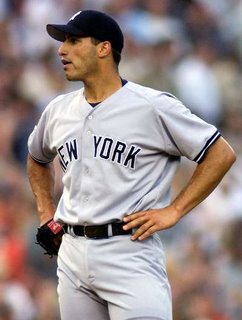 The Yankees even ignored the way Pettitte delayed in accepting their $16 million offer until just before he knew Mitchell would be branding him a user, signing the contract before the Yankees could revoke the offer on solid ground.
But getting his $16 million last year only makes it harder for Pettitte to accept $10 million now.
For Sabathia, $140 million for six years wasn’t enough for him to abandon his dream to play for a National League team closer to home in California. In their final meeting, in Las Vegas, Cashman raised the stakes to $161 million for seven years.
Like many players, Sabathia failed to understand that playing for a New York team didn’t mean that a player had to live in New York. When players come to New York for games at Yankee or Shea Stadium, they stay at a midtown Manhattan hotel and often have no other experience than riding the bus from the hotel to the park and back. They have no reason to leave Manhattan otherwise.
When they are considering signing with the Yankees or the Mets as free agents, players have to be made aware of another life – living in the suburbs in Westchester County or Connecticut north of the city, on Long Island east of the city or in Bergen County, New Jersey, west of the city. Trees, green lawns and good schools abound.
After Mike Hampton played for the Mets in 2000, he signed with Colorado as a free agent, saying he did so not for the $121 million the Rockies gave him but for the good school systems in the area. Playing for the Mets, he lived in Manhattan and never left it to go anywhere but Shea Stadium. He wouldn’t have known what a suburban school looked like.
But in his visits to Sabathia and his wife, Cashman impressed upon him the choices he would have living outside the city. Those assurances and an extra $21 million did the trick, and then Cashman went on to his next target, Burnett, who didn’t have to be convinced about living in New York but did have to have more dollars waved in front of him than the Braves dangled.
Addition by Subtraction and Addition
Five trades were made at the winter meetings last week. Four involved 11 players. The fifth had 12 players in it. That was the three-team transaction involving the Mets, the Mariners and the Indians. It was the deal in which the Mets acquired an established, proven reliever, J.J. Putz, and shed two members of their star-crossed relief corps from last season, Aaron Heilman and Joe Smith.
Heilman was by far the most disappointing and incendiary member of the Mets’ failed relief corps. Smith was probably the least culpable and very likely would have been worth keeping, but general manager Omar Minaya wanted Putz and had to give up Smith to get him.
Putz came from Seattle. Smith went to Cleveland. That’s how three-team trades work.
This one had its genesis in talks between Minaya and Jack Zdurencik, the Mariners’ new general manager, in the month before the winter meetings. Mark Shapiro of the Indians was out there on a side track.
Minaya and Zdurencik had talked about Minaya’s interest in Putz, but they had been unable to agree on players. Minaya had also been talking to Shapiro, who was interested in Heilman but was offering Franklin Gutierrez, an outfielder Minaya had no need for.
The Mariners were looking for a center fielder, and Minaya asked Zdurencik if he would like Gutierrez. Yes, Zdurencik said, but he also wanted a starting pitcher and asked for Jonathan Niese, the Mets’ young left-hander, who started three games for them this year. Minaya said no to Niese because he may wind up in the Mets’ rotation next season.
On Wednesday, the third day of the winter meetings, Zdurencik expressed interest in Gutierrez and Heilman. Minaya called Shapiro, who had always liked Smith, and asked if he could get Gutierrez for Smith. Shapiro called later that day and said Minaya could have Gutierrez for Smith, but he also wanted a young Mariners’ outfield prospect, Luis Valbuena, who hit .245 in 18 games for Seattle.
Back to Zdurencik went Minaya, saying he would give him Heilman for Putz, but throw in Valbuena and you can get Gutierrez because the Indians will take Smith and Valbuena for him.
Agreeing to the core of the deal, the general managers worked out some other elements, and their deal grew to 12 players, matching a 12-player deal between Houston and San Diego in 1994 that was the largest since the Tigers and the Athletics exchanged 13 players, including Billy Martin, in 1957.
The Mets also sent the Mariners Endy Chavez, their talented backup outfielder, but in return got an outfielder, Jeremy Reed, who hit .269 in 97 games.
And the Mets, who included four minor leaguers, got a relief pitcher, Sean Green, whose 72 appearances for the Mariners were tied for eighth most in the American League after his 61 games following his recall in May 2007 led the league for that period.
It’s Sean, Not Shawn
Shawn Green batted and threw left-handed. Sean Green throws and bats right-handed.
 Shawn Green was an outfielder. Sean Green is a relief pitcher.
Shawn Green played for the Mets in 2006 and 2007. Sean Green will play for the Mets next season.
Shawn Green is 36 and retired after 13 major league seasons. Sean Green is 29 and going into his fourth major league season.
Shawn Green is Jewish. Sean Green is not.
“I don’t know how many entertainment companies called in the last couple years and said they wanted Sean for functions like bar mitzvahs,” said Adam Hubble, Sean Green’s agent, who can expect even more calls now that Green has been traded to the Mets.
“With the appearance fees he’s lost over the last few years not being the other Shawn Green, he may want to reconsider his approach,” Hubble said, laughing and quickly adding, “I say that tongue in cheek.”
Gordon Beats Williams for M.V.P. But Not to Hall
A year after hitting .406, Ted Williams won the Triple Crown in 1942, leading the American League in hitting (.356), home runs (36) and runs batted in (137). He also led the league in total bases, runs scored, walks, on-base percentage and slugging percentage.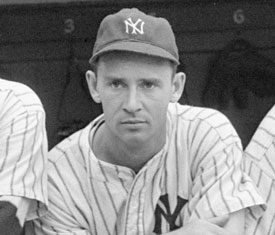
Joe Gordon, who played second base for the Yankees, created a triple crown of his own. He led the league in strikeouts (95), led the league in double plays grounded into (22) and made the most errors at second base (28). Gordon, however, did not top Williams in any positive category, though he batted .322 and drove in 103 runs.
Yet Gordon, who last week was elected to the Hall of Fame, won the most valuable player award that year, gaining 270 points (including12 first-place votes) to 249 (9 firsts) for the Red Sox slugger.
The Yankees won the A.L. pennant, finishing 9 games ahead of the second-place Red Sox. A Williams teammate, Johnny Pesky, finished third in the voting, indicating that the writers who voted felt that Gordon was more valuable to the Yankees’ pennant than Williams was to Boston’s distant challenge.
Sample Leaving Baseball a Second Time
On Tuesday (Dec. 16) employees of mlb.com will gather at Stout bar and restaurant on West 33rd Street in Manhattan for their annual Christmas party. Employees will fly to New York from all over the country at company expense and stay at hotels the company will pay for.
Twenty-six employees who were laid off Dec. 5 aren’t expected to attend. Nor does anyone expect to see four on-air members of the staff. They have been let go, too.
 MLB.com wouldn’t acknowledge the latest layoffs, but some of its employees said that Billy Sample, a major league outfielder from 1978 through 1986, and three others, Seth Everett, Casey Stern and Ed Randall have been excused from further service, although Randall apparently has been told he can stay on if he accepts a reduction in pay.

“They got rid of the four biggest salaries,” an mlb.com employee said.
Sample, the best known of the quartet because of his playing career, said he was informed of the mlb.com decision the evening of Dec. 5, the Friday before the start of the winter meetings. That was the same day 26 other employees learned that they were losing their jobs. Sample said he was called by Dinn Mann, an executive vice president, and Leslie Knickerbocker, vice president for human resources.
“He said something to the effect ‘we’re making changes’ or cutbacks,” Sample said, referring to Mann. “I didn’t really listen to it. I’m a bottom-line kind of person. Just tell me what the severance is. I had a sense the way people were moving around the office that something was coming down. I may have thought I was above it, but I knew it was coming.”
Sample, 53 years old, had been with mlb.com since 2001, its first year of operation. He said he was offered the opportunity to continue working but said it would have been at a huge reduction in pay. When he was told of the development, he said, he was also given the option of covering or not covering the winter meetings and decided to do it because he had already made plans to go.
Officials of the Advanced Media subsidiary of Major League Baseball declined to discuss the latest layoffs. “We’re not going to get into decisions on individual people; that’s a private personnel matter,” said Matt Gould, vice president for corporate communications
Gould declined to comment specifically on other cost-saving matters that employees have disclosed. “Our corporate policies have not been altered at all,” he said.
Employees disagreed. One wrote in an e-mail, “I also know that taxi and car service (for late night employees) was eliminated last Friday to save a few million.”
Another employee said, and a second confirmed, that reporters have been told they have to have Blackberrys or Blackberry-type instruments, but if they don’t have them already, they have to get them at their own expense. In other words, mlb.com is telling the reporters we need to be able to reach you whenever we want, but we won’t pay for being able to do that.
“That message was conveyed,” a reporter said. “I sensed that it was a problem for some individuals.”
Despite the financial considerations that prompted the four layoffs plus the original 26 and other cost-cutting measures, it’s party on this week.
“They have established a tradition of flying people in for the party,” an employee said. “They started it in boom times and raised expectations every year of flying everybody in. I’ve heard it wasn’t an easy decision.”
The employee meant the decision to have the party this year.
The same employee said the party was a double-edged sword. “If they canceled it some people would complain,” the employee said. “If they have it, people complain. They’re screwed whatever they do.”
The idea of the party is to boost morale, the employee said. “They’re spending money when the company can’t afford it,” the employee said. “But if they cancel the party, people would say things must be worse than we thought. It could hurt morale.”
Another employee estimated that the number of people who work outside New York is 50 or more.