Whither goest Jake Peavy now?
“I don’t know that,” the pitcher’s agent said. “We haven’t talked. He is very frustrated.”
As Peavy should be. He has had a difficult off-season. Peavy, the San Diego Padres’ pitcher, was the subject of extended trade talks for weeks. The Padres wanted to trade him to get rid of the $63 million he had left in his contract, and everyone in the baseball world knew it.
John Moores, the Padres’ owner, was going through a self-induced divorce, and Peavy was paying for it.
This is how baseball works. Instead of becoming a free agent, a player signs a contract with his team because he wants to stay with it. The team wants him to stay, too. That’s why it gives him a 5-year, $69.5 million contract. But circumstances change, and suddenly the team wants to trade him to get rid of that big contract he signed only a year earlier.
But the player’s agent has seen this scenario and knows to protect his client. He has the club include a no-trade provision in the contract, meaning the player cannot be traded without his permission. Remember, though, that circumstances have changed, and now the club seeks the player’s permission to trade him.
The club induces the player to grant that permission by telling him we’re going to slash our payroll by so much that we will not be a very good team and you won’t enjoy being here. Your chances of winning a fair amount of games will certainly be reduced.
All right, says Peavy, the party of the first part, I will accept a trade to the Braves or the Cubs. Fine, says Kevin Towers, the general manager of the party of the second part, and proceeds to initiate talks with the Braves and the Cubs.
Only Towers isn’t going to play an early version of Santa Claus and give Peavy away. Not only does he want to get rid of his contract, but he also wants to extract a large package of talented young players in return.
“I thought from the very beginning of this that this would be a very difficult trade to make,” Barry Axelrod, Peavy’s agent, said. “You have a player who has a hefty contract and the Padres were very public in expressing what they needed to do and what they needed to have back in exchange. They are clearly looking to shed a lot of salary and they want back some high quality prospects they can control financially for a couple years. That is a tough combination notwithstanding the no-trade rights.”
In these costly times, much more money than ever is included in trades to offset salary, if the player leaving a team has a much larger salary than the player arriving. The rule of thumb is the more money a team includes in a trade the better the players it gets in return.
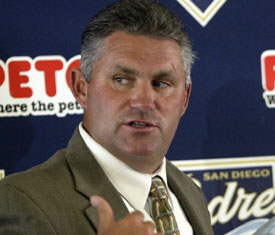 The Padres, though, weren’t going to include any money to offset Peavy’s $11 million salary for next year or any part of the contract, and they still wanted top-notch prospects.
Towers acknowledged that he was looking for an attractive package of players. Speaking of the collapse of his talks with the Braves, he said, “It probably came down to our wanting more than they were willing to give up. Their offer was fair, but we said from the get-go we wanted a lot.”
The Braves were the first to drop out of the Great Peavy Chase. Their general manager, Frank Wren, said they had decided to go in a different direction, and shortly afterward they acquired Javier Vazquez from the White Sox.
That development narrowed the Padres’ field to the Cubs, and the teams talked and talked, and then they talked some more. Before the end of the winter meetings, though, the Cubs decided not to talk anymore.
“When you have a player like Peavy who is available, you want to make it work, but we have a good rotation already,” Jim Hendry, the Cubs’ general manager, said. “We had a priority to add a left-handed hitter and we’ll do that. But when someone of that quality becomes available, we try to do it. But you also have an obligation to the new ownership.
At the end of the day what made me decide not to do it was the amount of talent going back and taking on the whole contract.”
The Cubs are for sale, and Hendry meant he was obliged not to shred the team’s minor league system for one player and take on $63 million in the process.
Now the Padres have been placed on the market as well, and they could benefit by getting rid of the remaining $63 million they owe Peavy, who got the contract after winning the Cy Young award unanimously last year.. But he’s not going anywhere so fast. The Padres realize the bind they are in and have pulled Peavy off the market, hoping he changes his mind once he sees how decimated the team is.
Assessing the wasted weeks of trade talks, Axelrod said, “I don’t think it was helped by it being so public and out there, identifying the few teams they could talk to.”
“You see the spectrum of the way teams do these things,” the agent continued, “San Francisco and Boston, who play it very close to the vest, to the Padres, who are completely open with their goals, including a blog by a high-ranking executive stating their goals.”
Axelrod refered to Paul DePodesta, special assistant for baseball operations, who reports not to Towers but to Sandy Alderson, the chief executive officer in the Padres’ top heavy executive echelon.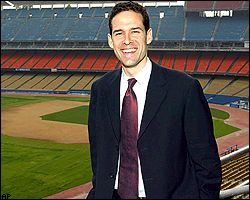
There is a belief in some baseball circles that DePodesta, former general manager of the Dodgers, has to approve all trades, but Alderson said that isn’t true.
“He helps round out our front office,” Alderson said. “He reports to me in part because he didn’t want to be perceived as an assistant general manager. He works very closely with Kevin. I talk to him from time to time. He doesn’t approve trades. Ultimately I’m the only one who has to approve what Kevin wants to do.”
DePodesta, a Harvard graduate with a degree in economics, was among the first young general managers who were hired for their belief in the statistical analysis method of selecting players. But he lasted only two seasons and now is an assistant whatever you want to call him.
It should come as no surprise that a statistics-oriented guy has a blog. Those pursuits seem to go together these days. But a club executive writing a blog?
“In all candor,” DePodesta wrote in a recent blog about the team’s trade of shortstop Khalil Greene, “the other part of this deal is the trade of Khalil’s contract which was due to pay him $6.5 million in 2009.”
He has blogged nothing about Peavy since Oct. 16, at which point he wrote, “So, to answer the most basic question: are we going to trade Jake Peavy? We’ll see if someone offers us a compelling deal that makes us better.”
As Axelrod mentioned DePodesta’s blog, I think I could hear him shaking his head in some disbelief.
“I think the public nature was harmful,” he said. “It was hard on Jake. It was hard to be the focal point of the team wanting to get rid of you.”
Will it continue to be hard on Peavy? “I imagine it will be,” his agent said, “Jake being the competitive guy he is, being with a club that will be hard pressed to be competitive.”
Maybe the Padres are counting on Peavy’s likely frustration to prompt him to agree during the season to be traded to someone other than the Braves and the Cubs. Maybe as the July 31 trading deadline approaches, Peavy will have had enough of a team that lost 99 games in 2008 and is headed for an even worse record halfway through 2009.
Maybe we will be able to keep up with developments through DePodesta’s blog.