When Jayson Werth was a young boy, he was a skinny kid and his family named him Stick. They even put the 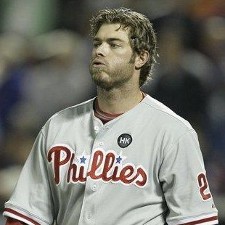 name on a license plate on his toy truck. It wasn’t original.
“I think I caught that off Stick Michael,” Dennis Werth related. “That came to mind. Stick Michael was a big influence in my career.”
Stick is Gene Michael, the Yankees’ senior vice president and special adviser, who also has served the organization as general manager, manager, coach and minor league manager, all of that after he played for the Yankees.
Michael managed the Yankees Class AAA minor league team in Columbus, Ohio, in 1979. It was his first managing job, and he would become the Yankees’ general manager the next year and manager the year after that.
“I really liked Denny,” Michael recalled Saturday. “He could play defense, he could hit, he was selective at the plate. I remember campaigning and begging to have Denny Werth instead a kid named McDonald, one of our top prospects. He couldn’t concentrate. I remember one game he was talking to the other team’s first base coach. A line drive went by him. He wasn’t ready.”
Michael also recalled pushing to have another youngster, Roger Holt, on the team. Werth and Holt both played for Michael that year, and they were named the Clippers’ co-players of the year.
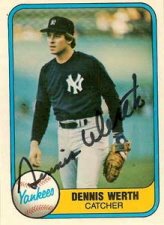 Holt played two games for the Yankees in 1980, and his baseball lineage ended there. Werth played a total of 73 games for the Yankees in 1980 (Michael was general manager) and ‘81 (Michael was the manager), hitting .308 in ‘80.
The Yankees traded Werth to Kansas City in 1982, the Royals released him after 41 games and 15 at-bats, he went to spring training with the Angels in ‘83 and they released him. The timing and the location are important here.
Dick Schofield was a rookie with the Angels in 1983. He lived in Springfield, Ill. Werth lived in Springfield, Ill. The Angels released Werth, and he wound up back in the Yankees’ minor league system in the middle of that year.
“George Sisler bought my contract from the Louisville Redbirds,” Werth related, referring to the Hall of Famer who ran the Columbus team. “They got me to play first base.”
But, he added, “I wasn’t there a week when Mattingly or Balboni was sent down. I got my golf clubs out. In ‘84 I went to Louisville and was a player-coach for Jim Fregosi.
When I came home from the ‘84 season I saw Dicky Schofield and that’s when I met Kim. She had just gone through a divorce and Jayson was 4 or 5.”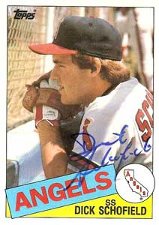
Kim was Schofield’s older sister, and she soon became Mrs. Dennis Werth. “We initially met in mid-October of ‘84,” Werth said. “I bumped into her the day after Thanksgiving, and we were engaged New Year’s Eve.”
It was a package deal. Jayson was the player to be named Werth.
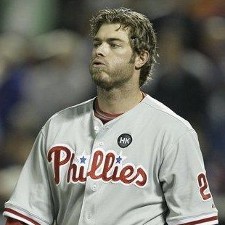
The common perception is Dennis adopted Jayson, but it would be more accurate to say that Jayson adopted Dennis.
“Before sixth grade the kids just wrote their first name on their papers,” Dennis said. “When he was in sixth grade he started putting Jayson Werth on his papers, “I guess he felt left out and started using my name. We spent some money to make it legal. His biological father said it was fine. Then at the last minute he wouldn’t sign the papers. But Jayson kept using Werth.”
After Baltimore made Jayson the 22nd player selected in the 1997 draft a couple of weeks after he turned 18, “he legally changed his own name,” Dennis said.
The adult Jayson has lost the nickname Stick. The adult Jayson is 6-5 and weights 212 pounds.
“I still call him Jaybird; everyone in the family calls him Jaybird,” Dennis said in a telephone interview. “But he was just small. He never filled out the way he has now. It took forever and a day. He was in his mid-20s fighting to keep weight on.”
Jayson has had to work hard, too, to attain the level of play expected of him.
“I always thought he had that ability,” Dennis said. “He had that team sense. He always came up with the big hit. He knew the game, being around me and Dicky. I did 95 percent of his teaching. He had a batting cage in the backyard since he was 9 years old. We moved to a new house and had a new batting cage, and we moved again. Same thing.”
The turning point in Jayson’s career came after a wrist injury kept him out of the entire 2006 season. He tore the ulnar triquetral ligament 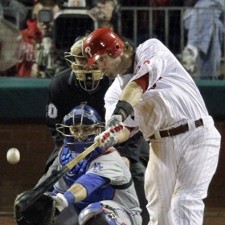 in his left wrist playing for the Dodgers in 2005, had surgery and didn’t play for them again. When Dec. 20, 2006 arrived, the Dodgers did not tender Werth a contract, making him a free agent.
“For one night he was a little concerned or upset because they cut him loose,” Dennis said. “At 7 o’clock the next morning our phone was ringing off the wall.”
Jayson and his wife lived down the street from his parents. Pat Gillick, the Phillies’ general manager, didn’t have a telephone number for Jayson, but he did have one for Dennis. Gillick was interested in Jayson because he had drafted him for the Orioles in 1997.
Dennis had already left for his job as a senior sales representative for an orthopedics company so his wife trotted on down the street, told Jayson’s wife, she woke him and he called Gillick.
“Pat and Mike Arbuckle show up at Jayson’s house the next day and we all go out to dinner,” Dennis continued. “That was a Thursday evening. That was pretty impressive to Jayson.”
Dennis said Jayson’s agent also heard from the Padres, the Athletics, the Cardinals and the Yankees, “who threw their two cents in.” He signed with the Phillies for $850,000, though only $400,000 guaranteed. “The Phillies are the ones who came up with the best deal and showed the most interest,” Dennis said.
Short of service time to be a six-year free agent, Jayson subsequently signed two more contracts, one for $1.7 million for last year and a two-year deal for $10 million. Had he limited that second contract to one year, Jayson could have been a free agent after he plays in the World Series this year.
Considering the season he had this year, 30-year-old Jayson could have attracted a lucrative multi-year contract. The right-handed hitter socked 36 home runs and drove in 99 runs and has added a team-high 5 homers and 10 r.b.i. in the playoffs.
“It’s a real pleasure to see him have success for himself, but it makes me feel good that I led him in the right direction,” Dennis said.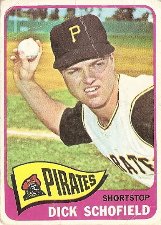
What specifically has Jayson done to make the improvement the Phillies saw this year? “He’s lowered his hands and spread himself out,” Dennis said. “He’s taken a lot of garbage out of his swing. He’s got himself in a really good situation hitting wise. He’s confident in what he’s doing.”
In earlier years, Jayson had a wealth of home training.
“Grandpa was always around,” he added, referring to Dick (Ducky) Schofield, who preceded his son in the majors, “and they’d talk about the game. We’d sit around and talk about situations. The kid at 13 knew more about baseball than college kids. He was way, way beyond his years.”
Uncle Dick, or Dicky, as Dennis refers to him, was playing in the majors when Jayson was growing up, but if he needs help now, he has a triumvirate on call.
MORE CALLS ON UMPIRES
Don Denkinger blew a call at first base that probably led to the wrong team winning the 1985 World Series, and baseball and the world survived. Nearly a quarter of a century later people still talk about Denkinger’s call. It’s probably the only thing anyone talks about from that World Series.
I’m not advocating that umpires’ make mistakes to create long-lasting talk. What I am suggesting is that an umpire’s mistake is not the worst thing that can happen in a baseball game, even a game with the importance of the World Series. Players have fouled up far more games than umpires.
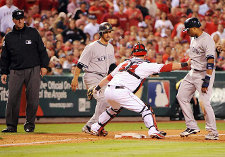 This post-season has not been a good one for umpires. I don’t know why they have made so many mistakes with their calls, but unless it becomes a regular practice I say forget the idea of increasing the use of television replays.
Fay Vincent, the former baseball commissioner, suggested in an op-ed piece in The New York Times that Major League Baseball could improve the caliber of umpiring in two ways: take over the training of umpires from the private umpiring schools that are operated by former umpires and increase umpires’pay at all levels.
Those are good ideas, and they might lead to an improvement in the over-all caliber of umpiring. However, two of the most egregious calls in the playoffs this year were the work of Tim McClelland, a veteran umpire, who is widely recognized as one of the best.
McClelland said incorrectly that Nick Swisher left third base too soon on a fly to left field, and he failed to call a double play when two Yankees baserunners were tagged as they stood in the vicinity of but not on third base. To his credit, McClelland acknowledged his errors after the game.
Yes, it was too late to fix them, but the admission enhanced the human being that McClelland is. Proponents of replays say it would be better for McClelland to have had someone in the press box view replays and correct the calls, but the game is played on the field. That’s where it should stay.
I don’t think anyone wants to send the umpires off the field to look at replays themselves, as they now have to do on questionable home runs. If the National Football League wants to interrupt its games so that referees can view replays, that’s the N.F.L.’s business.
The wait sometimes is interminable, but I suppose when fans have bets riding on the outcome of games and the point spreads, they are willing to wait for the game to resume as long as the referee gets it right.
But that’s not baseball and shouldn’t be baseball. Commissioner Bud Selig has expressed his opposition to increased use of replays. However, he initially opposed any use of replays and succumbed to the chorus of cries urging replays to determine home runs. That is known as the slippery slope. One more step down the slope, and Selig will go tumbling down it all the way.
THE WILPON PONZI PUZZLE
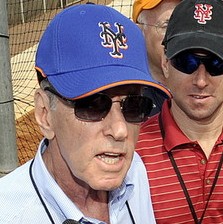 Unless Fred Wilpon discloses details of his investments with Bernie Madoff, no one outside his immediate circle of associates will know how he fared in his good friend’s $65 billion Ponzi scheme.
Those not in the know include Major League Baseball officials, who say all they know is that the Mets’ owner has said his dealings with Madoff will not affect his operation of the Mets.
Some details emerged recently in a filing in United States Bankruptcy Court, and they showed a profit, not a loss. An entity known as Mets Limited Partnership had two accounts totaling investments of $522.7 million. But that entity apparently was one of the lucky investors, gaining a total return of $570.6 million for a profit of $47.9 million.
How that happened only Madoff knows, and the last we knew he wasn’t offering clues to any aspect of his scheme, which purportedly brought him more money than Alex Rodriguez makes.
What the court filing by the bankruptcy trustee shows is that all was not lost for Wilpon. Several sources who claim to know of Wilpon’s investments have said he lost $700 million to Madoff. But they didn’t know about the profit those two accounts made so should we subtract nearly $50 million from the speculated losses?
Or should we deduce that the two accounts are the sum total of Wilpon’s investments and he didn’t lose $700 million at all but actually made money?
A baseball official took a highly skeptical view toward the latter possibility. “They could not have made money,” he said. “That’s just one part of the story. You don’t know how many other investments there were.”
But it just may be that Wilpon didn’t lose as much as speculated, and we won’t have to hold any benefits for him any time soon.
