When the Philadelphia Phillies overcame the New York Mets in the final 17 games of the 2007 season and won the National League East title, I attributed the outcome more to the Mets’ collapse than to the Phillies’ comeback ability. After all, if the Mets hadn’t lost 12 of their last 17 games, if they had lost only 10 of the last 17, they would have finished in first place.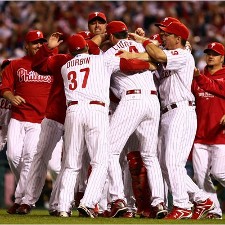
Two more division championships and two N.L. pennants later, though, I am a believer. The Phillies are a really good team, maybe even good enough to beat the Yankees and become the first National League team in more than 30 years, since the 1975-76 Cincinnati Reds, to win two successive World Series.
I am not prepared to say the Phillies will knock off the Yankees, assuming the Yankees don’t squander their three games to one lead over the Angels in the American League Championship Series, but I think they are good enough to pull off that feat.
My appreciation for the Phillies grew last season and post-season, in which they lost only one game in each series for an 11-3 post-season record. By this year’s post-season they seemed certain to get into position to have a chance to defend their World Series championship. They are that good.
The Phillies are that good to a great extent because of Pat Gillick. He was the Phillies’ general manager for only three years, but moves he made during his tenure have been instrumental in the success of the team that had been a second and third-place team before his arrival.
That Gillick was available to replace Ed Wade as general manager was a result of his third “retirement” in nine years. Though at the time of his departure from Toronto (1994), Baltimore (1998) and Seattle (2003) he said he was retiring, Gillick was not to be taken literally. He demonstrated that reality by taking jobs subsequent to those so-called retirements.
Gillick solidified the Phillies’ lineup and pitching staff, adding right fielder Jayson Werth, third baseman Pedro Feliz, closer Brad Lidge, relievers Chad Durbin and Scott Eyre and starting pitchers Jamie Moyer and Joe Blanton.
His work was not an accident. He was the general manager of the Toronto Blue Jays when they won the World Series in 1992 and ‘93.
As it turned out, Werth was Gillick’s most interesting acquisition. Gillick was the Baltimore general manager when the Orioles drafted Werth in 1997. He was the Philadelphia general manager when the Phillies signed him as a free agent in December 2006.
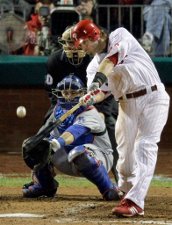 He was a free agent because the Dodgers did not tender him a contract for 2007 after he missed the entire 2006 season with a wrist injury. Gillick signed him to a one-year contract for $850,000, of which less than half was guaranteed. It turned out to be one of the best signings in recent years.
It’s just possible that the non-tender decision flashed through the mind of Ned Colletti, the Dodgers’ general manager who made it, when Werth slugged two home runs, added a single and drove in four runs in the 10-4 pennant-clinching victory Tuesday night.
Werth has one of the most interesting ancestries in baseball. He is the grandson of Dick (Ducky) Schofield, who was a major league shortstop for seven teams in a 19-year career. He is the nephew of Dick Schofield, who was a major league shortstop for four teams in a 14-year career. He is the stepson of Dennis Werth, who played a variety of positions in a brief career with the Yankees in the early 1980s.
Werth has become an integral part of the National League’s most potent offense, one of four Phillies who hit more than 30 home runs and drove in more than 90 runs. But the quartet – Ryan Howard, Werth, Raul Ibanez and Chase Utley – is only part of a lineup that can devastate pitchers top to bottom: Jimmy Rollins, Shane Victorino, Utley, Howard, Werth, Ibanez, Feliz, Carlos Ruiz.
There is no lineup in the National League that can match it, and only the Yankees in the American League can. That’s what would make a World Series between these two teams a most attractive show.
The Yankees, according to the Elias Sports Bureau, led the majors with 51 victories in games they were trailing. The Phillies led the National League with 43 such wins.
Like the Yankees, the Phillies are a dangerously resilient team, seemingly able to come back from a deficit on a regular basis. And anyone in the lineup is capable of producing a hit to start a rally or fuel a rally. A team cannot go into the late innings with a lead secure in the feeling that it is safe.
If there is an Achilles heel on the Phillies’ body, it is their pitching. It does not come with a guarantee.
For example, Cole Hamels, supposedly the team’s No. 1 pitcher, last year was the most valuable player in both the World Series and the N.L. Championship Series and compiled a 4-0 post-season record with a 1.80 earned run average. This month, however, he gave up four runs in five innings against Colorado in the division series and didn’t last five innings in the clinching game against the Dodgers.
Cliff Lee, on the other hand, has turned into the staff ace. Acquired from Cleveland in July, Lee has a 0.74 e.r.a. (2 earned runs in 24 1/3 innings) in three post-season starts.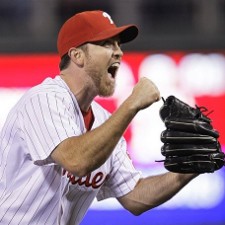
Lidge (right) has also blossomed this month but could still enter the ninth inning of World Series games with a question mark attached to his right arm. Lidge was perfect in the Phillies’ championship season, 48 saves in 48 chances, but lost his effectiveness this season. He squandered 11 leads in 42 save opportunities and had a 0-8 record and 7.21 e.r.a.
However, with careful use by manager Charlie Manuel, Lidge has rebounded in the playoffs, gaining three saves in three chances and allowing no runs in five appearances.
Besides Lee, general manager Ruben Amaro Jr., Gillick’s successor, added Pedro Martinez to the pitching staff, and Martinez pitched seven shutout innings against the Dodgers. Martinez also compiled a 5-1 record in nine starts during the season, validating Amaro’s decision to sign him.
Not that the son of the former Phillies’ infielder needed validation. Last December Amaro signed Ibanez as a free agent, and he might have been the best free-agent signing of the year. Some teams were scared off by the left fielder’s age – he turned 37 in June – but Ibanez showed no signs of age as he hit 34 home runs and drove in 93 runs as part of the Phillies’ quartet of crushers.
Now Ibanez and his teammates await the start of the World Series as the first National League team to be back in the Series as defending champions since the Atlanta Braves in 1996. The Braves lost their chance to repeat when the Yankees beat them in six games. The Phillies look forward to a different outcome.
