I could never throw a baseball as fast as Rich Gossage. Goose, in fact, could probably throw two pitches from the mound to the plate in the time it would take one of my pitches to arrive there. I am confident, however, that I can write better than Gossage. On the other hand, he speaks a better game than I do, and all I can do is nod in agreement with his views.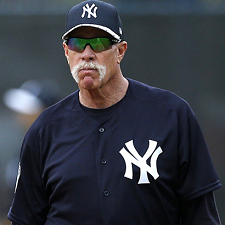
Take, for example, the incident in 1982 in which he deftly turned an innocent question from me into one of the best all-time rants of his verbally raucous career, highlighted by the memorable statement to “take it upstairs to the fat man,” meaning George Steinbrenner, of course.
I might write harshly at times, but I don’t think I rant and rave. Nevertheless, Gossage and I find ourselves in a similar situation in our post-career lives. We have both made comments that have estranged us from our former employers.
Gossage has been banned from the New York Yankees’ Old-Timers’ Day and spring training instruction. I have been banned from appearing in The New York Times and speaking to Times editors.
This column was prompted by a terrific article by Billy Witz, who covers the Yankees for the Times, that appeared in the paper last Sunday. Sadly, the Times rarely publishes baseball stories like that one. It’s not soccer or cricket or rugby or cup stacking.
Cup what? Now there I go again.
However, before I revisit that most bizarre Times incident, let’s get to Gossage, who is the reason for this column. I spoke to Gossage last week for the first time in years, and we had a delightful conversation. Goose seemed to enjoy hearing a familiar, friendly voice after suffering the indignities heaped on him by the Yankees.
Like the Times, it seems, the Yankees are ultra-sensitive to and above criticism. The Yankees also reacted seemingly in defense of Major League Baseball, which hardly needs such defense even when it is a Hall of Famer who is critical.
As the target of the Yankees’ ill-conceived reaction, Gossage has suffered cruel and unusual punishment. But with General Manager Brian Cashman at the center, the team’s reaction comes as no surprise.
“He’s become intoxicated with his power, especially with George gone,” said a man who has known Cashman for years, referring to the 2010 death of owner George Steinbrenner. “He’s a very vindictive person. Guys in the ’90s, the Core Four included, don’t like him.”
A member of the organization suggested that view was exaggerated, saying, “He’s had issues with a couple of guys, like Goose. He’s had a problem with Mickey Rivers because of his son. He’s had little run-ins with players from the ‘90s.”
Cashman did not responds to a telephone request for comment. “I thought he was down the hall, but he isn’t,” his secretary said, using a typical secretarial copout when her boss doesn’t want to speak to the caller.
Cashman’s failure to respond came as no surprise. He has not responded since I began advocating his dismissal a few years ago. He spent $3.665 billion on players’ salaries in his first two decades as general manager, and the Yankees received little in return. He answered his phone once when I called – his secretary must have been out to lunch – and when he heard I was on the phone, he barked, “Go write your crap,” and instantly hung up.
Gossage’s communications with Cashman have not been much better.
In the Times article, Witz quotes Gossage as criticizing the increasing impact analytics were having on baseball. Cashman, Witz wrote, summoned Gossage and asked him to tone down his rhetoric on the subject because the Yankees had developed one of the largest analytics staffs in MLB. What nonsense.
Before the 2017 season, according to Witz, Cashman offered to reinstate Gossage to the Yankees’ good graces “but only if Gossage promised not to be disruptive.” More nonsense from a tin-horn dictator with a Napoleonic complex.
Baseball players don’t have freedom of speech, but trying to prevent an Hall of Fame player from expressing his opinion makes no sense. Players are individuals, and their views can be sensible or foolish. Letting them have their say will do nothing but generate debate, which the last I knew was good for the game.
As an admittedly old-school viewer, I happen to agree with much of Gossage’s thinking. He was critical of the view that Mariano Rivera and Aroldis Chapman, two of his successors as the Yankees’ closer, were his equals. Rivera and Chapman have basically been one-inning closers. Gossage, who pitched as long as was necessary, was offended, again with good reason.
While Rivera got his three-out saves and Chapman gets his, Gossage pitched two or more innings 115 times during his six-year free-agent term (1978-83) with the Yankees, 35 times alone in ‘78. That yeoman-like effort, I believe, gives Gossage the freedom to say what he wants about Yankees’ closers, and Cashman should respect it.
Cashman, however, wants to play the Little Dictator and control what any member or affiliate of the organization says. He can do that – freedom of speech is linked to the government, not private industry – but why does he want to? Are the Yankees or MLB doomed if Gossage expresses an opinion counter to what the Yankees believe? Of course not.
“The game was protected for a hundred years,” Gossage said on the telephone from his mountain retreat in Leadville, Colo. “Now it’s run out of a computer. They are taking the human element out of the game.”
He referred to the game’s current trend toward use of analytics by increasingly younger general managers out of Ivy League schools. The new system has reduced the role of scouts, whose work for decades served as players’ entry into the game. “Their eyes don’t lie,” Gossage said.
In this regard, I completely agree with Gossage. I’ll take scouts over computers any day, and for Cashman to punish Gossage for his contradictory view is inane. It says more about Cashman than it does about Gossage.
The former player lodged another complaint: He doesn’t like the newest Yankee Stadium.
“It makes me kind of sick,” he said. “When I walked into (the old) Yankees Stadium, the hair stood up on my neck. It was an out-of-body experience.”
The outspoken pitcher, however, is realistic enough to know he is losing the battle.
“Those of us who played the game know we can’t control it,” he lamented.
So what is he doing, Gossage said someone asked him. Demonstrating that he has retained his sense of humor, he said he replied, “Just burning bridges.”
During our conversation I told Gossage he wasn’t alone is his position outside the Yankees’ tent. I have had a similar experiences with the Times and related it to him.
Two years ago this past April 1 the Times sports section featured an article on cup stacking. A first in the newspaper’s history, the articled so dumfounded Fay Vincent, the former baseball commissioner, that he was certain it was the Times’ idea of an April Fool’s joke. I assured him it wasn’t, telling him the Times didn’t play April Fool’s jokes.
Not satisfied, Vincent wrote a letter to Jason Stallman, the sports editor, who assured him it was no joke, April Fool’s or otherwise. At the same time, Stallman believed I had put Vincent up to writing the letter. That, however, was just one of the errors Stallman has made as sports editor. I knew nothing about the letter until Vincent told me of the editor’s reply.
Five years after I left the cost-cutting Times with a buyout in 2008 (the same day as two great Times reporters (Linda Greenhouse, who covered the Supreme Court, and Dr. Lawrence Altman, the excellent medical man), Stallman invited me to lunch. I had not worked for him, and he wanted to get to know me to see if he would like me to write occasional baseball pieces for the paper.
That made sense because for years the Times had been the paper other papers read to find out what was happening in baseball. I wrote a couple of pieces for Stallman, but then many months went by without my hearing from him.
When I finally called him, he said I had been critical of the Times on this now 10-year-old web site, and he and others editors saw no reason to have me write for the paper that believed it was too good to be criticized.
This may be a good spot to insert a copy of an e-mail sent to Stallman by a reader, Peter Wagner, as I was writing this column:
To the sports editor of the NYT
You’re making your point, we get it, with the (over)coverage of the World Cup, but really? At the expense of having one of your own great reporters at last nights Mets home game, in Queens, vs the Dodgers ( they are the Natl league champs, recently having relocated to the west coast from these very parts)
Who is making these allocation of resource decisions? And why?
Jerry Rothstein was copied on the original email and he added:
I’m afraid that the New York Times has made the decision that its New York subscribers who are sports fans will continue to subscribe even though the Times has largely abandoned covering New York sports.
And a final response from Peter Wagner
…and the Time’s is assuming that we read, or forcing us to get, the NY Post, for chrisssakes.
The e-mail refers to the lack, or absence, of baseball coverage in the Times. It is the primary topic of criticism I have leveled at the Times because baseball has virtually disappeared from the Times. It is embarrassing, disgusting and inexcusable. Baseball carried the Times’ sports section in the last century and – poof – it’s gone.
It’s a punch to the solar plexus of Times’ baseball fans, and the Times has never explained it. From what I have been told by readers of this site, Stallman has ignored complaints from readers, apparently thinking they are not worth his time.
I have occasionally tried to find out what’s up at the Times, but all I have learned is I am persona non grata. There was/is a deputy sports editor named Jay Schreiber for whom I did an awful lot of work. When he needed help on another reporter’s baseball story, he called me and asked me to help.
Those calls always came when, for example, Buster Olney, now an ESPN star, was working on a story that involved an agent. Olney didn’t like talking to agents – maybe they intimidated him – so Schreiber would ask me to make the call. I never refused his request.
However, after I left the Times, Schreiber wouldn’t talk to me. Several years ago, he told a former colleague he would talk to me as long as I didn’t bring up anything from the past. I have never had that conversation and don’t intend to. I have made it this far without it and think I can make it the rest of the way without it.
I relate my Times experience only to let my friend, Goose, know he’s not alone and that Cashman isn’t the only jerk on this planet.