On the same night last week New York relief pitchers walked their teams to losses. Daisuke Matsuzaka became the Mets’ pitcher at the start of the eighth inning with a 3-0 lead over Miami. In Anaheim later that evening, Shawn Kelley took over the pitching for the Yankees in the eighth inning of a 1-1 tie with the Angels.
Matsuzaka walked the first two batters, and both scored in the game-tying three-run rally. The Marlins won in the ninth.
Kelly walked four batters, one intentionally, forcing in the lead run. Before the wild inning was over, Matt Thornton and Preston Claiborne each also walked home a run, making for a six-walk, no-hit, three-run inning and a 4-1 Angels’ win.
As I watched these dreadful developments unfold before me on my television, I decided some research was necessary. Were those putrid pitching performances typical of current events or were they exceptions to what was happening throughout the major leagues?
After all, Lou Piniella, as an expert on the subject as a major league manager for 23 years with five different teams, said of walks, “That drives managers more crazy than anything.”
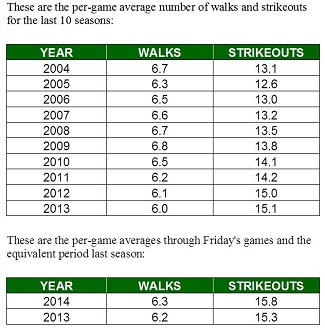
As it turns out, that wild Monday night was an exception. The number of walks has decreased each year for the past four years, though this year is up slightly, from 6.2 per game to 6.3. The exceptions, however, are entertainingly worth noting.
One of those events was an April 17 game between Toronto and Minnesota, which was dominated by a two-team total of 17 walks, an even dozen by Blue Jays’ pitchers and five by the Twins’ Mike Pelfrey in 4 1/3 innings.
Three Toronto relievers combined for eight walks in one inning and a franchise record: Steve Delabar two walks and one out, Sergio Santos three walks and no outs, J.A. Happ three walks and two outs. The walk-fueled rally, which included only one hit and three wild pitches, produced six eighth-inning runs and a 9-5 victory.
“Nine of the walks scored,” said Tom Kelly, the Twins’ former manager and now a special assistant to the general manager, including the four walks issued by starter Dustin McGowan. “It was unbelievable. It wasn’t the umpire who caused it. Sometimes the umpire gets small with the strike zone but that one wasn’t.”
Umpires are not receiving blame or credit for the increase in the number of strikeouts. Strikeouts have risen each of the past eight seasons and are up again this season, from 15.3 per game at this time last season to 15.8.
“Hitter take strike three, put their head down and walk back to the dugout,” Kelly said. “It’s nauseating. Our hitting people tried to address that this year. At least fight, swing and miss. That’s doing it differently. They’re guessing. It’s disturbing. Put it in play; you have a chance.”
Piniella has long been a hitting expert, and he began his post-playing career as the Yankees’ hitting coach. But hitting was always on his mind. Nothing was more important than hitting.
I remember the year the Yankees opened the season in Milwaukee. Batting practice was over, the players had taken infield and now the grounds crew was preparing the infield for the game. But there in the batter’s box was Piniella with his bat, staring out at the pitcher’s mound as he got into his stance and prepared for an imaginary pitch from an imaginary pitcher. He would be doing the exact same thing in a few minutes, and he wanted to be ready.
 Unlike today with the current hitters, strikeouts in Piniella’s playing time were unacceptable, a result to be avoided at all costs.
“To me, it’s a combination of things,” said the 70-year-old Piniella, now retired, speaking of the increase in strikeouts. “The biggest is hitters’ mechanics. You look at guys that try to pull ball, hit the ball out of the ball park. They give the outside part of plate to the pitcher.
“When I played, the hitting coach talked about using a slightly closed stance. The majority of hitters now hit with an open stance. They’re trying to hit the ball out of the ball park.”
Hitters apparently also are not concerned when they have two strikes, another difference from previous generations. “I taught protecting with two strikes,” Piniella said, suggesting that that practice is no longer in the curriculum.
As a hitting coach and a close observer of hitters, Piniella learned a lot about pitchers and addressed the subject of walks with some of his views and knowledge:
“If you can’t throw aggressively in the strike zone, you’re not going to be in the big leagues too long.”
“At the big league level you have to be able to throw the ball over the plate.”
“When you put the leadoff hitter on with a walk, I don’t know what the percentages are, but you’re going to give up runs.”
“Velocity is not really the answer. Very few pitchers in the big leagues rely on velocity to win.”
Kelly, who retired in 2001 at the age of 51, has one word for walks. “Walks,” he said, “are atrocious.”
Speaking of this season, he added, “We have seen more walks, especially from relief pitchers. I attribute it to the cold. But even when temperatures weren’t ridiculously cold we’ve seen relief pitchers pitch poorly. There’s no excuse. I don’t know what it’s about. It seems a lot of relief pitchers are coming in and throwing a lot of balls.”
And Kelly’s final word on relievers:
A lot of pitchers can throw one inning, but then you have to get them out of there.”
METS ACHIEVE ART OF FUTILITY
The New York Mets won’t achieve 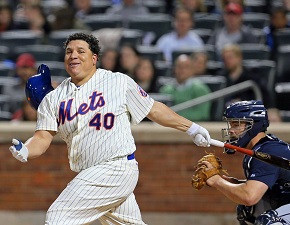 anything else this season but they don’t seem to be proud of the one thing they have already achieved. Their pitchers, going into Sunday’s game with Philadelphia, had not managed to get a single hit – or a double, triple or home run, for that matter – in 61 times at bat this season.
No team’s pitchers have ever done that at the start of a season in recorded history since 1900, Elias Sports Bureau reports.
The Mets, however, do not acknowledge that feat in their daily game notes for the news media.
Jenrry Mejia is the leader of futility among the hitless pitchers with 16 at-bats. Dillon Gee has 14, Bartolo Colon 11 and Zack Wheeler 10.
LOVE BLOOMS AGAIN
In October 2007 the New York Yankees couldn’t wait for Joe Torre to leave. Now they have to wait only until Aug. 23 to retire his number. The Yankees will also hang a plaque of Torre in their quickly filling up Monument Park at Yankee Stadium.
The Yankees will honor Torre seven years after they extended a contract they knew he could easily refuse. It was for one year after he had managed under three-year contracts and it was for a lower salary than he had made in 2007.
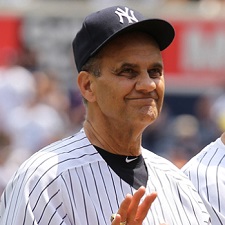 Torre rejected the offer, saying it showed a lack of commitment and trust. The Yankees felt it was time to jettison Torre because they had not reached the World Series in the three years of his expiring contract.
But they didn’t want to fire him so they designed their offer knowing Torre would not accept it even though the $5 million salary would have made him the highest-paid manager in the major leagues.
Torre resented not only the salary and length of the contract but also the $3 million in bonuses he would have earned if the Yankees had reached the World Series. He didn’t like having bonuses instead of salary even though his previous contract included bonuses.
“The fact that someone is reducing your salary is telling me they’re not satisfied with what you’re doing,” Torre said at the time.
Speaking last week, Randy Levine, the Yankees’ president, said of the 2007 dispute, “We made him an offer that would have made him the highest-paid manager in baseball,” adding, “There are no issues between Joe and the organization. We’re not going to get into past history. He’s going into the Hall of Fame as a Yankee.”