Consider this Part II of my observation that contrary to the way baseball used to be played when everything was decided on the field, too much is now often being decided off the field, in offices, where fans can’t watch.
In my previous column, I related how Major League Baseball (specifically Joe Torre) overturns rulings by official scorers, and the changes are kept secret to all but those who have to know, such as the teams involved in the plays and Elias Sports Bureau, MLB’s official statistician.
Scoring changes don’t alter the outcome of games. Changes made as the result of replays can and do.
According to MLB data, barely half of the challenged or reviewed plays have withstood reversal. Of the challenged calls, that means there’s an awful lot going on off the field. (Let’s remember that the vast majority of calls are not challenged.)
The development of successfully challenged calls, in turn, raises the question: Are umpires bad enough to get only every other close call right?
Entering Wednesday’s games, replay umpires had reviewed 679 calls (I’m eliminating the 7 reviews to confirm ball-strike counts). Of those calls, 354 (52 percent) were upheld and 325 (48 percent) were overturned.
The numbers make umpires look bad, but they look a lot worse than I think they are. When I watch a replay on television, I have a rule of thumb. If it takes more than one showing of the replay for me to decide if I agree or disagree with the call, I give the umpire the benefit of the doubt. He’s seeing the play live as it happens; he doesn’t get a do-over after watching a replay.
The replay umpires sit in front of a television monitor and can view a play as many times as is necessary and from as many different angles as necessary. They have no limit on the number of replays they can watch or the length of time they can spend watching them.
The average time they have taken to decide if a call was right or wrong is 1 minute and 49 seconds. That doesn’t add much time to the length of games, but several times the delay has exceeded 4 minutes.
The replays have had varying effects on the outcome of games. Most notable has been a May 5 game in which the replay decision reversed a two-out call in the ninth inning and gave Pittsburgh a 2-1 victory over San Francisco.
With two out in the ninth, Starling Marte lashed a drive to right field at PNC Park. Marte raced to third, then quickly got up when the relay throw skipped past third and scooted home, where umpire Quinn Wolcott called him out.
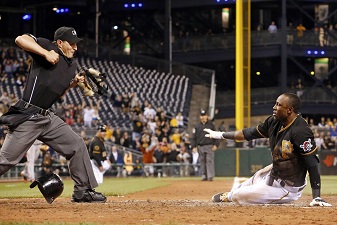 That wasn’t the way Pirates’ manager Clint Hurdle saw it, and he challenged Wolcott’s out call. Seventy-four seconds later, the replay umpires, positioned not on the field but on Ninth Avenue in Manhattan in the offices of MLB Advanced Media, ruled Marte safe, and the Pirates had a 2-1 win.
Two months and two days after the Marte play, just last week, in fact, the New York Mets had a ninth-inning call reversed but couldn’t capitalize on it. The play, however, promoted an explanation from MLB defining how umpires are to treat the old “neighborhood play,” in which an infielder comes off second base with a force play even though he didn‘t step on second when he had the ball.
Umpires make that call to avoid having the infielder injured by the runner coming from first. The neighborhood play, however, is not subject to challenge and review.
In that instance, with no one out and the game tied, 3-3, in the ninth, the replay umpires ruled that the neighborhood play didn’t apply because Andrelton Simmons’ foot had come off second base as he fielded the throw, before he threw to first trying for a double play.
Both runners would up safe, but the Mets couldn’t score the winning run. They did that two innings later.
The play, though, prompted MLB to offer this explanation:
“The replay regulations allow umpires to determine if they considered a play to be the neighborhood play or not, based on a variety of factors. Some of the factors they consider are the throw and if the player receiving the ball is making the turn. Umpires might consider whether it was an errant throw or if a player receiving a throw who is not at risk of contact made an effort to touch the bag.”
It all sounds like they’re making it up as they go along, something straight off the sandlot.
Would it have been unfair for the umpires’ original calls in these instances to have stood without challenge and review? Perhaps so, but if nearly 50 percent of all umpires’ challenged calls are wrong, how many games have had the wrong outcome in the first 100 plus years of Major League Baseball.
How many teams have lost games that cost them pennants or wild-card status or even World Series championships because wrong calls couldn’t be corrected by umpires secluded in an office watching repeated replays on television monitors?
The argument in favor of replay is it’s better to get it right than wrong, but if it’s better to get safe/out calls right, why not ball/strike calls? With the technology available today, surely an electronic system could be created to call balls and strikes.
Systems, in fact, already exist. Television broadcasters of major league games use such systems. For several years MLB used Questec to monitor umpires’ pitch calls. Nothing against umpires, whose work and work ethics I respect, but they very likely miss more pitch calls than base calls.
Having raised this issue, I don’t think baseball will ever get to electronic monitoring of balls and strikes, but I throw it out there in case Commissioner Bud Selig would like to add another element to his legacy before he retires in January.