One down, three or four to go. Michael Weiner, in his first venture as head of the players union, successfully wrestled the Florida Marlins to baseball’s financial mat and is prepared to take on similarly recalcitrant revenue-sharing rogues.
No other Florida-like agreements have been reached and none apparently will be sought until after April 1, the deadline for revenue-sharing recipients to report on their use of the 2009 money. But the Pirates, the Rays, the Padres and the Royals remain in the union’s sights, according to union and management representatives.
Weiner, who succeeded Donald Fehr last month as the union’s executive director, declined to discuss the matter Saturday, saying he had said all he wanted to say in a statement the union issued last week. 
Rob Manfred, the chief management labor executive, declined to confirm the identity of teams that have been discussed with the union but said, “We’ve had more conversations than just about the Marlins. It’s not a Marlins-only issue.”
Last week the union, the commissioner’s office and the Marlins issued an unusual joint statement about the team’s use of funds it has received from baseball’s revenue-sharing program. As in the settlements of actions taken by a district or United States attorney or the Securities and Exchange Commission, the Marlins admitted no wrongdoing but agreed to play by the rules.
No figures were included in the joint statement, but the Marlins’ share of the revenue-sharing pool has been around $40 million a year, according to a management person, and the team’s payroll last season was $37 million.
The agreement cited in the announcement resulted from extensive talks among the three parties and forestalled the union’s plans to file one or more grievances alleging that multiple clubs were violating the part of the collective bargaining agreement dealing with revenue sharing.
The labor contract requires recipients of revenue sharing to spend the money to improve their teams on the field. They can use the money to increase their payrolls, improve their scouting and player development programs and sign international free agents and drafted players. What clubs can’t do with the money is pay off debts or put the money in the owners’ pockets.
Revenue-sharing information is confidential, but one management person said the owners were told at their meeting in Arizona last week that for the 2009 season $450 million would move from wealthier teams to poorer teams. That sum is a far cry from the $80 million the clubs talked about sharing when they initially discussed revenue sharing at a meeting their then labor leader, Richard Ravitch, unsuccessfully tried to keep secret in Kohler, Wis., in 1993.
(A slight digression: The hotel, the American Club, is on Kohler’s main street, not hidden or set back from the road, as reporters thought it might be given Ravitch’s secrecy efforts. Once I found out where the owners would meet, I called and made a reservation, just as I would at any hotel. And I made the reservation in my name, even though Ravitch accused me of using a phony name. After one session, Jerry Reinsdorf, the White Sox owner, walked by a group of reporters and said hissingly, “You guys shouldn’t be here. You don’t belong here.”)
The Yankees, who have always contributed the most money to the revenue-sharing pool, are expected to put in about $130 million from their 2009 revenue followed by the Red Sox about $95 million, the Mets about $75 million and the Cubs $50 million to $60 million.
Basically, the clubs submit their revenue figures, and they are averaged. The teams above the average pay; the teams below the average receive.
The union is involved in revenue sharing because the clubs recognize reluctantly that players are affected by the transfer of money from some clubs to others.
Article XXIV B (5) (b) states that each club must use its revenue-sharing proceeds “in an effort to improve its performance on the field” and must submit a report by April 1 of each year detailing “the performance-related uses” it made of the money the previous year.
The union’s discussion with the commissioner’s office about the Marlins presumably began after it received that report last year.
The Marlins have had the lowest payrolls in the majors in three of the last four years and had the next-to-lowest the other year. Remarkably they have often been competitive in spite of their meager payrolls. They won the World Series twice in seven years under two different owners but each time decimated the team in subsequent seasons to slash the payroll.
 Jeffrey Loria, the Marlins’ owner, and David Samson, the president, did not return telephone calls seeking comment on their economic plans. They wasted no time complying with the agreement, signing their best pitcher, Josh Johnson, to a four-year, $39 million contract two days after the joint statement. Previously, it was believed the Marlins would trade Johnson rather than pay him.
Frank Coonelly, president of the Pirates, who are supposedly No. 2 on the union’s hit list, did not return calls either. But Stu Sternberg, owner of the Rays, No. 3, said he knew nothing about the union’s interest in the Rays’ use of the Rays’ revenue-sharing money.
“I saw the thing with the Marlins.” he said, “but we’ve never been asked at all about it so whether we are or not I don’t know. I think we’ve invested a lot in the team, and certainly you can see the results from it. I don’t understand why this would involve us at this point. I could understand it several years ago.”
Jeff Moorad, the Padres’ chief executive officer soon to be managing owner, said he was not aware of any union interest in the Padres.
The commissioner’s office evidently felt the union had a strong case against the Marlins and didn’t want to risk a hearing before an arbitrator because too much financial information would most likely had to have been disclosed. The agreement didn’t come overnight, but it’s not often that the commissioner’s office capitulates without a fight.
One of the differences here was the clubs that pay into the revenue-sharing pool have been as outraged as the union by the recipients’ failure to spend the money properly. Owners have said they don’t have a problem paying into the pool, but they don’t like the money going into other owners’ pockets.
Bob Nutting, the Pirates’ managing partner, has been especially criticized by other owners for not spending the money to improve his team, which is on a record 17-year streak of losing seasons.
The Pirates’ payroll has been among the majors’ four lowest each of the last six years. It ranked 28th last season when it was determined to be $48 million. However, by the end of the season the salaries of the players on the team’s roster totaled $20 million. During the season the Pirates traded Nate McLouth, Nyjer Morgan, Adam LaRoche, Freddy Sanchez, Jack Wilson, Eric Hinske, Ian Snell, Tom Gorzelanny, John Grabow and Sean Burnett. Then for good measure after the season they did not tender a 2010 contract to their closer, Matt Capps.
“The Pirates, Marlins and Rays are spending nothing on payroll and showing operating profits of $20, $25 million, which goes into the owners’ pockets,” one executive said.
Last month John Henry, the Red Sox owner, said in an e-mail to the Boston Globe, “Change is needed, and that is reflected by the fact that over a billion dollars has been paid to seven chronically uncompetitive teams, five of whom have had baseball’s highest operating profits. Who, except these teams, can think this is a good idea?”
The combined pressure exerted by Henry, other owners and the union was too much for the commissioner’s office to ignore. When Selig and Manfred don’t let a dispute get to a grievance, a management person said, “you know it’s serious. They made the Marlins accept it.”
Now the Pirates are on deck. There’s no more deserving team to bat next.
NBC ANCHOR WHIFFS
Anybody who watches the NBC Nightly News should hope that Brian Williams, the show’s anchor,  is more accurate in his news reports than he was with his commentary on Mark McGwire’s admission that he used steroids. In his item leading off the news on his show that evening, Williams said that McGwire “stopped lying today.”
“He didn’t tell the truth to Congress or to his fans until finally, formally coming clean today,” Williams added.
But McGwire never lied – to Congress or to anyone else. He didn’t confess his use of steroids, but he never said he had not used them when, in fact, he had. What he said was that he was not at the Congressional hearing “to talk about the past.”
I don’t know about Williams, but I think most people took that repeated statement as a tacit admission that he had used steroids. Most of the writers who voted in the Hall of Fame elections certainly took it that way, refusing to vote for him in four elections.
MARK YES, JOSE NO
In his interview with Bob Costas, Mark McGwire denied Jose Canseco’s assertion that the two of them injected each other with steroids when they were teammates with the Oakland Athletics. Canseco might have been right about a lot of his steroids allegations, but in this instance I believe McGwire.
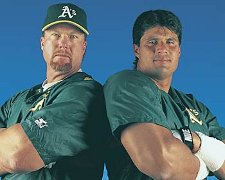 Besides general credibility, here’s one reason:
When Canseco appeared on the CBS show “60 Minutes” a month before the 2005 Congressional hearing, Mike Wallace read an excerpt from Canseco’s book in which he wrote, “What we did more times than I can count was go into a bathroom stall together, shoot up steroids. After batting practice or right before the game, Mark and I would duck into a stall in the men’s room, load up our syringes and inject ourselves. I would often inject Mark.”
According to an excerpt from a transcript provided by Ari Fleischer, who represents McGwire, Canseco responded, “I injected him probably twice. But it wasn’t like-I mean we would just walk in and-a lot of times they were pill form. A lot of times, you know, you would just-a quick injection of whatever and that’s it. It was-
Wallace: I’m just repeating what you say-
Canseco: Right.
Wallace: in the book. And if we’re to believe what you say in the book. “I would often”-often. Not twice. “Inject Mark.”
Canseco: Well I think it was more inject ourselves. I think I injected him-I mean this is a long time ago. Once or twice for sure. I didn’t keep track but …
In other words, Canseco quickly backed off his claim of having injected McGwire more often than he could count. But consider the possibility that Canseco couldn’t count beyond one.
DO AS I SAY
In recent years, Commissioner Bud Selig has acted admirably in his effort to induce clubs to hire members of minorities for important, decision-making positions. However, in a blatant act of do-as-I-say, not-as-I-do, Selig created a special committee to study all facets of baseball and stocked it with virtually all white guys.
When Selig’s committee met for the first time last Thursday in Arizona, 13 white men sat at the table with one black man, Frank Robinson, who works in the commissioner’s office and carries out assignments given him by Selig
This committee has received a mandate to study all phases of baseball on and off the field and propose improvements if any are needed. The first step the members could make is recommend that Selig replace some of the white guys with minorities or increase the committee’s size by adding minorities.
The committee’s job may not be the kind of task where race or nationality would make a difference, but if Selig’s idea of having clubs hire minorities is to give everyone a fair chance, then it would be reasonable for the commissioner’s committee to give baseball people of all colors and nationalities an opportunity to participate in potentially significant changes in the game.
The committee has no Hispanics. In case the commissioner has forgotten, one team in his sport, the Angels, have an Hispanic owner, Arte Moreno. If Selig feels Moreno hasn’t been around long enough to understand the game thoroughly, he could have his pick of a general manager, Omar Minaya of the Mets or Ruben Amaro Jr. of the Phillies, or a manager, Ozzie Guillen of the White Sox or Fredi Gonzalez of the Marlins.
Selig also could have easily added a black general manager, Ken Williams of the White Sox or Tony Reagins of the Angels, or a black manager, Dusty Baker of the Reds, Cito Gaston of the Blue Jays, Jerry Manuel of the Mets or Ron Washington of the Rangers.
And he could have gone in a different direction and named the Mariners’ manager, Don Wakamatsu.
Instead the committee has four white owners or owners’ representatives, four white front-office executives and four white managers. It also has a white journalist, the political columnist, George Will.
The next time Selig talks proudly of baseball’s record of minority hiring, you might drop him a note asking about his committee appointments. Selig incidentally did not return a call seeking comment on his appointments.
“This is an extraordinary committee,” Selig was quoted as saying the other day. It is also an extraordinarily white committee.