In the space of three years, December 2008 to December 2011, Mark Teixeira, Adrian Gonzalez and Albert Pujols signed contracts whose salaries and signing bonuses totaled $574 million. For the 25 years of the contracts they averaged just about $23 million a year.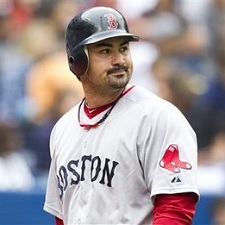
All three players had demonstrated their value before attaining those rare financial heights. For example, in his first 10 years in the major leagues, Pujols batted .331, slugged more than 40 home runs six times and no fewer than 32 the other four times and drove in more than 100 runs each season.
An “off year” for him was last year when he batted .299 with 37 homers and 99 r.b.i. The Angels ignored that uncharacteristic performance and lured Pujols to California with an offer of $240 million for 10 years, snatching him from the Cardinals, who made a competitive offer but one that was devalued by heavily deferred pay.
Gonzalez did not go to Boston as a free agent. The Padres traded him there for four minor league prospects before last season because they faced losing him as a free agent after the season. In his last five years in San Diego Gonzalez hit 167 home runs and drove in 536 runs.
In his first year in Boston he maintained that kind of production, slugging 27 homers, knocking in 117 runs and adding a career-high .338 batting average.
Although it was widely known that the Red Sox would sign Gonzalez and not let him become a free agent, they waited until two weeks of the season had gone by before signing him to a seven-year, $154 million contract. They deliberately waited so that his new contract wouldn’t count in their payroll that would be used to determine whether they owed luxury tax.
In 2008 the Yankees finished third and out of the playoffs. Determined not to let that happen again, they decided to spend heavily in the 2008-09 free agent market. They signed the best pitcher available, CC Sabathia, and the best hitter available, Mark Teixeira.
In stops in Texas, Atlanta and Anaheim, Teixeira did not produce a steady stream of monstrous seasons, but he was the best hitter among free-agent hitters and the Yankees gave him $180 million for eight years. Whereupon he had the three most productive seasons of his career, slugging 111 home runs and knocking in 341 runs.
 Suddenly, however, this season the three slugging first basemen have turned into shells of their former selves. A reader called attention to the intriguing development.
“What’s up with the dramatic decline in the production of 1B sluggers?” he asked. “Pujols, Teixeira, and now Gonzalez who seems to have stopped hitting HRs. Gotta be a coincidence, but still….”
Investigation of the matter did not produce any smoking guns or ongoing conspiracy against wealthy, lusty-hitting first basemen. In fact, Joey Votto, the Reds’ young slugger, who was the National League most valuable player in 2010, is having another productive season, as is Carlos Lee of Houston.
But to qualify for the Pujols-Gonzalez-Teixeira category, a first baseman apparently has to make a lot more money than Votto’s $38 million for three years or even the $100 million the Astros gave Lee for six years nearly six years ago.
Let’s see what the Angels, the Red Sox and the Yankees are getting seven weeks into the season for the huge expenditures they made for their first basemen (through Wednesday):
| BA | OB % | SLG % | HR | RBI | ||
| Pujols | .213 | .258 | .331 | 4 | 20 | |
| Gonzalez | .269 | .333 | .406 | 3 | 22 | |
| Teixeira | .226 | .291 | .381 | 5 | 21 |
Those figures are ugly, no matter how you view them. Let’s look at another nouveau riche first baseman, Prince Fielder, and see if he belongs with the rest of the group. At $214 million for nine years, he certainly qualifies economically:
| BA | OB % | SLG % | HR | RBI | ||
| Fielder | .285 | .346 | .461 | 7 | 25 |
Should defense factor in what these first basemen have done for their teams? It’s unlikely that their gloves had much bearing on the millions they received, but there is one huge difference worth noting.
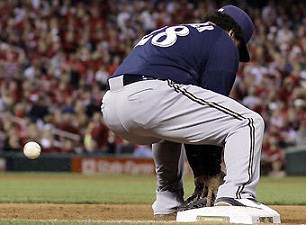 Gonzalez and Teixeira have made no errors, Gonzalez in a league-leading 423 chances, Teixeira in 372 chances. Pujols has committed one error in 406 chances. Then there is Fielder, who made his sixth error Wednesday night in 360 chances.
Before you dismiss Fielder’s errors as insignificant, know that No. 6 cost the Tigers their game with the Indians. Fielder’s low throw to the plate allowed the Indians to score the tie-breaking run and put another runner in position to score another unearned run.
The error also broke Fielder’s tie with Yonder Alonso of San Diego for the major league lead in errors committed by a first baseman.
Alonso, a 25-year-old Cuban native, joined the Padres as one of four players they received in December from the Reds in exchange for pitcher Mat Latos.
Alonso does not make as much as Fielder – he signed a five-year, $4.55 million contract with the Reds after they made him the seventh player picked in the 2008 draft. But in some ways, he is outhitting Fielder.
The line for Alonso:
| BA | OB % | SLG % | HR | RBI | ||
| Alonso | .300 | .384 | .413 | 1 | 13 |
I have strayed from the primary point of the column, the mysterious disappearance of the offense provided by Pujols, Gonzalez and Teixeira. But it may be more rewarding to follow the future of a youngster like Alonso as he continues to develop than to follow the million-dollar meltdowns of a trio of rich guys.