What a pity it would be if three teams from the American League East make the playoffs, and the Boston Red Sox were not one of them. It wouldn’t be fair. It especially wouldn’t be fair if the Red Sox didn’t make the playoffs because they have started the season with so many of their starting players on the disabled list instead of on the field.
And as if the injuries haven’t done enough damage, the Red Sox are saddled with Bobby Valentine as their manager. He got off on the wrong foot – actually, his foot was in his mouth – as he questioned the desire of Kevin Youkilis, possibly the hardest playing player on the roster.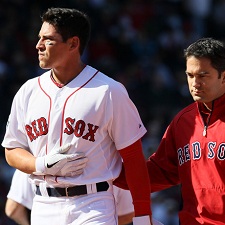
No one, however, is going to feel sorry for the Red Sox, just as no one will feel sorry for the Yankees if they are left behind at the post-season gate come October. Like the Red Sox, the Yankees have encountered significant physical setbacks.
The maligned Youkilis is one of the players the Red Sox have missed. Plagued by a low-back strain, he has played in only 18 games and has struggled with a .219 batting average.
At least he is the only infielder whom the Red Sox have had to replace.
The outfield is missing two of its three regulars – Carl Crawford and Jacoby Ellsbury. Crawford, who has yet to play this season, is recovering from a sprained elbow ligament. Ellsbury injured his right shoulder after playing only seven games and hitting .192. He sustained the injury in a slide into second base when the fielder flipped in the air and landed on Ellsbury’s shoulder.
Andrew Bailey, whom the Red Sox acquired from Oakland to replace Jonathan Papelbon as their closer, hurt his right thumb, also in a collision, this one at first base in a Florida exhibition game. He didn’t initially realize that he had injured the thumb, discovering it a few days later when he felt pain as he squeezed a shampoo bottle.
Daisuke Matsuzaka, a member of the starting pitching rotation, has been out since early last season, having ligament-transplant elbow surgery in June. John Lackey, a fellow starter, had the same operation after the season and will not pitch this season.
Bobby Jenks, whom the Red Sox signed before last season to bolster their bullpen, pitched only 15 2/3 innings because of arm and back problems, then underwent two operations last December to remove bone fragments from his lower back. He has not returned.
Will he ever return, as the Kingston Trio asked in a tune from my youth. The reference is appropriate because the song I refer to is about a rider, Charlie, on Boston’s underground system, the M.T.A.
The Red Sox believe Jenks and the other recovering injured, except for Lackey, will return sometime this season. Jenks, they think, could be back after the All-Star break.
Youkilis is in the minors on a rehabilitation assignment, looking fit enough to return this week. Matsuzaka had been there, too, but suffered a setback and was recalled from his rehab assignment.
The Red Sox say Bailey possibly could be ready to relieve for them in August, Ellsbury could possibly return in the middle of next month and Crawford may possibly be ready to make his second-year debut after the All-Star break.
The Red Sox await Crawford’s return anxiously because they don’t know what to expect after last season. Last season he did not perform as they expected for their $142 million commitment.
Crawford batted a career-low .255 after hitting between .305 and .315 in five of the previous six seasons. He also had his lowest on-base percentage (.289) and his fewest stolen bases (18) as well as his second lowest slugging percentage in eight years (.405) and his second lowest total bases in his career (205).
In other words, he did not produce in the manner that prompted the Red Sox to give him the eyebrow-raising seven-year contract. Now it’s very likely that when he comes back, he will try to make up in half a season, if that much, what he didn’t do that year and the first half of this year, an effort that can only result in more disaster.
Lest anyone forget – surely Red Sox fans won’t – the Crawford contract was extended by Theo Epstein, the general manager, who was the first one out the door – voluntarily – after the Red Sox suffered their worst September collapse ever and didn’t get to the post-season for the second successive season.
Epstein’s successor, Ben Cherington, did not return a call seeking comment on the plight of the Red Sox. General managers don’t like to use injuries as an excuse for losing, but they don’t mind if others suggest it.
Unlike the Red Sox physical ills, the Yankees’ problems have centered primarily on pitching. They have the world’s best closer,  Mariano Rivera, and two of his setup aides, David Robertson and Joba Chamberlain, on the disabled list, Rivera with a torn knee ligament that most likely has finished his season, Chamberlain with a doubly injured ankle (torn ligament, dislocation) and Robertson with a strained oblique.
Another reliever, Pedro Feliciano, is in his second season with the Yankees but has not pitched for them because of the rotator cuff in his left shoulder, on which he had surgery last September after a conservative approach didn’t solve the problem.
Michael Pineda, a starting pitcher, whom the Yankees obtained from Seattle in a January trade, also hasn’t pitched for the Yankees. He had surgery May 1 to fix a labrum tear in his right shoulder and won’t pitch this season.
Brett Gardner, who is not a pitcher but the Yankees’ left fielder (when healthy), has played in only nine games this season because of an elbow ailment and is on the disabled list with a .321 batting average. He was told May 10 not to swing a bat for 10 days, but the Yankees hope to have him back by early next month.
Chamberlain, who injured his ankle playing on a trampoline with his son while recovering from elbow surgery, was playing catch as of last week, the Yankees said, but they had no target date for his return. They hope that Robertson will be ready to return by the end of this month.
Even with all of the Red Sox and Yankees’ injuries, the most intriguing development with the disabled list, I think, is the season-long presence on it of half the Philadelphia infield. Neither first baseman Ryan Howard (Achilles heel surgery) nor second baseman Chase Utley knee) has played an inning of the season.
Howard is hitting, fielding and throwing, and the Phillies hope he’ll be ready to play later this month or early next month.
Utley has fielded and run but doesn’t have an estimated time of arrival in the Phillies’ lineup.
Without Howard and Utley, the Phillies have been a solid last-place team in the National League East. But in recent days the Phillies pushed their way beyond .500 for the first time since they won their season opener.
The Yankees have been above .500 for a month, but in two different stretches this month they have slipped behind Toronto into fourth place. Only a quarter of the season has been played so plenty of time remains for the standings to undergo a shuffle or three.
The Red Sox? They have owned last place in the A.L. East, have not had a winning record on any day and needed a recent five-game winning spurt to get close to .500. However, before their Sunday game in Philadelphia they were the same 7 ½ games from first as they were before the streak.
VALENTINE NEARS NO. 2 ALL-TIME RANKING
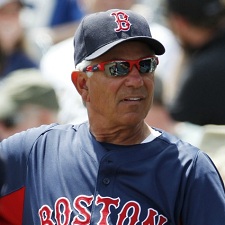 Bobby Valentine is on the threshold of advancing in his particular niche in baseball history. The Red Sox place in the standings is integral to Valentine’s success at attaining his new place.
The Red Sox, it should be remembered, fired Terry Francona, who managed the team to not one but two World Series titles, and hired Valentine, who was not the choice of general manager Ben Cherington but chief executive Larry Lucchino.
Maybe Lucchino was enraptured by Valentine’s pending achievement. With Boston’s June 2 game at Toronto, barring rainouts, Valentine will pass Frank Robinson and ascend to No. 2 on the list of managing the most games without finishing in first place. His total that day of 2,242 will be exceeded only by Jimmy Dykes and his 2,962 games.
Valentine would need three and two-thirds seasons after this season to become No. 1. Valentine has managed teams into the playoffs – in 1999 and 2000 – but in both years the Mets got there as a second-place, wild-card team. The Red Sox could reach the playoffs this season as a wild card, but it would not deter Valentine’s quest to be No. 2.
WHILE SELIG FIDDLES, WOLFF BURNS
Despite widespread skepticism to the contrary, Bud Selig must be serious about his intention to retire as commissioner after the 2014 season. What has he done to indicate that? After the owners’ meeting in New York last week, he made some comments that some people found so funny that they figured he must be working on his next life as a comedian.
 The comments were about the fight between the Oakland Athletic and the San Francisco Giants over the status of San Jose. The Athletics want to build a new stadium and move to San Jose. The Giants are blocking the plan, claiming San Jose is part of their territory.
More than three years ago Selig appointed a three-man committee to study the matter, but when he has been asked in recent months what is happening with San Jose, the commissioner has said the committee hasn’t completed its work.
In reality, that excuse is a euphemism for “the teams haven’t reached an agreement, and I don’t want to have to make a decision.”
Last Thursday, Selig was asked about the issue at a press briefing. A regular reader of this Web site saw the Associated Press report on Selig’s comments and wrote:
“When I saw this last night I immediately thought of your articles on the A’s to San Jose disaster.
“Paragraphs 4 and 6 border on Orwellian (Seliggian?). Paragraphs 11 and 12 seem to indicate the ‘danse macabre’ of the A’s franchise will continue for quite some time.”
The reader/writer referred to Selig’s comments in response to reporters’ questions. Asked, for example, whether the A’s would consider other possibilities, Selig said, “You’d have to ask Lew Wolff. That’s really his decision to make.”
What exactly is Wolff’s decision? To stay and die in Oakland? To move to San Jose without Selig’s permission?
Then, speaking on the need for approval for a move, Selig said, “It depends where they’d be. They could be all over the world, for that matter. They need approval. \ We have to go through an approval process. It just depends on where they’re moving to.”
Apparently, it would be easier for Wolff to receive approval to move to San Jose, Costa Rica, than to San Jose, Calif.
Selig said he could not offer a timetable, and when he was asked if a decision was approaching, he said no.
Meanwhile, Wolff, who is in baseball because his college buddy, Selig, urged him to buy the A’s, sits in Oakland and waits forlornly for a decision that may never come. He is not laughing; nor should he be?
THANKS A LOT, DAD
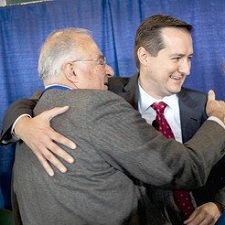 This is a typical case of the right hand not knowing what the left hand is doing. It’s just in an unusual context, and there’s greater meaning to right and left than unusual.
In this instance, the right hand represents Joe Ricketts, the patriarch of the family that owns the Chicago Cubs and the left hand Tom Ricketts, son of Joe and chairman of the Cubs.
News developed last week, first appearing in The New York Times, that Joe Ricketts, with $10 million of his own money, would fund a nasty campaign based on race aimed at defeating President Barack Obama’s bid for re-election.
The plan might have been good for the Republican Party but not for the Cubs, who have been in sensitive negotiations with the city and the state to fund a $300 million renovation of Wrigley Field.
The mayor of Chicago is Rahm Emanuel, who was Obama’s first chief of staff. It didn’t take much for Tom Ricketts to envision Mayor Emanuel saying at their next meeting, “Why don’t you just ask daddy for that $300 million?”
An aide to the mayor was quoted in Chicago as saying that the Ricketts family had tried to reach Emanuel to discuss the matter but that he had rejected them.
The Times reported that a 54-page proposal that was prepared for Joe Ricketts was titled “The Defeat of Barack Hussein Obama: The Ricketts Plan to End His Spending for Good.” Instead the plan might have ended the Cubs’ chances of getting the city of Chicago to spend millions on a Wrigley renovation.
HERE COMES MANNY
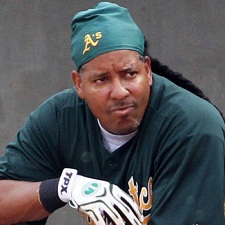 Just when you thought you’d heard and seen the last of Manny Ramirez, he’s back. Barring rainouts, which would prolong the days covered by his 50-game suspension, Ramirez will be eligible to play for the Oakland Athletics May 30, his 40th birthday.
The Athletics scheduled Ramirez for 10 Class AAA minor league games, the first of which was Saturday for Sacramento against Albuquerque. Playing his first game of any kind since April 2011, the designated hitter was hitless in four at-bats,
The 2011 season ended prematurely for Ramirez because he tested positive for use of a banned substance. It was his second suspension, meaning the penalty was 100 games.
Rather than serve the suspension and miss most of the season, Ramirez opted to retire.
Changing his mind last year, he was reinstated with the understanding that his missed season entitled him to have 50 games shaved from the original penalty. He begins the post-retirement part of his career with a .312 batting average and 555 home runs.