Gene Michael was the general manager of the Yankees when Derek Jeter was drafted into their organization in 1992, the sixth player taken in that year’s June draft, but he didn’t know much about the young shortstop. In fact, the first and most vivid recollection he has of Jeter stemmed from a telephone call he received from a former player.
Tim Cullen, a major league second baseman who retired in 1972, was working for the owner of the minor league team Jeter was playing for in Greensboro, N.C. in 1993, his second year as a professional player.
“He called me one day at the stadium,” Michael related, “and said, ‘Stick, you have a shortstop here who’s erratic. He throws the ball away. His hands are bad.’ I said what do you mean bad? He said, ‘This kid is terrible. He’s making all these errors.’ I didn’t realize he was making them. He must have had 35 errors halfway through the season.”
“I went down to Greensboro and I could see he was erratic,” continued Michael, a former shortstop. “He was fielding the same ground balls differently. He didn’t have a routine. He ended up with 56 errors. I made 56 errors my first year. I didn’t know how to play. I just made plays differently. ”
Michael said he suggested to Jeter that he adopt a fielding routine, taking the same steps and throwing the ball the same way on each routine grounder.
“I don’t know if it had any effect,” Michael said. But the next season Jeter sped through the minors, climbing from Class A to AA to AAA and reducing his error total to 25.
“It was quite a trip for a young player like that,” Michael said.
As impressive as the trip was, however, it was nothing like the trip Jeter has taken since then. Arriving in New York in 1995, Jeter has established himself as one of the greatest Yankees players of all time.
Jeter entered the weekend only eights hits from tying Lou Gehrig for No. 1 on the Yankees’ lifetime list of hitters.
As many great hitters as the Yankees have had, it’s remarkable to realize that Jeter is only several swings from becoming the Yankees’ all-time hits leader. As many great hitters as the Yankees have had, it’s even more remarkable to realize that they don’t have a player of their own with 3,000 hits.
Three of the 27 players who attained the 3,000-hit plateau played for the Yankees, but combined Dave Winfield (3,110), Wade Boggs (3,010) and Rickey Henderson (3,055) didn’t reach 3,000 with the Yankees. Winfield collected 1,300, Boggs 702 and Henderson 663. Their Yankees’ total of 2,665 falls short of Jeter’s 2,713.
 Jeter has been remarkable for the career he has had, but he is also remarkable for his ability, at age 35, to continue playing at the high level of his younger years.
With 178 hits before Saturday’s game and 27 games to play, Jeter is in position to get 200 hits for the seventh time in his career. Two years ago Jeter registered his sixth 200-hit season, joining Gehrig as the only Yankees’ hitters to have at least six 200-hit seasons (Gehrig had eight). No other shortstop for any team ever had six 200-hit seasons.
It was also the ninth season in which Jeter had 190 hits, and the only players who had reached that distinction were Pete Rose, Ty Cobb, Stan Musial, Paul Waner and Gehrig. In other words Jeter is in pretty good company with a serious chunk of his career remaining.
Jeter fell short of those levels last season with 179, but his 178 hits this season are second in the league to Ichiro Suzuki’s 189. Jeter also began Saturday with a .330 batting average, fifth in the league, 54 multi-hit games (third) and 95 runs scored (tied for third).
Jeter had 40 hits in July and 46 in August, marking his first consecutive 40-hit months since 2001. Jeter has had a total of 13 40-hit months in his career, second among active players to Ichiro’s 21 and most for a Yankees hitter since Joe DiMaggio’s 17.
For his career, Jeter is 16th for hits while playing for only one team, Elias Sports Bureau said, and he is 56th on the career-hit list, just behind Gehrig, who is 53rd, the man he is about to pass.
“I don’t believe anybody who tells you he could envision what he’s done,” Michael said. “I remember ‘94 when he jumped three classes. It looked like he’d be a big leaguer but you couldn’t envision the career he’s had.”
The Yankees had the sixth pick in the June 1992 draft and tabbed Jeter after Phil Nevin, Paul Shuey, B.J. Wallace, Jeffrey Hammonds and Chad Mottola had been taken. Four of those players reached the majors, but their careers were over by the end of the 2007 season or earlier.
Meanwhile, Jeter keeps going and going and going, and at a level few players have attained at any age.
“We’ve had a lot of good players but nothing like Derek,” Michael said.
Though Michael was not responsible for choosing Jeter, he created a new culture at the Yankees where they retained their good young prospects instead of trading them for high-priced veterans, a practice pursued to disaster by George Steinbrenner. Michael was able to keep players like Jeter, Mariano Rivera, Andy Pettitte and Jorge Posada because the owner was under suspension.
The nucleus Michael constructed produced four World Series championships and remains intact all of these years later. Jeter clearly has been its leader.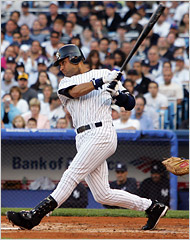
“He takes care of himself physically so well,” Michael said of the shortstop. “I know for a fact he works out and won’t allow anything to break up his workout routine. I know in January he’s fulltime with his workouts.”
Michael recalled a first-hand experience he had with Jeter and his workouts. “I offered him $200,000 from a friend of mine one time for a fund-raiser,” Michael said. “He said he didn’t know if he could do it because of his schedule. He said ‘I’ll try to find out, Stick, but I don’t like to do anything to break up my schedule. I don’t want to go anywhere.’ He didn’t want to do anything to interfere with baseball.”
One could argue that with an average salary of $18.9 million a year Jeter didn’t need the $200,000, but even wealthy players like that kind of payday.
Jeter’s workouts are aimed at winning. If they improve or maintain his level of play, he can help the Yankees win. But don’t try to talk to him about his specific numbers or performance.
“He’s a rare player,” said Michael, who is a Yankees senior vice president and special advisor. “He’s into winning, not into numbers. He loves the glorification of winning. He wants to be the very best. He’s a special kind of person.”
At 35, Jeter doesn’t show signs of slowing down, which will force the Yankees to make a critical decision in the next year or so. Jeter’s 10-year, $189 million contract will expire after next season, and the Yankees will have to decide how to structure a new deal.
Michael recalled a scene from a recent spring that signaled Jeter’s thinking.
“I was in the trainer’s room in Tampa,” Michael said. “We were talking about some players, and Derek was sitting on the trainer’s table, not talking much. He said, ‘Stick, how many more years do you think I can play?’ I said one. He said, ‘No, I’m serious. How many years? I want to play 10.’ I said why 10. Wouldn’t you like to do something else in your life besides playing baseball?”
“He’s a baseball junky,” Michael said. “He’s all about winning. Down deep he loves the attention of baseball. That’s all he wants to do.”
In recent years Jeter has come under criticism from the self-proclaimed experts who base their expertise on new-fangled statistics that purportedly measure a player’s defensive ability. Michael isn’t a subscriber.
Refering to Don Zimmer, the Yankees’ former bench coach, Michael said, “Zimmer and I said he’s the best ever at coming in for a chopper over the mound and throwing the guy out. I could do it; a lot of players could do it, but who could catch it better on the run and throw the guy out? He never misses the ball. He has the best hands you could ever see.
 “They forget about all the choppers and all the balls he chases into center field running full tilt and catching the ball. I don’t know how he could bend his head back to see the ball.”
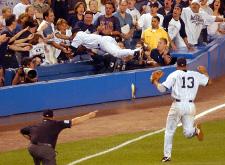
There are also the spectacular plays that Jeter has made, the backhand flip to the plate that caught Jeremy Giambi and the dive into the third baseball stands in catching a foul pop. The Giambi play helped keep the Yankees in the 2001 playoffs.
“He’s so clutch,” Michael said. “Who do you want the ball hit to? You’d love to have it hit to Derek, and you want him up in a key moment.”
And Jeter is usually available to field and hit because he doesn’t believe in taking time off, a reminder of a guy named Gehrig. “I wasn’t good at playing through injuries,” Michael said. “I could never ever play through injuries the way he has. He doesn’t even let you know that anything’s wrong.”
At one point in the telephone conversation Michael remembered a phone call he made early in Jeter’s career. “After his rookie year in ‘96,” Michael related, laughing, “I couldn’t resist the temptation of calling Timmy Cullen and telling him I could never hire him as a scout.”
PITCHERS – GO FIGURE
After Mark Buehrle pitched a perfect game against Tampa Bay July 23, he had an 11-3 record and a 3.28 earned run average in 20 starts. In 8 starts since the perfect game, the Chicago White Sox pitcher has a 0-4 record and a 5.44 e.r.a.
Brad Penny started 24 games for Boston and produced a 7-8 record and a 5.61 e.r.a. The Red Sox released him, and Penny signed with San Francisco. In his first start for the Giants last Wednesday Penny pitched eight shutout innings against Philadelphia and won, 4-0.
Like Penny, John Smoltz joined the Red Sox as a free agent, and he, too, failed. He struggled with a 2-5 record and an 8.33 e.r.a. before the Red Sox released him. Smoltz, a free agent again, went to St. Louis where he has started three games and produced a 1-1 record and 2.65 e.r.a. He allowed only one run in 11 innings in his first two starts.
Jose Contreras is yet another National League reclamation project. Contreras had lost his spot in the White Sox starting rotation because of his 5-13 record and 5.42 e.r.a. in 21 start, and they traded him to Colorado . In his first start for the Rockies Saturday night, Contreras allowed one run in 6 2/3 innings in a 4-1 victory over Arizona .
Then there is Brett Tomko. He relieved in 15 games for the Yankees, compiling a 1-2 record and 5.23 e.r.a., and after they released him he signed with Oakland. The Athletics needed the 36-year-old right-hander as a starter, and his first assignment was against the Yankees. He gave up 5 hits and no runs in 5 innings in the A’s 3-0 victory.
ZANY ZITO
 Maybe the Giants will never figure out Barry Zito.
After a poor first half of the season, which followed a poor two full seasons with the Giants under a 7-year, $126 million contract, Zito began pitching consistently well. In 18 starts before July 18, the left-hander had a 5-9 record and 5.01 e.r.a. In his next nine starts he had a 4-2 record and 2.97 e.r.a.
Aha, the Giants figured, they could count on Zito to join Tim Lincecum and Matt Cain in pitching them into the playoffs. They knew they wouldn’t make it with their hitting.
But then Zito started against Milwaukee last Friday night and lasted only 4 innings because he threw 96 pitches. That’s an average of 24 pitches an inning. No pitcher can win throwing 24 pitches an inning. No pitcher can last long throwing 24 pitches an inning.
Zito didn’t last long, but the six pitchers who followed him allowed the Brewers no more runs, and the Giants won, 3-2, with the aid of a Mike Cameron error and a Benji Molina home run.
LEGACY OF A LAST-MINUTE SWITCH
Last season the Toronto Blue Jays had an 86-76 record, matching their best record in J.P. Ricciardi’s six years as general manager. They had the same record in Ricciardi’s first year in 2003. But with a 60-75 record after Saturday’s loss to the Yankees the Blue Jays are expected to finish with their second worst record under Ricciardi.
That trend doesn’t represent progress for the Blue Jays and has prompted recall of a story of how Ricciardi became the team’s general manager in October 2002.
Paul Godfrey, the club president and c.e.o., was set to name Doug Melvin, a Canadian, to the position. Melvin was available because the Texas Rangers had fired him a year earlier as their general manager. Godfrey had interviewed Melvin and now called him to ask him to return to Toronto and plan to stay overnight. Though Godfrey didn’t say as much, the job appeared to be his.
But then Godfrey called Melvin again, cancelling the visit, saying another candidate had come in “and knocked our socks off so we’re going in another direction.”
In the interim, Godfrey had received a call from Peter Gammons, an ESPN analyst, who strongly recommended that Godfrey hire Ricciardi. Figuring the Blue Jays could benefit from good publicity via ESPN, Godfrey did precisely that.
There’s no telling if the Blue Jays would be better off had Melvin been hired, but the Blue Jays certainly aren’t well off now and they have to decide in the next year if they want to extend Ricciardi’s contract.
Paul Beeston, who succeeded Godfrey as the Blue Jays chief executive, recently said he likes Ricciardi, but he is also eager to give up his job. Furthermore, there is a lot of grumbling in Toronto about Ricciardi and a lot of sentiment favoring a change.
TEMPERING TAMPERING
On the day last week that the Los Angeles Dodgers traded for Jim Thome, general manager Ned Colletti disclosed that Thome had called him before the trade had been completed to tell him not to count on him to play first base. It was a thoughtful gesture by Thome but raised a question about tampering.
 Clubs are not permitted to talk to other teams’ players generally and specifically not without permission from and the knowledge of the commissioner’s office. The commissioner’s office was not involved in the Thome-Colletti conversation and did not know about it. Under what circumstance did the conversation take place?
“The White Sox gave them permission,” said Jimmie Lee Solomon, head of Major League Baseball’s baseball operations. “Technically they should have notified us. But by the time they went to him to talk to him about his no-trade waiver, time was of the essence. We would have agreed with it. We would have approved it anyway.”
But tampering is not as strictly enforced as it once was. The commissioner and his aides are more lenient than their predecessors. They will more readily approve a trade, for example, that includes a large amount of money because Commissioner Bud Selig wants to be accommodating to less wealthy teams.
PIRATES’ PERENNIAL POSITION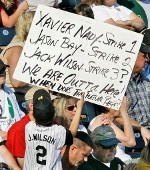
The Pirates entered their game with St. Louis Sunday needing only to lose to become the all-time worst franchise in baseball history. A loss would be their 82nd of the season, insuring their 17th successive losing season. The Philadelphia Phillies of 1933 through 1948 held the record for seasons-long futility until the Pirates caught them last year.
Now the Pirates will cast off those Phillies and stand alone as the putrid Pirates. The people who inherited the mess two years ago should not be blamed for the streak, but their start to their part of the operation has not begun with promise. They threaten to extend the streak for many more years because like their predecessors, they have traded their best players under the guise of accumulating good young talent.
They will retain that good young talent until they start making too much money, and they will trade them, too.
