Seeing the flurry of trade activity earlier this week, I had to check the calendar to make sure it wasn’t July 31, the day of the nonwaiver trading deadline. It could be Groundhog Day, Major League Baseball version.
But no, it was the 31st all right, but the 31st of August, not July. Nevertheless it was a deadline day, the deadline for players to be on teams that wanted them eligible for post-season games.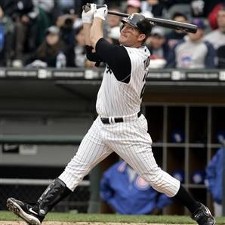
The Los Angeles Dodgers were particularly busy rearranging their roster. Their general manager, Ned Colletti, painfully aware that his team had lost 19 of its previous 36 games, made three trades, acquiring a starting pitcher, Jon Garland, and a prolific home run hitter, Jim Thome, the day after picking up an infielder, Ronnie Belliard.
Besides trading Thome, the Chicago White Sox traded pitcher Jose Contreras, to the Colorado Rockies, and San Francisco signed a pitcher, Brad Penny, whom Boston had put on waivers.
The Dodgers obviously were gearing up for the final month of the regular season – the stretch run, as it is called – and the Giants were reinforcing their starting rotation for their run at the National League wild card, if not the N.L. West title that the Dodgers seemed headed for.
But the White Sox? They alone among other contenders were acting as sellers, not buyers. Were they signaling surrender in both the American League Central and the wild-card races?
The wild card certainly seemed beyond their reach. On the day they traded Thome and Contreras they were 12 ½ games behind Boston, and four other teams stood between them and the Red Sox. But first place in the division? The White Sox had been in second place for nearly two months, never too far from Detroit, and the Tigers were showing signs of collapsing.
The White Sox, though, were suddenly struggling. They had lost seven of their last eight games and had slipped to third. Maybe they were signaling surrender. But wait a minute. How could that be? In the previous month they had made two bold, expensive moves to reinforce their position in the division race, uncharacteristic moves, one could almost say.
On July 31 they had acquired Jake Peavy, one of baseball’s best starting pitchers, from San Diego, and 10 days later they claimed Alex Rios, a good-hitting outfielder, on waivers from Toronto. In assuming their contracts the White Sox were playing in Yankees territory.
For Peavy and Rios the White Sox had committed $117 million. Peavy has a three-year contract for $52 million beginning next year, and the White Sox would pay $3.9 million of his $11 million salary for this year. Rios is in the second year of a seven-year contract that runs through 2014, and the White Sox will pay $61.5 million of that.
 To commit to such contracts, the White Sox had to be ultra serious about going after a division title this season. Having tried unsuccessfully to get Peavy earlier in the season, they wanted him so badly that they were willing to wait for him to get past an ankle ailment and get off the disabled list.
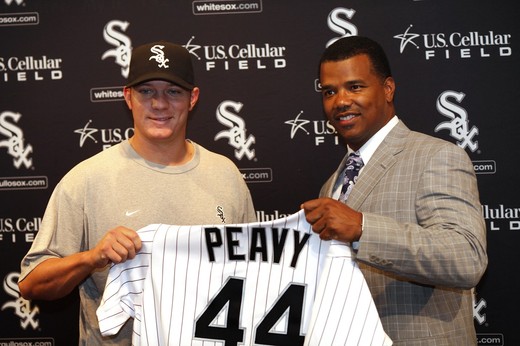
As it turned out, the wait would be longer than the White Sox expected because Peavy was hit on his right elbow by a line drive in his third rehabilitation start. The resulting bruise and swelling have delayed his appearance with the White Sox.
“He actually would have been able to pitch last week in New York had he not got hit on the elbow by a comebacker,” Ken Williams, the White Sox general manager, said in a telephone interview. “Now it’s a matter of getting that soreness out and feeling good enough to pitch. We’ll exercise extreme caution and care. It’s in Jake’s hands.”
It’s possible that the White Sox will be so careful that depending on where they are in the standings when Peavy is ready to pitch they may tell him to wait ‘til next year.
That’s what it appears more and more likely that the White Sox will have to do themselves. Not only were they falling farther behind the Tigers but in losing two games to Minnesota at the end of August and the start of September they fell farther behind the second-place Twins.
So maybe it was smart of the White Sox to be sellers and not buyers before the August deadline day. Except their place in the race did not prompt them to trade Thome and Contreras, Williams said.
“Yesterday’s moves were just as much about doing the right thing for two quality people than anything else,” Williams said. He acknowledged that “we get some savings in salaries for the last month of the season, which always helps,” but offered an additional explanation for the trades.
About Thome, he said, “I made Thome a promise when he agreed to come here that we’d go after a championship. This guy, in all my years in baseball I have not run into a finer man. The opportunity that came up yesterday I had to put it in front of him. I didn’t want him to leave us, but I always felt if I had the opportunity to put him in position to get a ring I had to put it in front of him.”
Williams expected to get a negative reply from Thome, whose contract gives him veto rights over a trade. Thome has been a designated hitter with the White Sox, playing first base in only four games in four seasons, and the Dodgers don’t need a d.h. In other words, Thome would get little playing time, serving as a pinch-hitter and diluting his chances to add to his career home run total of 564.
“I was surprised that he accepted it,” Williams said. “But all he cares about is a championship. How many guys would leave this kind of situation for a chance to get a championship?”
Thome, however, could have it both ways. He goes to the Dodgers with a chance to win a championship, and because he can be a free agent after the season, he can return to the American League next season.
Reiterating that the two trades were done strictly for the players and saying that he had discussed them with the team owner, Jerry Reinsdorf, Williams explained the move with Contreras, who had been removed from the starting rotation.
“Contreras pitched us to a World Series a few years back,” Williams said. “If he is rotting in our bullpen, what kind of position does that put him in going out as a free agent? What does that do for him?”
By shedding Thome and Contreras for the final month, the White Six save $4.27 million from their salaries. While every little bit helps, that sum wouldn’t make much of a dent in the $117 million the White Sox have taken on with Peavy and Rios. In other words, Williams’ explanation for the trades is more believable than the excuse most general managers give when they shed payroll.
We’re not giving up the ship yet,” Williams said. “I understand how we’ve played recently. We’re still going to try to win this thing. The only thought I have right now is I’m not happy where the White Sox are in the division. We have been very lifeless. It’s disappointing. It’s been a tremendous opportunity so far wasted, but there’s still time.”