Only a few weeks ago the Oakland Athletics and the Milwaukee Brewers could have justifiably begun making post-season plans that didn’t include cruises on the Mediterranean and hunting in Montana. Baseball games in October would have been the idea.
Now the Athletics and the Brewers are in jeopardy of not even gaining wild-card spots in the playoffs, the perilous pleasure of potentially playing one game and going home.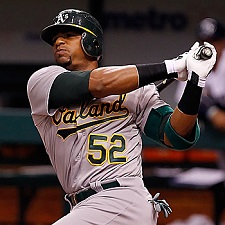
The Detroit Tigers face a similar quandary, though they seem to have short-circuited their tailspin and have at least a fighting chance to win the division title that had been conceded to them before the season began.
The Los Angeles Dodgers, meanwhile, were doing their utmost to justify their general manager’s cautionary concern that he expressed two weeks ago, before the San Francisco Giants slashed the Dodgers’ lead over them from five games to one (it was two before Sunday).
“They’ve got a long way to go,” Ned Colletti said of his players. “It’s a baseball season, not a baseball week.”
The Athletics especially face a perilous last two weeks because their general manager, Billy Beane, tried to corner the market on available starting pitching in pre-deadline trades, adding Jon Lester, Jeff Samardzija and Jason Hammel to the A’s starting rotation.
In the key deal, the Athletics gave up one of their best hitters, left fielder Yoenis Cespedes, and have suffered offensively without him.
“Did Oakland miscalculate with the offense?” asked the general manager of another team. “People say Billy Beane made a mistake, but we won’t know until it’s finished.”
The A’s, the general manager added, were “hoping if they get in a short series,” the renovated rotation could prevail over any playoff opponent.
Beane, however, denied that he had the post-season uppermost in his mind when he made the deals for pitchers.
“We needed pitching,” he said in a telephone interview Saturday. “I couldn’t be more adamant when I said after the Lester trade we had to get there first. We have a deep division. We had two very good teams behind us. This is not a surprise to me at all.”
On the same day the A’s acquired Lester, the Detroit Tigers made a similar move, obtaining David Price from Tampa Bay in a three-team transaction. They wanted to bolster their rotation for post-season purposes. Both high-profile, high-powered trades, however, boomeranged.
“How about a column on how the A’s and Tigers outsmarted themselves by making high-profile deals that ruined their teams?” an astute reader wrote last Sunday.
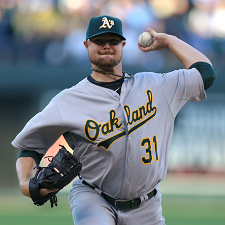 Lester has pitched more effectively for the A’s than Price has for the Tigers, but the Tigers have not played as poorly as the A’s since the trades. Entering Sunday’s games, the A’s had compiled a 16-25 record since July 31, the Tigers 25-20.
The A’s had squandered a two-game lead in the American League West, plummeting 11 games behind the Angels, and had also jeopardized their lead in the A.L. wild-card race. Holding a dominant lead in that race not long ago, the A’s were only a game and a half from slipping to third in a contest that allows for only two winners.
In Lester’s first eight starts for Oakland, he had a 4-3 record and a 2.54 earned run average. He has won only one of his last five starts despite a 2.57 e.r.a. His efforts, however, haven’t countered the loss of Cespedes, the left fielder Beane had to give up to get Lester.
“We had to rob Peter to pay Paul,” Beane said, using an old aphorism.
The view of the impact of the loss of Cespedes is mixed. One school says the A’s miss his presence in the lineup. Another school says his contribution was overrated, considering that he had the third lowest on-base percentage on the team at the time of the trade.
There is also a view that says the acquisition of Lester raised expectations for the A’s, whose players aren’t used to the higher expectations and very likely put too much pressure on themselves to meet them.
Injuries have also contributed, but few teams escape the injury problem.
Detroit has not fallen as quickly or as far as the Athletics. The Tigers led the A. L. Central by seven games July 24 and a week later, when they acquired Price, their lead was five games.
In his first eight starts for the Tigers, Price was not spectacular. He had a 2-3 record with a 3.83 e.r.a.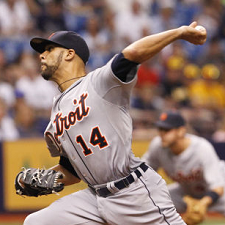
Kansas City, a team unfamiliar to the post-season for three decades, replaced Detroit in first place the second week of August by winning three of four from, interestingly, Oakland. The Royals clung to the division lead for a month, but the Tigers never fell farther behind by more than three games, and then only for a day.
The Tigers reclaimed the top spot Friday night, but with only two weeks left, the two teams will most likely go to the end of the season before a winner is determined. They have a three-game series next weekend in Kansas City.
If that segment of the schedule favors the Royals, the Tigers’ remaining seven games after that series are with the White Sox and the Twins, the only teams in the division with losing records. The Royals play the Indians and the White Sox.
The schedule is the thing that favors the Athletics in the A.L. wild-card competition. They have a three-game series with the Angels, but the rest of their games are with Texas (7) and Philadelphia (3). The Phillies have been in last place in the N.L. East virtually all season, and the Rangers have the majors’ worst record.
In spite of the A’s collapse, Beane said Saturday, “We’re still in the playoffs,” referring to his team’s slim wild-card lead. “We have 14 more games. It’s a sprint.”
BREWERS BOTCH BEAUTIFUL SEASON
First place in the N.L. Central belonged to the Brewers until the beginning of September. If possession is nine-tenths of the law, the division was theirs.
The Brewers didn’t compete in the race for pitchers. They added two players, but neither was a superstar: outfielder Gerardo Parra and reliever Jonathan Broxton. The Brewers seemed confident that they could join the post-season party without buying extravagant new duds or dudes.
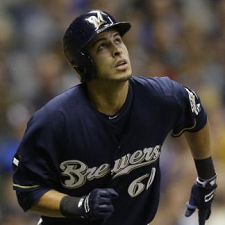
They ignored a critical sign, though. In late June and early July they lost 13 games in a 16-game stretch. As it turned out, that was a forewarning of doom. Beginning Aug. 20, they endured an even worse stretch, losing 16 of 19 games and dropping from an N.L. Central lead of two and a half games to third place and a six-game deficit.
Their playoff-certain status had evaporated.
“I get a kick out of the trade deadline,” Doug Melvin, the Milwaukee general manager, said in a telephone interview. “Dave Dombrowski is executive of the year (for the Price deal). “Another guy is manager of the year and teams are struggling. It’s a struggle. Baseball has no other sport like it because you play every day.”
What happened that the Brewers lost 16 of 19?
“All three components,” Melvin said candidly. “We didn’t do well. We didn’t hit well, we didn’t pitch well, we didn’t field well. You need to do two of those well to win games. If you don’t do at least two of those well, you’re not going to win games.”
“I can’t say injuries were an issue” Melvin added. “We had a few, but that’s not the reason. There’s such a small difference between winning and losing. You can get off to a good start, but you need to finish strong to win.”
 Melvin recalled the finish to the 2006 season in which the Brewers had a hand. St. Louis won 24 of its first 37 games, moved into first place in the N.L. Central May 13 and stayed there, except for one day, the rest of the season. No, that one day wasn’t the last day of the season; it was June 8.
But from Sept. 20 through Sept. 26, the Cardinals lost seven straight games at the same time Houston was winning nine in a row. Starting with a 72-78 record, the Astros jumped from third place, eight games behind the Cardinals, past Cincinnati into second place, only half a game from the Cardinals with three games to play.
Faced with a possible makeup game with San Francisco after the regular-season schedule ran out, the Cardinals won the first two games of their last three games with the Brewers. The Astros split two games with Atlanta and headed into their season finale one and a half games behind the Cardinals.
On Oct. 1, the Astros lost to the Braves, 3-1, while the Cardinals clinched the division title despite a 5-3 loss to the Brewers.
“It doesn’t matter how you start but how you finish,” Melvin said, adding, “We’re a better team now than we were at the start of the year. We added Broxton and Parra. If you were out of country for a whole season and came back and the Brewers were a game and a half out of the playoffs, you’d feel good.”
Not many Brewers fans, though, were out of the country. They painfully witnessed the collapse and now anxiously await the resurgence.