The headline read “Cano hopes to excite Seattle for baseball.”
The most celebrated member of the Mariners of an earlier generation excited Seattle for baseball, saved baseball for the city, in fact, led to the construction of a new park. As good and as exciting as Ken Griffey Jr. was, though, he didn’t spur the Mariners to post-season success.
While the city’s professional football team plays tonight in its second Super Bowl in its 38 years in the National Football League, the Mariners have never played in the World Series in their 37-year existence.
“That’s my one regret as I retire, that we haven’t gone to the World Series,” Chuck Armstrong, the team’s president for 28 years, said the day before he retired last week.
The Mariners reached the American League Championship Series in 2001 and 2002 but lost to the New York Yankees both times. They beat the Yankees in a scintillating five-game division series in 1995 (Griffey slid home with the winning run in the 11th inning) and had a two games to one lead over Cleveland in the A.L.C.S., but the Indians won the next three games.
The highlight of the Mariners’ history was their 116-win season under Lou Piniella in 2001, but recent history hasn’t been kind to the team that replaced the one Bud Selig, now the commissioner, spirited away to Milwaukee.
“We’ve been scuffling for a few years,” said a member of the front office of the team that has had four straight losing seasons and eight in the last 10.
And then came Cano.
In a move that was as surprising as any in many years, the Mariners signed the free-agent second baseman, snatching him from the Yankees with a 10-year, $240 million contract, a more unlikely deal than the one the Texas Rangers used to lure Alex Rodriguez from Seattle in 2000.
“I got here five years ago,” general manager Jack Zduriencik said. “We had pretty much bottomed out and started rebuilding, I felt ownership would allow us to do something like this at some point. I think the timing is right. Robbie was the best player on the market. With the opportunity to bring in that kind of talent ownership has to support it and they did.”
From the outside, if someone had suggested that the Mariners could land Cano, others would have looked at him strangely. Zduriencik, however, said, “I believed from the first discussion with the agent that it could happen.”
Mariners’ fans, though, have become used to failure. Armstrong himself acknowledged that in 2008 the Mariners became the first team to have a $100 million plus payroll ($120 million) and lose 100 games (101).
“The fans are very surprised,” said Randy Adamack, the Mariners’ communications director, who is a 35-year employee of the team. “Both to the money and that he left the Yankees and came to the Mariners. Fans are surprised but pleased by it.”
The 31-year-old Cano, who has played in four All-Star games and batted better than .300 seven times in his nine-year career, instantly became one of the most celebrated professional athletes in Seattle, tied perhaps with Russell Wilson, the Seahawks’ quarterback.
“Our FanFest is always a week before the Super Bowl,” Adamack said. “This year was the biggest two-day turnout we’ve ever had. Cano was there. People followed him everywhere he went.”
The Mariners are obviously are not suffering in the wake of the Seahawks’ success. Far from it.
“Our ticket sales are up over last year,” Armstrong said before departing. “Their success makes the city feel good about itself and creates a positive atmosphere around the city.”
Adamack added, “We’ve dug ourselves into a hole the last 10, 12 years. We have to dig our way out of it. It’s on us regardless of what’s happening in the marketplace.”
Cano, Zduriencik said, “is a big piece of that.”
“We’re going through a rebuilding process,” he added. “It takes time. It’s painstaking.”
It will be painful if Cano doesn’t hit up to expectations.
The Mariners last season had the lowest team batting average in the American League (.237) and one of the weakest offenses generally. The team earned run average was also weak, 4.31, the league’s third highest.
Those aren’t statistical characteristics that would easily attract a player who had played for the Yankees his entire career. He was asked at the FanFest why Seattle?
“A lot of people ask that,” Cano said. “But I’ve been coming here for nine years. I like this city. I always come and walk around the city. And this is a team to watch. I talked to the owners, and they’re going to build a team to win a championship. And that’s where you want to go.”
Notice he didn’t mention money. But as others have said, when a player says it’s not the money or cites other non-financial reasons, as Mike Hampton said it was the schools in the Denver area when he left New York in 2000 for Colorado and $121 million, it is the money.
In Cano’s case he said it was a matter of respect, as if a $175 million offer (an average of $25 million a year compared with a $24 million average the Mariners offered) demonstrates a lack of respect.
“I was hoping they would come up with a better offer,” Cano said, adding, “My goal was to stay there.”
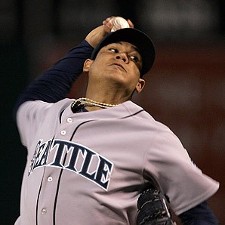 The Yankees’ part of Cano’s career is over, though, and now he will face great expectations to lead the Mariners out of baseball’s wilderness. Even with Cano and Felix Hernandez, one of baseball’s best pitchers, the Mariners aren’t likely to match the Seahawks’ Super Bowl achievement any time soon.
The closest the Mariners are likely to get to an ultimate post-season game or games is where they are now, sitting in the stands or in front of their television sets rooting for their hometown Seahawks.
“I’m a big Seahawks fan,” Armstrong said. “We’re going to pose for a team photo and everyone is going to wear a Seahawks jersey. It’ll be sent to the Seahawks, wishing them good luck.”
The Mariners also wished the Seahawks well in a full-page photo in the Super Bowl section of last Friday’s Seattle Times, showing uniform jerseys of nine players, including Cano and Hernandez, each with the No. 12 in place of their own numbers, 12 standing for the Seahawks’ 12th man.
“Bring it home, Hawks,” the photo said.
“As we say in Seattle, let’s go Hawks,” Adamack said on the phone.
“We’re ecstatic about the success the Seahawks are having,” said Zduriencik, who hopes the Seahawks have reason to return the sentiments in the near future. “Obviously our fans would like to see the Mariners get to the World Series. As we say in Seattle, let’s go Hawks.”
Seattle is the only existing Major League Baseball city that has never hosted a World Series game.
JUST A BIT SLOW ON USE OF SPEED
Billy Hamilton has played in the Cincinnati Reds’ minor league organization for five years, and it took them until this off-season to have him work on his bunting?
Faster than a speeding bullet, Hamilton is probably the most anticipated rookie in the majors as the Reds prepare to anoint him as their new center fielder. He will replace Shin-Soo Choo, the Korean who moved to Texas with a seven-year, $130 million contract.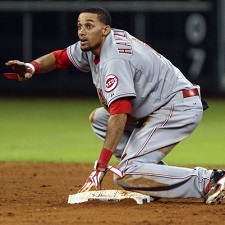
Hamilton played in 13 games for the Reds last September, batting .368 (7-for-19) and stealing successfully 13 times in 14 attempts.
In the minors last season, Hamilton stole 75 times in 90 attempts (83.7 percent) after breaking Vince Coleman’s professional record of 145 the year before by stealing 155 in 192 attempts (80.7 percent).
Now 23 years old, the 6-foot, 160-pound Hamilton is threatening to create stomach-turning discomfort for pitchers and catchers. Of course, he has to get on base first, and that’s where the bunting comes in.
Speaking with MLB.com about his work with former major leaguer Delino DeShields, Hamilton said, “It’s been good. I’ve been working on my bunting a lot more, and me and him are doing things with my hitting that will help me out this season. When spring training comes, I will be ready.”
The question I ask is with Hamilton’s speed, why didn‘t the Reds have him working on his bunting from day one? By now, he would be a master bunter and with his speed beat out any bunt no matter how well the defense played it.
Hamilton, a switch-hitter, is expected to replace Choo as the Reds’ leadoff hitter, and his proficiency for bunting plus his speed should be good for at least one hit a game.
I have always been a bunting enthusiast and think players, especially speedy ones, cheat themselves and their teams by not bunting more. The problem is bunting has fallen into disrepute because it is not a manly thing to do. Hitters, no matter their size and speed, would rather swing for the fences and strike out than bunt for a hit and get on base for someone to drive them in.
“Bunting is more points on your average,” Hamilton said. “My first year in Billings, I had maybe 20-something bunt hits and a great average [.318 in 2010]. I’m realizing now that I will have to bunt more for my average to get where I want it to be. It will be part of my game.”
I, for one, look forward to watching that part of his game.
A GOOD MAN LEAVES THE GAME
Michael Young is retiring and that’s too bad because baseball needs more Michael Youngs, not fewer.
Young, 37, had a 13-year career that was filled with as much class as any career ever. He ended that career with two more classy moves.
 The Los Angeles Dodgers, with whom he finished last season, wanted to sign the infielder for the 2014 season, making what was described as a substantial offer for what Young himself said would have been “a great role.”
But he decided he wanted to spend more time with his family and figured the best way to do that was to retire. Once he made that decision, Young opted to make the announcement in Arlington, Tex, where he played for 12 years.
One of the things that made Young such a class guy was his willingness to change positions. He demonstrated that several times, moving from second base to shortstop in 2004 when the Rangers traded Alex Rodriguez and acquired Alfonso Soriano; from short to third to make room for a Class AA rookie, Elvis Andrus, in 2009 and from third to designated hitter/“super” utility man when the Rangers signed Adrian Beltre in 2011
To think that some players object to moving from right field to left.
Playing a career total of 1,970 games, Young did it without ever going on the disabled list, and in his 12 full seasons he averaged 155 games a year.
The 2005 American League batting champion, Young finished his career with a .300 average. Technically it was .2999, and he reached that number by getting only 2 hits in his final 15 at-bats.
Given that he had played for the Dodgers for only the month of September and even he didn’t know he would be retiring, the Dodgers had no reason to think of protecting his .300 average.
GIANTS ACT ARROGANTLY AGAIN
Through a business news item last week, we learned that the San Francisco Giants are willing to take money from the company whose owner also owned the Oakland Athletics, but they are still unwilling to return the magnanimous gesture that Walter Haas Jr. made to them 25 years ago.
The late Haas and his family no longer own the baseball team, but members of the family remain involved with Levi Strauss, which agreed to a five-year renewal of a sponsorship agreement with the Giants that includes the right field wall at AT&T Park that is known as Levi’s Landing.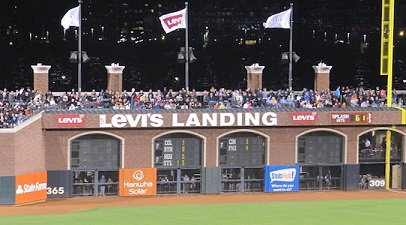
During Haas’s ownership of the A’s, the Giants needed a huge favor and he gave them what they needed at no cost. The teams shared territorial rights to Santa Clara County, and the Giants needed the A’s permission to build a new park in the city of Santa Clara.
Although Haas said ok, the Giants never built in Santa Clara, but they held onto the exclusive territorial rights, not returning to the shared status.
If you’re wondering what this has to do with present-day baseball matters, you haven’t followed the saga of San Jose.
The present A’s owner, Lew Wolff, wants to move the team to San Jose, which is in Santa Clara County, but the Giants refuse to allow the franchise shift, stubbornly standing on their technical claim that San Jose is in their territory.
Had Haas not agreed to relinquish the A’s share of the county, they would be able to move to San Jose. The Giants, however, arrogantly and foolishly deny the reality of how they got the rights. To make the matter worse, Commissioner Bud Selig, who probably was at the meeting when Haas said ok but at least has the minutes of the meeting, refuses to decide the issue, leaving Wolff twisting in the wind.
Meanwhile, the Giants readily and eagerly take Levi Strauss money.