Once upon a time Commissioner Bud Selig and I shared the same view on instant replay in baseball. We didn’t like it. Then somewhere along the way Selig relented and accepted the idea of limited replay, allowing its use for home runs.
Now, for the coming season, Selig finds widespread replay as palatable as his mother’s cooking. I have not talked to him about his change in thinking so I don’t know why he has enthusiastically embraced replay.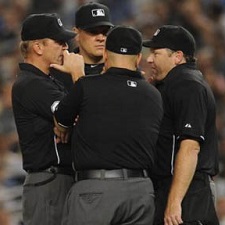
“I am very pleased that instant replay will expand to include additional impactful plays,” he said in a statement. “The new system will give managers valuable recourse in potentially game-changing situations.”
For me, though, baseball’s decision to implement replay for everything but players’ injecting themselves with steroids in a stall of the clubhouse bathroom remains distasteful.
The game has been played for 150 years and has survived umpires’ mistakes. Umpires are human, we have always been told, and humans make mistakes.
Pitchers make mistake pitches, and batters hit them over walls. If the pitchers make enough of those mistakes, they don’t last long, but we don’t replace them with pitching machines. Hitters and fielders make mistakes, too, but they’re on the field the next day, even if a shortstop’s wild throw cost his team a game.
Carlos Beltran took a called third strike several years ago, short-circuiting the New York Mets’ chances of going to the World Series, but he’s still playing and in fact, just got $45 million to play for the New York Yankees.
Mariano Rivera threw a pitch that wound up as a single and cost the Yankees the 2001 World Series, but he returned for a dozen more years of glorious relief pitching.
The two costliest wrong calls by umpires in the last 30 years were probably Don Denkinger’s blown call at first base that enabled the Kansas City Royals to overcome the St. Louis Cardinals in the 1985 World Series and Rich Garcia’s failure to rule fan interference on Derek Jeter’s game-tying home run in the 1996 American League Championship Series between the Yankees and Baltimore.
Armando Galarraga, on the other hand, would vote for Jim Joyce’s call at first base on what should have been the 27th and final out of his perfect game for Detroit against Cleveland in 2010.
All three of these calls were dreadful, and the Cardinals, the Orioles and Galarraga deserved better. But look at those calls another way. From 28 to 3 years later, they are still remembered and talked about.
 Had Denkinger called Jorge Orta out, had Garcia ruled that the young fan, Jeffrey Maier, interfered with Tony Tarasco’s chance of catching Jeter’s fly ball before it landed in the right field stands, had Joyce called Jason Donald out, we would never have a reason to recall those incidents and talk, sometimes incessantly, about them.
Would baseball be better off had those calls been made correctly? Maybe from a purists’s standpoint and maybe at the time the calls were made I had a problem with the umpires’ incompetence, but in retrospect I have no problem with the wrong calls.
One of the charms of baseball, I think, is the ability to dredge up historic instances that have taken on a life of their own. I suspect even the commissioner finds value in recalling memorable plays, right or wrong, though the wrong calls probably live longer than the correct calls.
As I said before, the game is played by people and officiated by people, and people are fallible. A major problem I have with new-age statistics is their creators and advocates ignore the fact that human beings play the game, and that fact creates intangibles that can’t be measured by mathematical formulas.
The statistical fanatics, though, refuse to acknowledge that intangibles matter. They don’t believe that intangibles create different players who have similar statistics. Compute the statistics and rank the players 1-2-3.
But we were talking about replay, and this may be a stretch, but one theory links Selig’s embrace of replay with his determination to rid baseball of performance-enhancing substances.
The commissioner was tardy in recognizing or acknowledging the presence of illegal drugs in baseball. Battered by Congress on two different occasions, Selig became a born-again anti-steroids zealot, determined to rid baseball of every vestige of illegal substances, even if it meant making a spectacle of one of the sport’s most visible stars.
Replay does not hold the same intensity or significance as steroids, but here again the commissioner was late to the recognition that replay had become a factor in other sports and fans apparently wanted it. Once he realized that, he named a high-powered committee to develop a plan.
Though I have expressed my negative view of replay, I accept that it is becoming part of baseball and I have some questions about the new plan.
Managers get one challenge unless they are right in their challenge and then they get a second one. But if they’re wrong, it’s one and done. If the idea is to get all plays right, why limit managers to one challenge?
Example: Manager challenges a call in the fourth inning and is found to be wrong. A play comes up in the sixth on which TV replays show an umpire made a wrong call. The manager has no challenge left, and it’s before the seventh inning when the umpires can’t raise their own challenge. The manager and his team have no recourse.
But Tony La Russa, one of the three members of the commissioner’s replay panel would tell you the manager had a choice, and he made the wrong decision. Speaking with reporters at the owners’ meetings last week, La Russa said the replay decision is like any other managerial decision.
“We told our managers at the winter meetings,” La Russa said, “‘You have tough decisions in the game. That’s what they pay you for. If those bother you, you’re doing the wrong job.'” La Russa compared the replay decision to the use of a pinch-hitter.
“Suppose I’m the Braves and Chipper Jones isn’t playing that day,” he said. “He’s just sitting there. You’ve got this weapon. Do you hit him in the sixth, the seventh? What [if] you get to the ninth and the situation isn’t there and you get to the clubhouse and you didn’t use him?
“You’re just taking your best guess. And that’s what this is. It’s a challenge for a game-changing play that goes against you.”
There is, however, a difference.
Using La Russa’s example with Jones, if the manager opts to use him early rather than taking a chance on wasting him, he has other hitters he can use in a later inning. If he uses his challenge early and loses, he has none for later innings.
If the aim is to get the plays right, why make it a guessing game for the managers? The answer apparently is pace of game. Selig doesn’t want to slow the pace of game by having too many challenges. But what is more important, pace of game or getting it right?
Replay is supposedly being introduced to get it right. Instead, what they’re doing is making a game show of it, stealing the name of a long-time game show for their own purposes – Jeopardy.
Again, if the idea of replay is to get it right, give managers a chance to get it right.
The big winners in the replay plan appear to be the umpires. MLB will need to add umpires to serve as replay officials in the Replay Command Center at the New York headquarters of MLB Advanced Media.
“After viewing video feeds,” says the MLB news release, “the Replay Official will make the ultimate determination of whether to overturn the call, based on the continuing standard of whether there is clear and convincing evidence.”
In other words, for the first time, games will be decided not on the field but in a room full of television monitors on Ninth Avenue in Manhattan. They will also be decided, in some instances, by slow-motion replays. Game umpires have never had that luxury.
Details remain to be worked out, but plans call for at least six umpires to be added to the umpiring staff and a replay official to be assigned to watching one or two games, depending on the day’s schedule.
MLB’s 2014 format is for that season only and will have to be approved by the players’ and umpires’ unions for use in future seasons with changes very likely to be made based on the first-year experience.
I noticed one point in the MLB’s news release that struck me as a potentially instant problem. It seemed that MLB was inviting clubs to steal catchers’ signs for pitchers:
“Both the home and visiting Clubs will have standardized technology to ensure each Club has equal access to all video.”
A baseball official added, “Each club is allowed one video specialist for replay purposes.”
It seems to be an open invitation to get the catcher’s signs to the pitcher and communicate them to the dugout, which in turn can flash them to the batter. This would amount to legalizing a practice that has gone on illegally forever.
“We will have guidelines that cover their responsibilities,” the official said. I think he meant the video specialists will be warned we’ll have none of that.
TANAKA COMES KNOCKING
Masahiro Tanaka, Japan’s perfect pitcher (24-0 last season), has until 5 o’clock (EST) Friday to sign with a major league team, which he is expected to do for what one club executive said is expected to be “substantially more than $100 million.”
 At least five teams and possibly as many as 10 are engaged in the high-powered auction.
Nikkan Sports of Japan reported Saturday that the Yankees, the Dodgers, the Cubs, the White Sox and the Diamondbacks have made offers to the 25-year-old right-hander. A United States club executive said that the Mariners, the Angels, the Red Sox, the Rangers and the Athletics can’t be counted out.
He said the Cubs were “going all out.” The Cubs, however, do not present an attractive picture to a pitcher who wants to succeed immediately in the majors and win. They are in the building process and don’t appear to be close to contending. The Cubs, though, seem to want to make the pitcher the centerpiece of their re-construction.
Tanaka was posted by his Japanese team last month and, under the posting agreement between Major League Baseball and Nippon Professional League, has 30 days in which to sign with an MLB team. Otherwise he has to return to his Japanese team for two more years until he can become a free agent.
Casey Close, Tanaka’s New York-based agent, has not returned telephone calls seeking comment on the status of his negotiations. His assistant, Juliette Daley, said, “We are not commenting on anything.”
KERSHAW BEING THE ANTI-MANNY
Listening to Clayton Kershaw on a conference call last Friday, I couldn’t help but think about Manny Ramirez.
The gone and forgotten PED-banned slugger was in the middle of an 8-year, $160 million contract when I wrote about how he refused to donate $10,000 or less for new baseball uniforms and some equipment to the baseball team at his high school in the economically deprived Washington Heights section of upper Manhattan.
A few readers criticized me, saying I had no business saying how Ramirez should spend his money, but then I listened to Kershaw talk about how he has spent his money. The Los Angeles Dodgers’ pitcher didn’t bring up the subject. Reporters, including me, asked him about his charitable efforts.
This is not a guy who spends $10,000 on baseball uniforms, though he probably would at the drop of a suggestion.
He and his wife, Ellen, built and maintain an orphanage in Africa, Zambia to be specific. They fund an after-school program, Mercy Street, in their hometown, Dallas. They have a charitable organization, Sharefest, in southern California.
They did all of that before Kershaw, winner of the Cy Young award twice in the last three years, signed a 7-year, $215 million contract last week. As a parallel to the baseball awards, the 25-year-old left-hander has won the 2011 Roberto Clemente and 2013 Branch Rickey awards for his exploits off the field as well as on.
“A large part of the funds will go to supporting that school,” he said of the African orphanage. You can be sure there will be other large chunks going elsewhere.