Imagine how American baseball fans would feel if Mike Trout, Andrew McCutchen and Clayton Kershaw left their major league teams and took their enormous talents to Japan for the rest of their careers or a large chunk thereof.
That’s what happens in Japan except the names are Masahiro Tanaka, Yu Darvish and Ichiro Suzuki.
Japanese fans lost Suzuki to the Seattle Mariners 13 years ago, and the outfielder has not returned home to resume playing there. Instead he is preparing to end his career with the New York Yankees, with whom last year he became only the third player in professional baseball history to collect 4,000 career hits.
Darvish jumped to the United States two years ago after six and a half strong Japanese seasons and in two seasons with the Texas Rangers has compiled a 29-18 record and struck out 498 in 401 innings. Given that he has four years left on his $56 million contract and, health permitting, he is assured of an even more lucrative deal at the age of 31, Japanese fans shouldn’t expect to see Darvish any season soon.
Tanaka, a 25-year-old right-handed pitcher, is the latest Japanese idol to abandon his countrymen. When he next pitches, it will be for the Yankees at the start of a 7-year, $155 million contract, the largest ever attained by an Asian player. He and the Yankees reached agreement on that contract Wednesday, with the Yankees prevailing over half a dozen to a dozen other teams that were interested in the posted Tanaka.
“Majority of people seems to be supportive,” Daisuke Sugiura, a Japanese baseball writer, said in an e-mail. “Tanaka is still young but he accomplished almost everything in Japan, and he wants new challenge. Why not?
“Japanese people usually encourage athletes to go overseas, where normally have higher level league. But I’ve heard some concerns for a lot of top players headed to major league, especially in young age, which makes the NPB almost as a minor league. I understand that too.”
NPB is Nippon Professional Baseball, Japan’s equivalent of Major League Baseball. NPB and MLB recently reached a three-year agreement on the posting system by which Japanese players can move to the majors before they are eligible to be free agents.
Under the old system, MLB teams would compete for posted Japanese players by making bids for them with their Japanese teams. The highest bidder gained negotiating rights to the player, and if the team were successful in signing him, it would pay the Japanese team the amount it bid.
Two years ago, for example, the Rangers won rights to Darvish with a $51.7 million bid, then negotiated a 6-year, $56 million contract with the pitcher. In 2006 the Boston Red Sox made the previously record bid of $51.1 million for rights to Daisuke Matsuzaka and signed the pitcher to a 6-year, $52 million contract.
 Suzuki, on the other hand, cost the Seattle Mariners a bid of $13,125,000 in 2000 and an initial 3-year contract for $14,088,000. The outfielder became a huge star in Seattle, both with American fans and the city’s large Japanese population.
Ichiro, which he preferred to Suzuki, remained a favorite in Japan as well. The decision to let Tanaka leave has not elicited outrage from Japanese fans.
“The vast majority of baseball fans here are delighted to see Japanese players in the major leagues,” wrote Jim Small, vice president of MLB in Asia. “They view MLB as the top baseball league in the world and the logical next step for their top players. And I think that point of view factored heavily into Rakuten’s decision to post Tanaka.”
Tanaka is the latest player to change countries but the first under the new and curious posting system.
The new system frankly makes no sense because it goes against everything the owners have fought for. This time it created one of the most attractive free agents on the market. Tanaka may turn out to be an exception during the three-year agreement, but he is expensive exception.
Under the new system, teams don’t bid against each other for negotiating rights. Any team willing to pay the posting fee, which has been made a $20 million maximum, is eligible to negotiate with the player. The team that signs him then pays the posting fee set by the Japanese team.
By pressuring NPB to accept the new system, MLB made Tanaka wealthy and deprived his Japanese team, the Rakuten Golden Eagles, of many millions. An executive of a club that was trying to get Tanaka speculated that under the old system, it would have taken a $75 million bid to win negotiating rights and another $75 million to sign the pitcher.
In other words, Tanaka emerged a big winner and Rakuten a big loser. What was MLB’s motive for creating the new system?
Rob Manfred, MLB’s chief operating officer and former chief labor executive, said, “The majority of clubs wanted something closer to the true value of the player to be included in the competitive balance tax calculation.”
Actually, Frank Coonelly, president of the Pittsburgh Pirates and a former colleague of Manfred in the commissioner’s office, proposed that not only the posted player’s contract but also the posting fee be included in the winning club’s luxury tax payroll. He was told that couldn’t be done.
The Yankees no sooner announced that they had signed Tanaka than they came under criticism for their expenditure. The critics were very likely among those who pushed for the new posting system. The owners often don’t understand or accept they can’t have it both ways.
Even if Japanese fans want to see Tanaka match pitches with MLB’s best, they will miss seeing him pitch. They have seen him for seven years, and he has dazzled them. He had a 99-35 won-lost record and a 2.30 earned run average, capping the Japanese segment of his career last season with a 24-0 won-lost record and a 1.27 e.r.a.
It could be said that Tanaka had nothing left to prove in Japan so it’s understandable that he wanted to test himself in the major leagues, but his team, the Rakuten Golden Eagles, didn’t have to let him leave. They had him for two more seasons before he could have been a free agent.
The team owner, in fact, expressed a desire to retain Tanaka, but in the end the $20 million posting fee the Eagles will get for their star was more appealing than losing him as a free agent in two years and getting nothing for him.
Not all posted Japanese players or Japanese free agents find success in the majors and not all Japanese players who have been successful have become major leaguers through the posting system, leaving instead as free agents.
The most prominent free-agent successes have been Hideki Matsui, Yankees’ outfielder and 2009 World Series most valuable player, and Hideo Nomo, who pitched two no-hitters, one for the Dodgers, one for the Red Sox.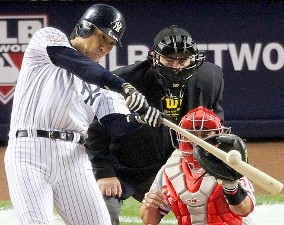
By signing Tanaka, the Yankees will have three Japanese players on their roster and two in their starting rotation. The other pitcher is Hiroki Kuroda, who in two years with them has a 27-24 won-loss record and a 3.31 earned run average.
The Yankees have had some notable failures from Japan. Hideki Irabu, who preceded but prompted the posting policy, had a 34-35 record and 5.15 e.r.a. and inspired owner George Steinbrenner to call him a “fat pussy toad.” The Yankees spent $46 million in posting price and contract for Kei Igawa and got a 2-4 record and 6.66 e.r.a. from him in two seasons.
Peter Miller, Marvin’s son, has lived in Japan since 1981 and for a while, served as a consultant with the Players Association. I asked him for his view of the Japanese reaction to the country’s players going to the United States. His e-mail reply:
“When Hideo Nomo left the Kintetsu Buffaloes to play for the Los Angeles Dodgers, he was vilified by the Mainichi Newspaper, among others, and many fans considered him a traitor. With support from Tommy Lasorda and Mike Piazza, Nomo succeeded brilliantly with the Dodgers.
“Nomo’s status among Japanese fans and sports media changed instantly from villain to hero. Their initial reaction had been based on fear that he would fail as a big-leaguer, plus the loss of a star.
“Japanese baseball club owners immediately closed the loophole he had exploited to leave Japanese baseball, implementing the ‘posting system’ of bi-national collusion which is still in effect today.
“Hideo Nomo’s later re-entry into Japan as a member of the visiting Major League All-Star team generated overwhelming interest, as he was well aware it would when he insisted that Series sponsor Mainichi issue a written apology for their past vilification.
“I assisted both parties by writing that letter and negotiating additional compensation for Nomo.
“Japanese club owners also implemented a 10-year qualification period for ‘free agency’ which is not really free, since it involves payment of a ‘posting fee’ by a Major League club to the Japanese club that ‘owns’ the player.
“Japanese clubs, media, and fans have reconciled themselves to this auction as the best deal they could get, given the superior financial resources of the Major League clubs. Japanese players have been so eager to play in the Major Leagues that neither they nor their union have ever tried to challenge the posting system.
“How much impact, for example, does the absence of a Darvish or a Tanaka have on the game there? How do fans feel? Do they feel cheated by not having some of the best players playing there, or do they like the idea of seeing how their players fare in the major leagues?
“Both. There is a grudging acceptance of the de facto use of Japanese baseball as a sort of Major League farm system. Japanese TV prominently features the Japanese Major Leaguers and derives advertising revenue and viewership from those broadcasts.
“And the Japanese players themselves collect substantial endorsement income from Japanese sponsors due to their presence in the Major Leagues. Ideally, most fans would probably prefer that their star players stay in Japanese baseball, but they are proud of the successes ‘their’ players have achieved in the Majors.”
The coming season will be the 50th anniversary of the first Japanese player to play in the major leagues. Masanori Murakami pitched his first game for the San Francisco Giants Sept. 1, 1964. How many wins will Tanaka have by Sept. 1, 2014?