Put it in the category of throwing good money after bad.
The bad money is what Alex Rodriguez has squandered on his team of lawyers, publicists and advisers of other kinds. He has wasted it on a lot of bad advice. The good money is what A-Rod is about to spend on challenging the arbitrator’s decision in Federal court. Those millions will be wasted, too, because judges don’t overturn arbitrators’ decisions.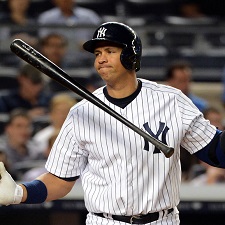
All right, so Alex Rodriguez has a lot of money; he has earned $360 million in salary and signing bonuses since he became a free agent in December 2000. It’s his money, and if he wants to throw it away, that’s his right.
But he didn’t have to throw it all away. Instead of losing his entire 2014 salary of $25 million, instead of missing the entire season as he will under the arbitrator’s ruling, the New York Yankees’ third baseman could have had a 100-game suspension and lost about $15 million of his salary.
A baseball official who was briefed on the Rodriguez case as it proceeded told me Saturday after arbitrator Frederic Horowitz reduced A-Rod’s suspension from 212 games to 162 plus post-season that early on in the process Commissioner Bud Selig would have settled for a 100-game suspension.
It wasn’t clear if Rodriguez was ever offered that deal, but the prevailing feeling is he wouldn’t have taken it because he insisted he didn’t do what the evidence the commissioner’s investigation turned up found that he did.
“The written ruling could be devastating to Alex,” the official said. “It becomes public if he goes through with his lawsuit.”
The written ruling he referred to is the arbitrator’s explanation of his decision. Written rulings are not made public, but the official said he understood that Horowitz had given his written ruling to both sides.
Rodriguez issued a statement in which he denied using performance-enhancing drugs in his years with the Yankees (in 2009 he admitted using them with Texas). However, he was suspended for his link to the Biogenesis anti-aging clinic near his home in south Florida and his alleged interference with baseball’s investigation of the clinic.
He also said that baseball’s case was based on “false and wholly unreliable testimony.” Rodriguez, however, offered no testimony of his own at his own grievance hearing repudiating that testimony.
Instead, with what was seen as feigned anger, he slammed his hand on a table and stormed out of a hearing session Nov. 20 when the arbitrator ruled that the commissioner did not have to testify.
“He didn’t put on a case,” said an official familiar with the grievance. “He had no one testify for him. This was about the credibility of witnesses. The arbitrator had to make a credibility call. Was the guy telling the truth?”
That “guy” was Anthony Bosch, the owner of the Florida clinic, who testified that he injected Rodriguez with steroids.
“Where Rodriguez can’t even take the stand, it doesn’t do much for his case,” the official said. “Did Bosch give him drugs? There was no evidence from the other side that he didn’t. Bosch said ‘here’s what I did’ and Tacopina had no rebuttal.”
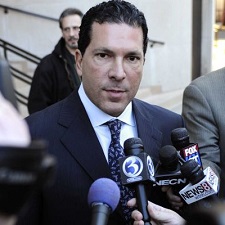 That would be Joseph Tacopina, A-Rod’s lead lawyer, a criminal defense attorney, who made a lot of noise outside the hearing room but apparently not much else inside it.
The reason Rodriguez appeared to stage his angry walkout, one of the officials said, was to avoid testifying.
“Losing a year of baseball might be bad, but going to jail is worse,” he said, suggesting that Rodriguez would have had two choices had he testified: perjuring himself if he denied under oath that he used steroids or admitting that he had used and ending the case.
At the time of his walkout, I wondered if the arbitrator would be able to overlook it and not hold it against Rodriguez. As it turned out, baseball’s case was strong enough that Horowitz didn’t have to consider the unprecedented walkout.
Neither does Horowitz have to be concerned about the court case Rodriguez has vowed to use to fight the arbitrator’s ruling.
In a statement, Rodriguez said:
“The number of games sadly comes as no surprise, as the deck has been stacked against me from day one. This is one man’s decision, that was not put before a fair and impartial jury, does not involve me having failed a single drug test, is at odds with the facts and is inconsistent with the terms of the Joint Drug Agreement and the Basic Agreement, and relies on testimony and documents that would never have been allowed in any court in the United States because they are false and wholly unreliable.”
Note to A-Rod: His appeal precisely followed the grievance procedure as established in the collective bargaining agreement. This was not a court case, and the arbitrator conducted it as a grievance hearing. If Rodriguez never failed a drug test, he was clever or lucky.
Rodriguez is right. The case did not go before a fair and impartial jury. It went before a fair and impartial arbitrator, which is what the labor agreement provides. The union had no problem with the conduct of the hearing.
In a statement, the union said it “strongly disagrees with the award…even despite the arbitration panel’s decision to reduce the duration of Mr. Rodriguez’s unprecedented 211-game suspension.”
But the statement added, “We recognize that a final and binding decision has been reached, however, and we respect the collectively bargained arbitration process which led to the decision.”
The language of the Rodriguez statement was obviously the lawyers’ and that only makes them worse than they are in proclaiming they can win the case in court.
In baseball’s most famous grievance, the Messersmith-McNally case of 1975, Peter Seitz, the arbitrator, was ready to rule and hinted to the negotiators, Marvin Miller for the players and John Gaherin for the owners, where he was headed. He encouraged them to negotiate a settlement.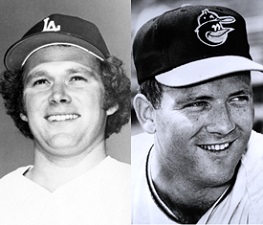
Gaherin, a practical Irishman, relayed Seitz’s cautionary suggestion to the owners, but their chief lawyer, Lou Hoynes, and Commissioner Bowie Kuhn, rejected Gaherin’s advice and told the owners, “Let him rule against us. If he rules against us, we’ll take him to court and whip his rear end there.”
A few months and a court victory later, the players had free agency and nearly 40 years later, the clubs are still trying to recover.
What Hoynes and Kuhn, in their ignorance of labor matters, didn’t know was that Federal judges don’t overturn arbitrators’ rulings. That’s what Rodriguez faces, and his lawyers should know it. But their mouths have been too busy to allow their brains to work.
When his case began, Rodriguez had a pair of worthy lawyers, one of them Jay Reisinger of Pittsburgh, who has trod this ground before, but he fired both and hired a new crew. The new voices were loud and their strategy flawed.
“His team made just about every mistake in the hearing they could make,” said a long-time labor lawyer well versed in grievances.
The team issued a statement in Rodriguez’s name, part of which said:
“This injustice is MLB’s first step toward abolishing guaranteed contracts in the 2016 bargaining round, instituting lifetime bans for single violations of drug policy, and further insulating its corrupt investigative program from any variety defense by accused players, or any variety of objective review.”
Remarkable! My mind is boggled that a third baseman could make those determinations from his suspension. Maybe a catcher but not a third baseman who has had two hip replacements.
Instead of concocting such cockamamie ideas, Rodriguez would have been better off studying labor law. If he – or his lawyers – had read the Federal Arbitration Act, which was upheld by the United States Supreme Court in 2008, they would have learned that courts have very limited guidelines under which they can overturn arbitrators’ decisions:
- Corruption or fraud committed by the arbitrator
- Bias shown by the arbitrator (if he has worked for one side or the other)
- Misconduct by the arbitrator (examples: refusal to give one side extra time it has requested, refusal to hear new evidence)
- Exceeding his authority
According to an arbitration expert, who spoke on the condition of anonymity, there is an additional guideline that was created by the Court of Appeals for the Second Circuit, which would be the destination of a Rodriguez appeal.
“Even a wacky decision does not mean the arbitrator demonstrated a manifest disregard for the law,” he said, adding that the word “wacky” was borrowed from another court’s ruling.
When players violate the joint drug agreement, they are suspended without pay. However, contrary to rampant speculation, the Yankees cannot nullify the three years and $61 million remaining in Rodriguez’s contract after next season.
The joint drug programs gives the commissioner exclusive authority to deal with discipline. The club cannot take additional disciplinary action.
The year off, however, will create questions for Rodriguez’s post-suspension future. The biggest question is will he be able to come back at age 39 going on 40 after a year off. The year off may benefit his surgical hips, but he could easily have difficulty regaining his hitting ability.
Not that the money will mean much in the overall scheme of financial things, but he may have trouble earning his $6 million per milestone home run bonuses. He is only 6 home runs from Willie Mays’ 660, but then there are Babe Ruth’s 714, Hank Aaron’s 755 and Barry Bonds’ 762.
A-Rod would get $6 million each for tying and passing Bonds.
What could the Yankees have been thinking when they groveled at Rodriguez’s feet to get him to stay around after he opted out of his contract during the 2007 World Series?
WRITERS GO WILD WITH X’S
Last week I asked what happened to 545 votes that baseball writers withheld from players for whom they voted in last year’s Hall of Fame election. I don’t know that I really wanted someone to figure out what actually happened to all of those votes, how they were reallocated, though on some level I probably figured that when someone was finished playing WAR games he would jump onto the vote question.
Indeed, one or more figure filberts did, but now I have a different issue.
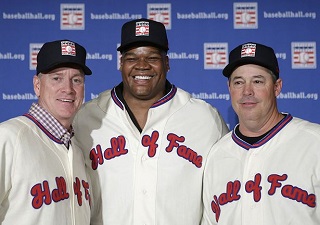 In that exercise I questioned why writers would vote for players for the Hall of Fame one year or more years and then drop them, as if they were no longer good enough. Lee Smith, for example, had reached 44.5 percent of the vote for five straight years and suddenly plummeted to 29.9 percent this year as he lost 101 votes.
But that’s old news now. My new news is the revolution among the writers in filling out their ballots with an abundance of X’s. It seems they couldn’t mark enough boxes with X’s.
Last year 22 percent of the 569 writers who voted opted to vote for the maximum 10 permitted. That computes to 125 maximum-voting writers. This year, according to Jack O’Connell, the BBWAA official who presides over the balloting, 288 voters, or slightly more than 50 percent, checked off 10 names.
What happened to cause this huge increase? I can think of only one thing, and that’s the organization’s consideration of eliminating the maximum of 10 or raising it. By voting for 10, those writers might be saying they need a higher maximum or none at all.
On the other hand, maybe it’s their way of demonstrating how foolish it would be to elect so many players in one year. I doubt that, but I can hope that is their clever way of protesting changing the maximum.
I would hope that because I don’t vote for the maximum. I voted for 10 players only once, and that was with the adrenaline rush of voting for the first time. By the time I received my second ballot, however, I had come back to earth.
By voting for 10 players, I realized, I was saying I thought 10 players should be inducted into the Hall in one year. How ridiculous that would be. For two reasons: It would dilute the honor for each player elected, and it would make for an insufferable induction ceremony.
Ten players, 10 speeches. The Hall of Famers already in would not return the next year. I have sat on the stage for two players and two speeches. That was enough.
Since that first year, I think I have voted for more than three players only once. That was this year when I voted for four, three of whom were elected. I usually note for no more than three.
That’s because the Hall of Fame I see is a place for the best of the best. That’s what I don’t understand about those of my colleagues who vote for 6 or 8 or 10. Do they really think those 6 or 8 or 10 players are equally deserving of election? What are their standards?
If they vote for 10 because they can’t decide which three or four to vote for as the best of the best, let them work harder at making the determination.
Maybe instead of raising the maximum number of players writers can vote for, we should raise the standards they use in their voting.