Parity or mediocrity? That was the choice presented to some general managers last week, and it stemmed from the look of the standings the past two weeks. A .500 record seemed to be a very popular record, and it prompted the question:
Has Major League Baseball achieved parity, where many, if not most, teams are relatively even, or are so many teams just plain poor that it masquerades as parity but it’s really mediocrity?
In the space of each team’s having played 40 to 50 games, 10 teams had .500 records a total of 24 times. In the equivalent period last season, five teams had .500 records a total of eight times.
Leagues in all sports like the idea of parity because more teams have a chance to win division titles and no teams dominate the leagues from season to season. However, when leagues achieve parity, there is a danger of having an absence of glamorous teams that attract fans in the post-season.
But parity in baseball it may be, 2014 vintage.
The American League Central has been the epitome of parity. Entering Sunday’s games, the Tigers ruled the division with the league’s best record (28-17). The rest of the division, however, was closely bunched at or near .500: Royals 24-24, Twins 23-23, White Sox 25-26, Indians 24-26.
The Indians were the only one of those teams that didn’t reach .500 in the 40-to-50 game span, but the Royals had been even five times, most in the majors, one more time than the Mariners.
The Blue Jays reached .500 May 13 with a 20-20 record. They were in fourth place in the A.L. East at the time. They proceeded to win 9 of their next 11 games, sweeping successive three-game series from the Red Sox, last year’s World Series champions, and the Athletics, who began their series with the A.L.’s best record.
The Blue Jays’ general manager, Alex Anthopoulos, seemed like a good person to ask about parity and mediocrity after the team had finished fourth for five consecutive seasons and then fifth last year.
“I don’t think anyone has played exceptionally well,” Anthopoulos said last Friday in a telephone interview. “It’s still May. I don’t even look at the standings. When you get to the end of June, the beginning of July, you can look. The month of June will be telling for everybody. There’s just too many games remaining. By the end of June we’ll have a good idea of who’s going to be in the races.”
But what does he think about parity? “I absolutely think there’s been more parity the last five, six years,”
Jack Zduriencik, the Mariners’ general manager, rejected both parity and mediocrity to explain this season’s early developments.
“I think you could call it the age of injury,” he said last Friday. “Everybody seems to be affected by injuries. Everyone seems to have one or two. I think that’s had a major effect on teams.”
Have there been more injuries than usual this season?
“I don’t know,” he said. “It seems that way. You’ve seen a lot of good players go down. Besides the Tommy John injuries, you have injuries that take six to eight weeks to recover.”
Zduriencik cited his team’s injuries as an example: Hisashi Iwakuma, the Mariners’ best pitcher last year with a 14-6 record and 2.66 earned run average, didn’t pitch until May 3 because of a torn tendon in the middle finger of his right hand. Taijuan Walker, a 21-year-old right-hander, who was scheduled to be in the starting rotation, has not pitched because of an impingement in his right shoulder. Stephen Pryor, “one of our good arms in the bullpen,” who missed all but the first two weeks of last season, hasn’t pitched because he continues to recover from a torn muscle in his right side.
“Lots of clubs are having a lot of injuries,” Zduriencik
Looks can be deceiving. According to the commissioner’s office, 236 players have served time on the disabled list this season, up from 231 in the same period last year, but entering the weekend a total of 7,175 days had been lost to the disabled list compared with 7,377 last year.
“I think the number of injuries has probably dropped the level of play,” said Doug Melvin, general manager of the Brewers, who have the second-best National League record. “That’s dropped the game to the mediocre level and given other teams a chance to catch up. There are way too many injuries to star players. We have to keep star players on the field. People come to see the players.”
He added, “I remember hearing ‘surgeries,’ but I don’t remember hearing ‘season-ending surgeries.’ It seems more doctors and trainers and better conditioning have led to more injuries. I don’t know if it’s brought more injuries, but it seems like it.”
The Brewers have been able to overcome their own injuries to lead the N.L. Central. Results, however, don’t lie. With Ryan Braun, Carlos Gomez and Aramis Ramirez in the lineup together, the Brewers have a 15-6 record. When they aren’t, the record is 15-15.
I have always enjoyed talking to Melvin, whom I’ve known since he was a batting practice pitcher for the Yankees in the early 1980s, because he has an interesting, creative baseball mind.
One example: Seeking a way to reduce the number of injuries, Melvin said, “Maybe we should reduce the schedule to 156 games,” creating more days off and giving players occasional breathers.
For another example, Melvin said maybe baseball should consider adopting the substitution rule other sports have. “We’re the only sport where a player can’t go back in the game,” he said. “Players can’t go out to get treatment and come back in,” he said. “For us to want to keep our star players, there has to be serious consideration to change some rules.”
Finally, Melvin proposed an idea for avoiding injuries to pitchers, especially American League pitchers, who have to bat in interleague games played in National League parks. For A.L. pitchers, batting is an alien event.
“I asked Jack Zduriencik do you ever get nervous when Felix Hernandez squares to bunt,” Melvin related. “He said he thinks about it all the time. We have the designated hitter. Why not a pinch-hitter d.h.? Have him bat twice a game for the pitcher.”
The whole d.h. issue is one that should have been cleaned up long ago, but Commissioner Bud Selig has been too busy avoiding becoming embroiled in a fight between the leagues. Like the dispute over San Jose, the d.h. war is one Selig would rather have the antagonists settle.
If the leagues never played each other, let them have their separate rules, but they play each other in the World Series and they play each other every day in the regular-season schedule. They play under different rules – d.h. in games played in A.L. cities, no d.h. in games played in N.L. cities. Two leagues, two rules, too much chance for pitchers to get hurt.
This is exactly the sort of things that commissioners are supposed to decide and not let fester. This commissioner, however, is good at festering.
FROM REMOVING PITCHER TO REMOVING G.M.?
Early this month Kevin Towers, the Diamondbacks’ general manager, acknowledged that he didn’t know if he would be in his job much longer.
In a candid, forthright interview with MLB.com, Towers said, “We all thought that with our payroll we had a good chance. And we got off to a horrible start,” adding that Ken Kendrick, the managing partner, “is probably scratching his head. ‘Do I have the right manager? Do I have the right general manager? Is this really what we have? Is this really who we are?’ I guess if he believes that we’re terrible and we stink and we’re bad, then we’re probably in trouble.”
Kendrick did not take immediate action against Towers and manager Kirk Gibson. Instead, a couple of weeks after Towers expressed questions about his job, Kendrick moved in the opposite direction, adding instead of subtracting.
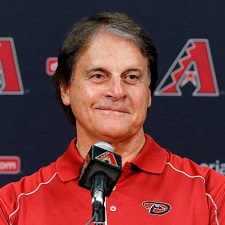 Kendrick hired Hall-of-Fame manager Tony La Russa to the newly created position of chief baseball officer. The post is new for the Diamondbacks but not new in Major League Baseball.
Dan O’Dowd has had the same title with the Rockies since 2011, and six others have the title of president of baseball operations: Walt Jocketty (Reds 2008), Theo Epstein (Cubs 2011), Doug Melvin (Brewers 2012) and three who were promoted to the position last year—Jon Daniels (Rangers), Michael Hill (Marlins), Mike Rizzo (Nationals).
The naming of Epstein and Daniels were particularly newsworthy. The new owners of the Cubs were so eager to pry Epstein away from the Red Sox, for whom he had been the general manager, that they created the new title for the club. Epstein had a year left on his Red Sox contract so the Cubs justified his hiring with the higher-ranking title.
In Daniels’ case, he was the general manager under Nolan Ryan, who was the Rangers’ president and chief executive officer. However, in March 2013, the team’s co-owners promoted Daniels to president of baseball operations and stripped Ryan of the president’s part of his title, never explaining why.
Ryan subsequently and not surprisingly left the Rangers and is now an executive adviser with the Astros, where his son Reid is president of business operations.
La Russa’s journey to Arizona was much simpler, though it took 33 years as a manager to get him to the point where he was willing to take a front-office job.
“I haven’t missed managing, but I’ve missed the competition,” said the 69-year-old La Russa, who retired from managing after guiding the Cardinals to the 2011 World Series championship.
“I had been asked enough times what are you doing. I was working with the commissioner’s office and staying close to the game. But I felt if there’s an opportunity to join a team I’d be interested. I understand how an organization competes.”
The Diamondbacks, he said on the telephone last Friday, called him. “I wouldn’t call anybody.”
He spoke with Kendrick and Derrick Hall, the team’s president and c.e.o. They told La Russa what they had in mind, and he said he told them he would be interested as long as they weren’t talking about general manager. “That wouldn’t be right,” he said, meaning he would not have taken Towers’ job.
The irony is La Russa may still take the general manager’s job, though not work it.
“That’s the position you take,” he said. “You are to understand what the sense is. You make decisions to improve. That’s the responsibility they’ve given me. To do that you have to understand what you’re doing.
You have the responsibility to make tough decisions. My first priority is to establish relationships.”
His second may be the decision on the general manager and the manager. “Derrick and Ken said it’s the quality of the decision, not the timing of it,” La Russa said. “I’ve known Kirk and Kevin a long time.”